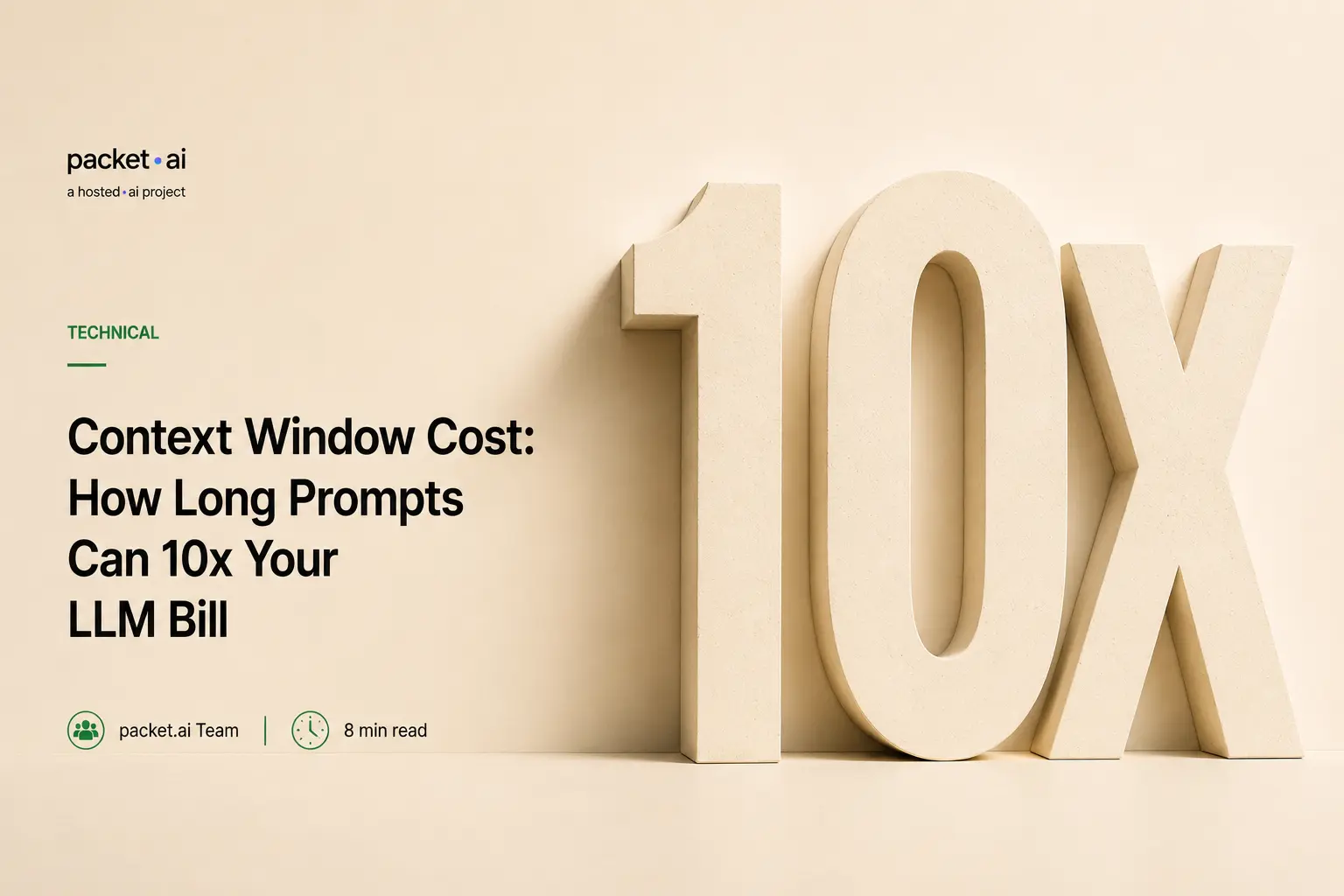
A context window is a capacity limit, not a price. Here is how a growing conversation can cost far more than its final request size suggests.
Context window size gets marketed as a feature. For anyone paying per token, it's also a cost multiplier that's easy to lose track of. Every token in your context window, system prompt, conversation history, retrieved documents, tool definitions, is generally billed as input on every request, whether or not the model ultimately uses every part of it to answer. This guide covers what is context window in cost terms specifically, why long prompts quietly inflate a bill far more than people expect, and how to tell when a large context window is actually buying you something versus just adding to the invoice.
Key takeaways
A context window is the maximum amount of context a model can handle for a request. Depending on the model and API, that budget interacts with the maximum output length and other request limits, and providers don't all account for it identically. Token limit and max tokens are the same underlying concept under different names, and a context window claude, Gemini, or any other provider's API reports is just that provider's specific ceiling. None of these numbers say anything about cost by themselves; they describe a ceiling, not a price. For token-priced APIs, input tokens are generally billed whether or not the model ultimately uses every part of the context to answer the request.
This distinction matters because a large context window is easy to mistake for a free capability. It isn't. A 1M-token context window doesn't cost anything by existing; what costs money is choosing to actually fill a meaningful fraction of it on every call. A model with a huge window and a short, focused prompt costs the same as a model with a small window and that same short prompt. The window size only becomes a cost factor once you start using more of it.
Context length has grown enormously over the past several years, from a few thousand tokens on early models to roughly 1 million tokens as the current baseline among frontier models, with some open-weight models advertising a far higher token max. Long context capability is genuinely useful for tasks that need it: analyzing a large codebase, processing a long document, or maintaining a lengthy conversation without truncation.
But the growth in advertised capacity happened faster than most applications' actual need for it, and that gap is exactly where wasted spend accumulates. A large context window explained honestly: it's a ceiling that expanded because some workloads genuinely need it, not a signal that every request should use as much of it as possible. Treating a bigger window as an invitation to send more context by default, rather than as available headroom for the requests that actually require it, is a common and expensive mistake.
⚡ Advertised context and effective context are different numbers
Independent long-context evaluations, including NVIDIA's RULER benchmark, show that advertised context length can substantially exceed the length at which models maintain reliable performance. RULER's own headline finding, evaluating 17 models across 13 tasks, was that only about half of the models tested could maintain satisfactory performance at a 32K context length, despite claiming that much or more, with performance for most models degrading well before the length they advertised. The exact point varies significantly by model and task, but the pattern, sometimes called context rot, is consistent. This matters directly for cost: paying to fill a large fraction of a large context window may be buying steadily diminishing returns on answer quality, not proportional value for the tokens billed.
The most common way context length turns into unexpectedly large spend isn't a single long prompt, it's a growing one sent repeatedly. A multi-turn conversation that appends each new message to the full prior history, and resends that entire history on every turn, pays for the same earlier messages again and again.
A prompt getting larger and a conversation's cumulative bill getting larger are two different claims, and the second one compounds faster than the first suggests. Suppose a conversation starts at 10K input tokens on turn one, and each subsequent turn adds another 10K, so turn ten sends 100K input tokens, ten times the first turn. That final request being 10x larger doesn't mean the conversation cost 10x more: summing every turn's input (10K + 20K + 30K ... + 100K) comes to 550K total input tokens across the conversation, 55 times the first turn's cost, not 10. The context window didn't create that cost. Repeatedly resending the growing context did.
Retrieval-augmented generation pipelines have a related version of the same problem: stuffing an entire retrieved document, or several, into context on every query, rather than retrieving only the relevant passages, inflates input token cost per query without a proportional gain in answer quality once the model already has what it needs. Retrieving five genuinely relevant passages is one thing; retrieving an entire 200-page document because the model's window is large enough to hold it defeats the purpose of retrieval in the first place. The token count climbs steadily; the marginal value of the extra tokens generally does not climb at the same rate.
Prompt caching can be the highest-leverage of these when the same large prefix is genuinely reused across requests: the packet.ai Prompt Caching: How Much Can You Actually Save guide covers the provider-by-provider discount structure and how to calculate the actual savings for a given hit rate. Caching helps most when the same content repeats across requests; it doesn't help a conversation whose content is genuinely growing and changing turn to turn, which is where summarization and retrieval do the real work instead.
Depending on the provider and implementation, a request that exceeds the total context window can be rejected outright, truncated automatically, or handled differently depending on how the calling application manages history; behavior isn't uniform across providers and frameworks. A request that sends a large share of a window's capacity as input also leaves correspondingly less room for the model's response, since input and output typically draw from the same overall budget. Context overflow is a functional problem before it's a cost problem, but the fix, trimming or summarizing what gets sent, addresses both at once.
Since context is generally billed as input tokens regardless of which model is serving the request, the practical fixes, caching, retrieval instead of stuffing, summarization, apply the same way whether you're calling a hosted API or running your own infrastructure. packet.ai's Token Factory bills per token with these efficiency mechanisms available at the serving layer, so a well-structured prompt actually pays less rather than being billed a flat rate regardless of how it's built. Token Factory is currently in private preview, with its model catalog and pricing still being finalized.
Join the waitlist for early access once it opens.
Last reviewed: August 27, 2026. Context window sizes and pricing change frequently across providers; verify current figures against each provider's own documentation. For how to reduce the cost of repeated context specifically, see the packet.ai Prompt Caching guide.
Same models. Same API. Fraction of the cost. Start free — no credit card required.
Start Building →