
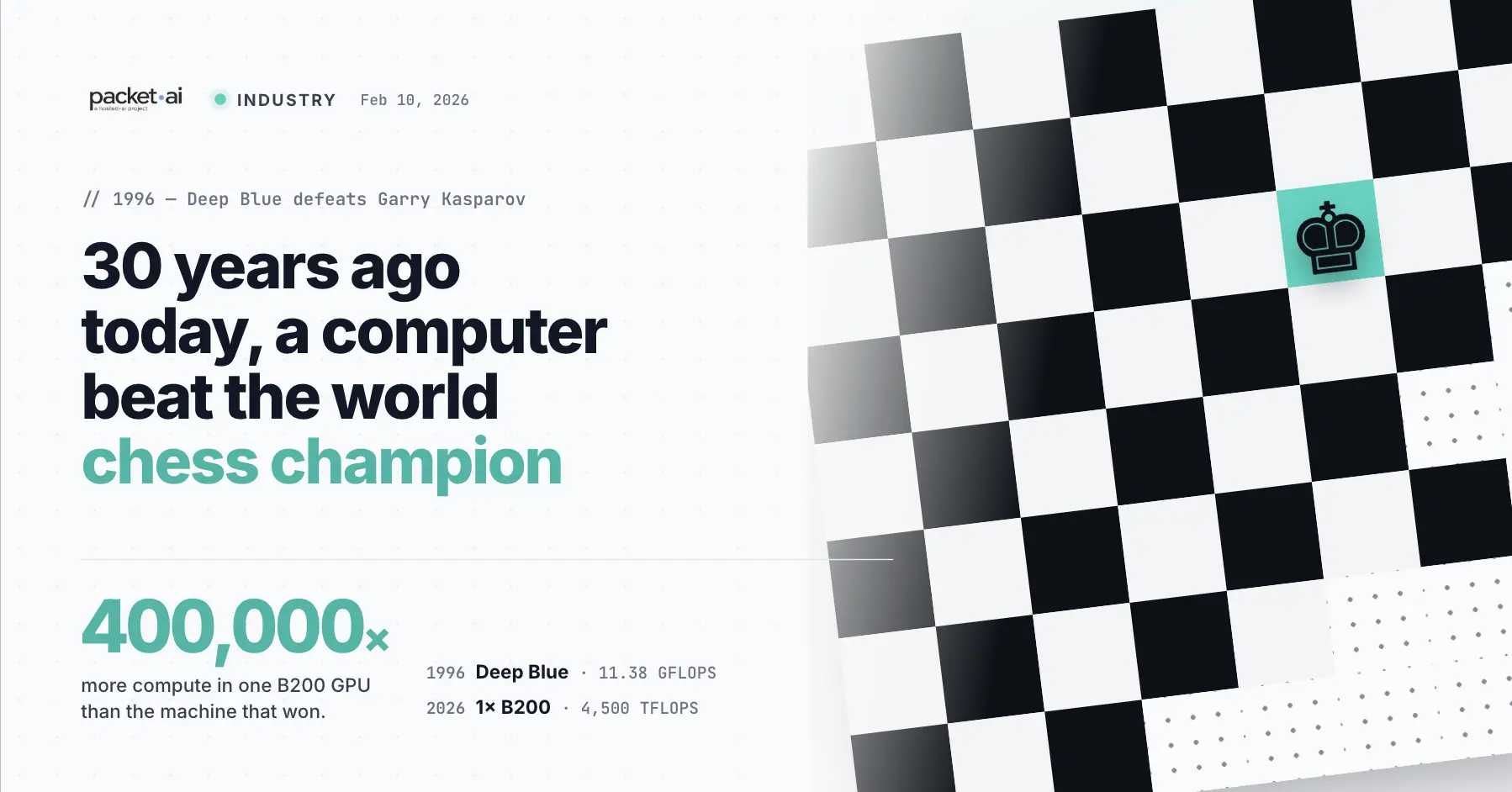
Deep Blue beat Kasparov with 11.38 GFLOPS in 1996. A B200 GPU today is 4,500,000x more powerful - and rents for $3.75 an hour. Thirty years on, here is what that inflection point actually meant.
On 10 February 1996, IBM's Deep Blue became the first computer to defeat a reigning world chess champion. It used 11.38 GFLOPS. A single B200 GPU today delivers 4,500,000x more compute - and you can rent one for $3.75 an hour.
Key takeaways
Deep Blue was not a neural network. It was a specialised tree-search engine with handcrafted evaluation functions - essentially a very fast version of the minimax algorithm with alpha-beta pruning, accelerated by 480 custom VLSI chips designed specifically for chess position evaluation.
Each chip evaluated positions at roughly 50 million moves per second. Combined, Deep Blue could search 200 million positions per second - looking roughly 12 moves ahead in most positions, and up to 40 moves in forcing lines. The total system ran on a 30-node IBM RS/6000 SP supercomputer.
Peak compute: approximately 11.38 GFLOPS, or about 11.38 billion floating-point operations per second.
Kasparov played six games in the 1997 rematch. He won one, drew three, and lost two. The match result was 3.5 to 2.5 in Deep Blue's favour.
To put Deep Blue's compute in context against modern GPU hardware:
The A100 alone delivers roughly 27,000x more compute than Deep Blue. The B200 at FP4 is approximately 1.76 million times more powerful by raw FLOPS - though comparing FP32 against FP4 understates the practical throughput difference on transformer workloads.
The 1996 match result - a win for Kasparov - prompted exactly the wrong conclusions from the AI community. Many interpreted it as evidence that general human intelligence was fundamentally different from what machines could replicate.
The 1997 rematch settled the question differently. Deep Blue won not because it had become generally intelligent, but because chess is a closed, deterministic system where sufficient search depth plus a reasonable evaluation function beats human intuition. Kasparov could not outcompute the machine. His creativity, his psychological reads, his opening preparation - none of it mattered past a certain search depth.
The pattern that emerged in 1997 is the same one that has driven AI progress since: specific tasks that can be formalised as optimisation problems over large search spaces get solved by machines before people expect them to.
Language understanding was supposed to require human-level general intelligence. Then scaling laws on transformers produced models that passed bar exams, wrote working code, and diagnosed rare diseases. Not because the models understood in the way humans do - but because, like Deep Blue, sufficient compute applied to the right architecture on the right task crosses a threshold.
IBM's investment in Deep Blue is estimated at roughly $10 million in 1996 dollars - call it $20 million in 2024 dollars. The 480 custom VLSI chips were fabricated specifically for chess move generation and evaluation. The 30-node RS/6000 SP supercomputer that ran the search was not commercially available at that spec.
To replicate Deep Blue's 200 million positions per second on a B200 running a modern chess engine like Stockfish:
Cost to match Deep Blue's compute on packet.ai: somewhere between $0.10 and $1.43 per hour, depending on whether you use CPU or GPU. Against Deep Blue's $20 million capital cost.
Stockfish runs in browsers. It evaluates hundreds of millions of positions per second on commodity hardware. It plays at an estimated Elo of 3500+ - roughly 500 points stronger than the strongest human grandmasters.
The compute that was exotic in 1996 - worth $20 million and housed in a supercomputer - is now a JavaScript file that runs on a laptop.
The same commoditisation is happening to GPU compute, just faster. The compute required to run frontier AI inference was exotic in 2022. By 2024, it is available on-demand at $3.75 per hour. The pattern from chess applies: the compute that seems expensive and specialised today will be infrastructure tomorrow.
Kasparov has argued for years that Deep Blue's team made a move in Game 2 of the 1997 match that no chess computer of that era would make - a subtle positional sacrifice that suggested, to him, that human operators had intervened. IBM has denied it. The game logs have been analysed extensively. The move was unusual but within the range of what Deep Blue's evaluation function could produce.
What is certain is that the match outcome was disputed in ways the 1996 match was not. Kasparov won in 1996 and felt he understood what he was playing against. He did not feel that way in 1997.
The psychological dimension of playing against a machine that does not tire, does not feel pressure, and does not make mistakes under time control is not something chess preparation addresses. That asymmetry is as relevant to current debates about AI in professional domains as it was to chess in 1997.
The B200 GPU available on packet.ai at $3.75 per hour delivers approximately 20 petaFLOPS at FP4 precision. It has 192 GB of HBM3e memory. It can run a 70B parameter language model in full FP16 precision on a single card - a model that passed the bar exam, writes production code, and diagnosing complex medical cases.
Deep Blue's entire purpose-built system, at $20 million in 2024 dollars, did one thing: play chess. The B200 can run any model on any task, on demand, for $3.75 an hour.
The 30 years between 10 February 1996 and today represent roughly the same compression of compute cost that separated the first room-sized computers from the calculators that fit in a pocket. The next 30 years will compress further still.
Same models. Same API. Fraction of the cost. Start free — no credit card required.
Start Building →