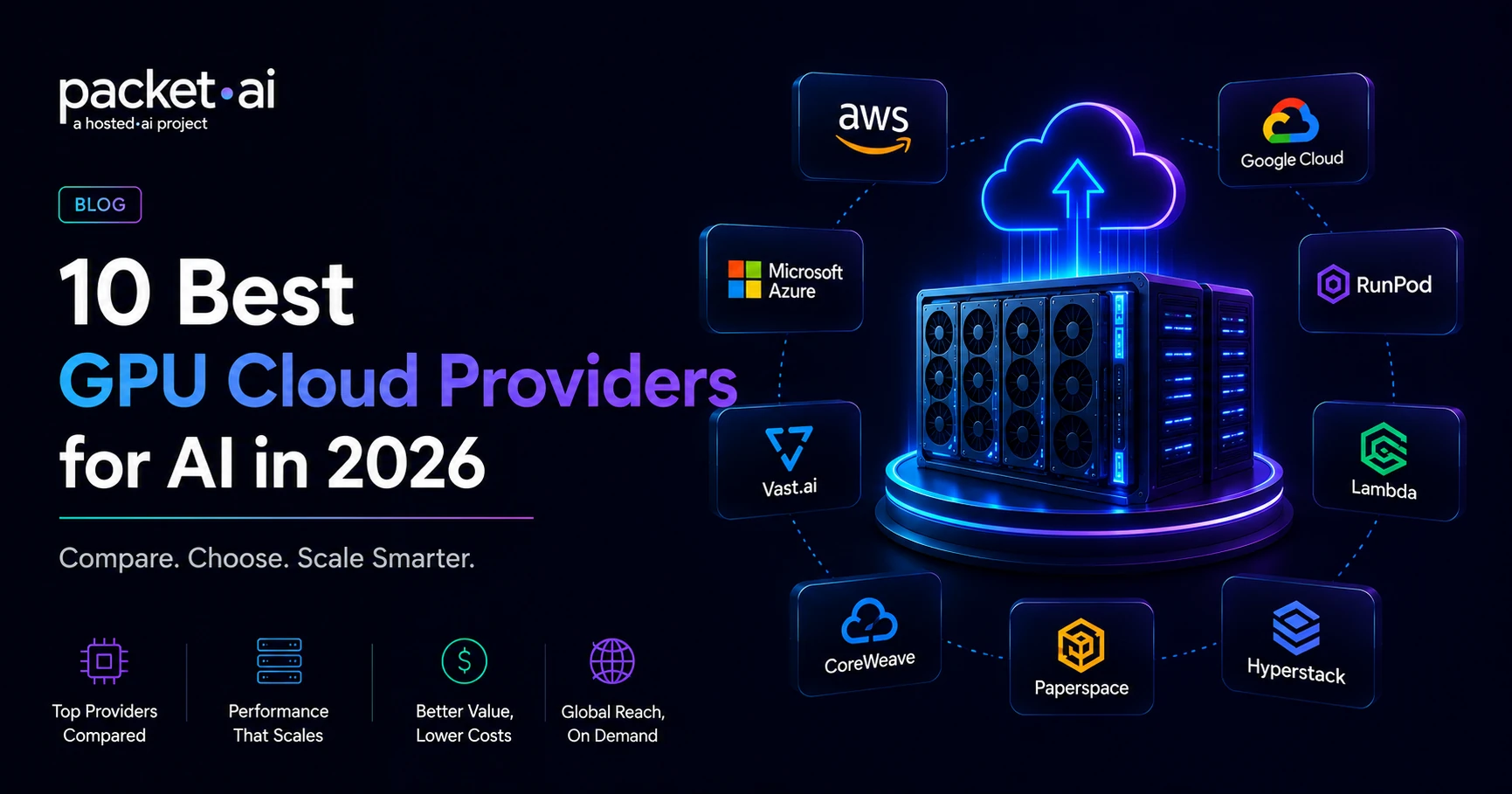
Specialized GPU clouds averaged 89% below hyperscaler H100 rates in August 2026. Here are the ten providers worth evaluating - ranked by what engineers actually care about: price, egress, setup time, and interconnect.
The median H100 on a specialized GPU cloud costs $4.17/hr in August 2026 - against $7.89/hr on hyperscalers for the same silicon. The difference is not hardware quality. It is margin, sales overhead, and ecosystem bundling you probably do not need.
Key takeaways
In 2023, the question was whether you could get a GPU at all. In 2026 that question is settled - every provider on this list has H100s - and the real question is which combination of pricing model, interconnect quality, egress policy, and developer experience fits your workload. H100 spot prices have fallen 40-50% since their 2024 peak. The spread between the cheapest and most expensive providers for identical hardware is now over 8x. That gap compounds fast at production scale.
This guide evaluates ten GPU cloud providers for AI workloads on five criteria used consistently across the best independent benchmarks: hardware availability and recency, pricing model and billing unit, egress policy, developer experience and setup time, and interconnect quality for multi-GPU training. To rent GPU cloud capacity from packet.ai, see packet.ai GPU pricing.
Most GPU cloud comparisons lead with a price table. That is necessary but not sufficient. The team that picked the cheapest H100 and ran an uninterruptible training job on a marketplace node with no checkpointing paid more per completed epoch than the team on a $2.89/hr dedicated instance. Here is what to evaluate before you look at prices.
packet.ai B200 on-demand starts at $3.75/hr with no egress fees and no minimum commitment, live in under 5 minutes from the pricing page.
packet.ai is a neocloud built on hosted.ai's GPU scheduling layer, offering on-demand NVIDIA B200, H200 (launching soon), H100 (launching soon), RTX 6000 Pro, L40S, A100, RTX 5090, and RTX 4090 with no contracts, no egress fees, and no storage fees on running instances. Capacity is live in the US and Europe across California, Virginia, Texas, Oregon, Frankfurt, Amsterdam, Paris, London, and Dublin. APAC rolling out in Q3 2026.
The RTX 6000 Pro at $0.66/hr is the most memory-dense PCIe GPU available on packet.ai: 96GB of VRAM fits 30B models in FP16 or 70B at 4-bit quantization on a single card. For teams that do not need NVLink scaling, it delivers the economics of a data center GPU at consumer GPU pricing. The B200 at $3.75/hr is the cheapest published B200 on-demand rate tracked by the AIMultiple GPU rental index in August 2026 - $3.75/hr against a market median of $6.25/hr and Google Cloud at $16.11/hr.
packet.ai B200 at $3.75/hr is $2.24/hr below the market median of $6.25/hr. On an 8-GPU cluster running continuously, that gap is $16,128/month.
For LLM inference without managing GPU pods, Token Factory provides an OpenAI-compatible API at $0.10/million tokens across Llama 3, Qwen, DeepSeek, and Kimi K3. No cold starts, no idle billing, no infrastructure to manage.
Best for: Teams that want Blackwell hardware at below-median pricing, no egress overhead, and on-demand access without a sales process. RTX 6000 Pro is the standout for single-GPU 70B inference at $0.66/hr.
CoreWeave is the only GPU cloud provider rated Platinum by SemiAnalysis ClusterMAX two years running. H100 SXM on CoreWeave normalizes to approximately $6.16/GPU-hr from 8-GPU HGX nodes, and A100 to roughly $2.70/hr. These are not the cheapest rates in the market, but CoreWeave's differentiator is not price - it is InfiniBand networking, bare-metal Kubernetes, SOC 2 and ISO 27001 compliance, and the ability to provision 256+ GPU clusters with guaranteed interconnect bandwidth.
The platform IPO'd on Nasdaq (CRWV) in March 2025 and reported $5.13 billion in full-year 2025 revenue - a 168% increase from 2024. Multi-year committed contracts can reduce rates by up to 60%. No egress fees. Expect a multi-month contract minimum for cluster-scale deployments, which makes it wrong for single-GPU or experimental workloads but right for foundation model training at 64+ GPUs with a dedicated infrastructure team.
CoreWeave is genuinely excellent. It is also almost certainly not what you need. If you are training foundation models at 64+ GPUs with a team to manage the infrastructure contract, it is the right call. If you need 1-8 GPUs spun up today, look elsewhere.
Best for: Large-scale distributed training at 64+ GPUs, enterprise compliance requirements, teams with predictable long-term GPU demand. Not the right fit for on-demand single-GPU access or cost-sensitive batch work.
Lambda Labs runs its own managed datacenter fleet at published, fixed on-demand rates. H100 PCIe is $3.29/hr, H100 SXM $3.99/hr, A100 SXM 80GB $2.79/hr, and B200 SXM $6.69/hr. No egress fees, no storage fees for persistent workspaces, and no IAM configuration - SSH access with PyTorch, CUDA, and cuDNN pre-installed. Lambda bills per-minute, not per-hour, which removes the hourly-minimum trap for short jobs. Note that H100 and A100 SXM configurations are only available as 8-GPU node purchases - you pay for the full node even if you need fewer GPUs.
The limitations are specific. Lambda has no serverless GPU product in 2026 - if your inference traffic is bursty and you need scale-to-zero, Lambda is not the answer. H100 SXM inventory has sold out during peak demand periods, with community reports in early 2026 of teams checking availability twice daily for weeks. Lambda is not a marketplace - every GPU is Lambda-owned hardware, which explains the reliability consistency but also the availability constraints.
Best for: Teams doing regular multi-GPU training who want managed infrastructure, no egress overhead, and fixed pricing without marketplace reliability risk. Not the right call for serverless inference or workloads where you need fewer than 8 SXM GPUs.
RunPod is a marketplace that aggregates compute from independent datacenter operators alongside its own managed fleet. Community Cloud offers H100 PCIe from approximately $1.99/hr (no SLA), Secure Cloud at $2.89/hr PCIe / $3.29/hr SXM (99.5% uptime SLA), and Serverless at $4.55/hr equivalent for H100. RTX 4090 runs from $0.34/hr on Community Cloud. All pods bill per second.
The platform supports 37+ GPU types, per-second billing on pods, and a template marketplace with pre-configured containers for Stable Diffusion, LLaMA, and vLLM. Storage is billed separately at $0.05-0.07/GB/month for network volumes. The SLA tier split is the main tradeoff: Community Cloud is cheap but host-dependent, Secure Cloud is reliable but priced similarly to Lambda. For genuinely bursty serverless inference, RunPod Serverless is one of two major options on this list alongside Modal.
Best for: GPU variety (consumer through datacenter), teams that need serverless inference endpoints, fault-tolerant batch jobs where Community Cloud pricing is acceptable. The widest hardware catalog of any provider on this list.
Vast.ai operates a peer-to-peer GPU marketplace where hosts set their own rates. H100 instances from verified datacenter hosts start from $1.49-1.87/hr, the lowest H100 rates from any named provider in August 2026. A100 80GB trades under $1.50/hr. These numbers are real and the rate advantage is consistent.
The structural tradeoff is that Vast.ai's terms of service do not guarantee uptime and hosts can reclaim machines with short notice. A March 2026 analysis across 19 GPU providers ranked Vast.ai as the least reliable for sustained uptime. Use Vast.ai for fault-tolerant training that checkpoints every 30 minutes, or experimentation where an interrupted job costs hours, not days. It is the wrong tool for production inference serving real users or any long job without checkpointing.
Best for: Checkpoint-tolerant batch training, budget experimentation, pre-production research. H100 from $1.49/hr is the cheapest reliable H100 access on the market when reliability is not the constraint.
AWS P5 instances (H100 SXM) are primarily sold via Capacity Blocks - a prepaid capacity product, not standard on-demand EC2. Capacity Block rates run approximately $5.19/GPU-hr in some US regions and $6.88/GPU-hr in others. Standard on-demand H100 availability without pre-purchasing Capacity Blocks is constrained. Egress fees are $0.09/GB outbound after the free tier. Downloading 10TB of checkpoints costs approximately $920.
The case for AWS is ecosystem integration, not price. S3, SageMaker, EKS, IAM, compliance certifications, and global footprint all plug in without custom wiring. For teams running mixed workloads - GPU training alongside RDS, Lambda, and S3 pipelines - the operational overhead of managing a separate specialized provider often exceeds the pricing premium. AWS spot instances can reduce H100 costs significantly but require accepting interruption risk.
Best for: Enterprises already running production workloads on AWS who need GPU compute to integrate with existing S3, EKS, and managed services pipelines. Not cost-competitive for pure GPU compute against specialized providers.
Google Cloud A3 High instances offer H100 at approximately $10.75-11/GPU-hr on-demand. Spot pricing drops this to approximately $2.25/GPU-hr (60-91% discount), making Google Cloud spot one of the most cost-competitive H100 options in the market when spot is acceptable. A4 instances bring B200 access at approximately $16.11/GPU-hr on-demand, or roughly $6.69/hr on spot.
Google Cloud's unique differentiation is TPU v5p, v6e, and v7 access - unavailable on any other cloud provider. Teams training with JAX and running large-scale distributed jobs on TPU architecture have no comparable alternative. The managed AI services (Vertex AI, Gemini APIs) provide direct integration for teams building on top of Google's model stack. Egress fees apply at standard rates.
Best for: Teams running JAX workloads on TPUs, organizations already committed to Google's data and analytics stack, or spot-price H100 jobs where preemption risk is acceptable. On-demand H100 pricing is not competitive against specialized providers.
Thunder Compute publishes A100 80GB at $1.09/hr and H100 PCIe at $2.19/hr - both lower than RunPod Secure Cloud's equivalent rates. Per-minute billing. 100GB storage included per GPU at no extra charge. Native VS Code, Cursor, and Windsurf integration without setup. At $2.19/hr, Thunder Compute H100 is roughly 2.4x cheaper than AWS Capacity Blocks ($5.19/hr) and 5x cheaper than Google Cloud A3 on-demand ($10.75/hr).
The catalog is narrower than RunPod: RTX A6000, L40, A100, and H100 PCIe. No B200, no H200, no serverless product. No NVLink multi-GPU configurations beyond node boundaries. For teams doing A100 or H100 training runs inside an IDE-native workflow, Thunder Compute is the most cost-efficient managed option on this list. For teams that need Blackwell hardware or serverless inference, it does not cover those needs.
Best for: A100 and H100 training jobs at the lowest managed rates in the market, developer teams who live in VS Code or Cursor, budget-sensitive research that does not need Blackwell or serverless.
Nebius is a purpose-built AI cloud that spun out of Yandex's cloud division. H100 on-demand at $2.15-$3.85/hr, H200 at $2.45-$4.50/hr, and B200 at $3.95-$7.15/hr. RTX 6000 Pro at $0.95-$1.80/hr. The platform features InfiniBand networking for multi-GPU training, Hugging Face import, a model evaluation playground, and zero egress fees.
Nebius's main advantage is EU data residency. For teams operating under GDPR or the EU AI Act who need GPU compute in European data centers with contractual data residency guarantees, Nebius provides a technically competitive option at rates below most hyperscalers. The platform also includes AI Studio - fine-tuning, model evaluation, and playground tooling on top of raw GPU access.
Best for: EU-regulated workloads requiring data residency, teams that want managed AI tooling (fine-tuning, model eval) alongside raw GPU access. Competitive rates that undercut hyperscalers without the setup complexity.
Hyperstack is for enterprises that cannot risk shared-tenant GPU access. Everything else about it follows from that. It is an NVIDIA Cloud Partner offering single-tenant deployments on NVIDIA Blackwell and Blackwell Ultra clusters with Managed Kubernetes and SLURM options. H100 SXM pricing starts at $2.40/hr on-demand, H100 NVLink from $1.95/hr, billed per minute. The platform targets regulated AI workloads that require strong tenant isolation, data residency compliance, and enterprise SLAs.
Hyperstack is not a self-serve marketplace. The minimum engagement is a cluster configuration discussion, and deployment timelines reflect enterprise procurement rather than instant on-demand access. For teams running regulated AI workloads under financial, healthcare, or government compliance frameworks, Hyperstack's single-tenant isolation and compliance certifications justify the engagement model.
Best for: Enterprise compliance workloads (HIPAA, FedRAMP, GDPR), regulated industries needing single-tenant GPU isolation, teams with established procurement processes and predictable long-term demand.
H100 on-demand rates verified August 2026. Rates are PCIe unless noted. Hyperscaler rates reflect published on-demand pricing - spot rates are significantly lower.
The provider decision maps cleanly to four workload categories. Most teams fit one primary category with a secondary consideration.
Training at scale (64+ GPUs)
CoreWeave for InfiniBand reliability and enterprise SLA. packet.ai cluster options for Blackwell at below-median pricing. AWS P5 if you are already in the ecosystem.
Single-GPU inference and fine-tuning
packet.ai RTX 6000 Pro at $0.66/hr for 70B at 4-bit. Thunder Compute H100 at $2.19/hr for H100-class inference. Nebius for EU residency requirements.
Budget batch training
Vast.ai from $1.49/hr with aggressive checkpointing. RunPod Community Cloud for GPU variety without SLA requirements. Both require fault-tolerant job design.
Serverless / managed inference API
packet.ai Token Factory at $0.10/M tokens for OpenAI-compatible API access. RunPod Serverless for custom container endpoints. Both scale to zero between requests.
The shortest version: rent GPU cloud from a specialized provider unless your workload requires hyperscaler ecosystem integration or enterprise compliance certifications. The pricing gap is real and persistent - specialized providers averaged 89% below hyperscaler rates for H100 in August 2026, and the gap on B200 is wider.
Last reviewed: August 24, 2026. Prices verified from provider pricing pages and independent sources including IntuitionLabs H100 rental comparison (August 2026), UsagePricing provider blueprints, gpucloudcost.com, and Spheron GPU cloud pricing benchmark. GPU pricing changes frequently - verify current rates on provider pricing pages before committing. To compare packet.ai GPU options for training and inference, browse available clusters or explore Token Factory for managed LLM inference.
Same models. Same API. Fraction of the cost. Start free — no credit card required.
Start Building →