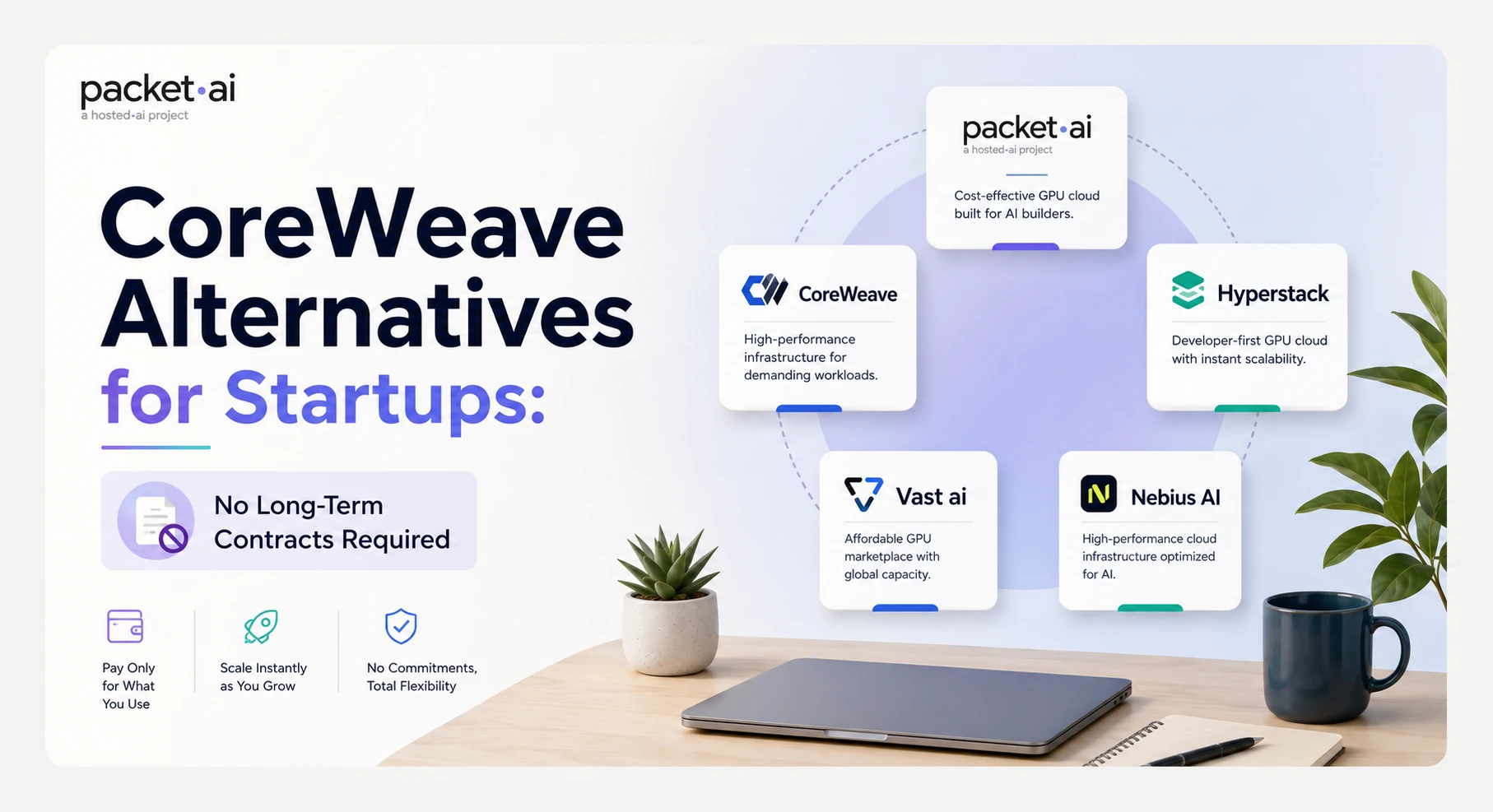
CoreWeave H100 costs $6.16/GPU-hr in 8-GPU nodes with ~5-year contracts for best rates. packet.ai A100 is $1.43/hr per GPU with no contract. The best CoreWeave alternatives for AI startups in 2026.
CoreWeave H100 on-demand costs $6.16/GPU-hr in August 2026 - sold only in 8-GPU nodes at $49.24/hr minimum. The weighted average contract length for new CoreWeave capacity is approximately 5 years (CFO Nitin Agrawal, Q1 2026 earnings call). CoreWeave also reported being "virtually sold out" of 2026 capacity. For AI startups that need one or two GPUs today without a multi-year enterprise contract, coreweave pricing and availability are the two problems that send teams elsewhere.
Key takeaways
CoreWeave (Nasdaq: CRWV) is the benchmark neocloud. $5B annual revenue in 2025 (+420% YoY), $99.4B contracted backlog, OpenAI and Meta as anchor tenants, InfiniBand fabric at scale, no egress fees, and first access to NVIDIA's latest silicon. SemiAnalysis ClusterMAX ranked CoreWeave alone in the Platinum tier - above every other neocloud. For the workload CoreWeave is built for - multi-node distributed training at frontier-lab scale with multi-year committed capacity - it is the right answer and the coreweave competitors on this list are not direct substitutes.
For AI startups, the picture is different. The minimum unit is an 8-GPU node. The committed rate requires a 5-year contract negotiation. The 2026 capacity is largely sold out. A startup trying to run QLoRA fine-tuning on one A100 or test a B200 workload for 10 hours does not fit CoreWeave's current commercial model. The coreweave alternatives below are built for exactly that workload shape: single GPU access, published rates, no contract, available today.
Note: this post does not cover RunPod or Lambda Labs - both have dedicated posts. For RunPod see the RunPod alternatives guide. For Lambda Labs see the Lambda Labs alternatives guide. For the full GPU cloud comparison, see the 10 best GPU cloud providers for AI.
CoreWeave pricing normalised to per-GPU-hour from 8-GPU node rates. On-demand list prices from UsagePricing.com (July 2026) and Spheron CoreWeave H100 guide (July 2026). packet.ai pricing from packet.ai pricing page (August 2026).
CoreWeave rates normalised to per-GPU-hr from 8-GPU node list prices. UsagePricing.com (July 2026): HGX H100 $49.24/hr node = $6.16/GPU-hr. HGX B200 $68.80/hr node = $8.60/GPU-hr. A100 $21.60/hr node = $2.70/GPU-hr. Spot H100 $19.71/hr node = $2.46/GPU-hr. packet.ai pricing from packet.ai pricing page (August 2026). Hyperstack and Nebius from respective pricing pages (August 2026). Vast.ai spot from gpucloudcost.com (July 2026). GMI Cloud from GMI Cloud blog (May 2026).
packet.ai B200 at $3.75/GPU-hr is 56% below CoreWeave HGX B200 at $8.60/GPU-hr normalised from the 8-GPU node rate, with single-GPU access and no contract.
The CoreWeave-to-packet.ai comparison for startups is less about on-demand rate and more about access model. CoreWeave minimum unit: 8 GPUs, $49.24/hr. packet.ai minimum unit: 1 GPU, $0.66/hr (RTX 6000 Pro). For a startup running experiments, fine-tuning, or inference on one or two GPUs, that is the only comparison that matters. packet.ai A100 80GB at $1.43/hr versus CoreWeave A100 normalised at $2.70/GPU-hr - for a 200-hour training run, packet.ai costs $286 versus CoreWeave's $540 at the normalised rate, assuming CoreWeave would even sell a single A100 which it does not self-serve.
On Blackwell: packet.ai B200 at $3.75/GPU-hr versus CoreWeave HGX B200 at $8.60/GPU-hr normalised. For startups that want Blackwell capability without a 5-year enterprise contract and without buying 8 GPUs at once, packet.ai is the only published self-serve B200 rate below $4/hr in August 2026. For teams that also need managed LLM inference, Token Factory serves Llama 3.3 70B at $0.59/M and Llama 3.1 8B at $0.06/M - inference without GPU management. For the self-host vs managed API break-even, see the LLM inference cost breakdown.
Best for: Startups that need single-GPU access, B200 at below $4/hr, A100 at $1.43/hr, or RTX 6000 Pro inference at $0.66/hr with no contract and no minimum node size. Not the CoreWeave replacement for teams that need multi-hundred-GPU InfiniBand clusters, GB200 NVL72 access, or CoreWeave's no-egress-fee architecture at scale.
Hyperstack (NexGen Cloud, NVIDIA Cloud Partner) is the most direct CoreWeave alternative for startups that need H100 or A100 access without an 8-GPU node minimum. H100 PCIe from $2.50/hr per GPU, A100 PCIe from $1.35/hr, B200 at $6.00/hr - all available as single-GPU on-demand with no contract. That makes H100 at $2.50/hr versus CoreWeave H100 at $6.16/GPU-hr (8-GPU node) a 59% savings on the same GPU class, with single-GPU access CoreWeave does not offer. VM hibernation is Hyperstack's differentiator for development workflows: pause billing when not running compute, resume with disk state intact.
Hyperstack does not have InfiniBand fabric or the same cluster-scale networking as CoreWeave. 350Gbps networking covers most startup multi-GPU workloads but is not the same as CoreWeave's InfiniBand for 100+ GPU distributed training. For the full Hyperstack comparison, see the Hyperstack alternatives guide.
Best for: Startups that need H100 or A100 per-GPU access at well below CoreWeave on-demand rates, GDPR-compliant EU infrastructure, and VM hibernation for dev workflows. H100 at $2.50/hr vs CoreWeave's $6.16/GPU-hr normalised is the sharpest H100 cost comparison on this list.
Vast.ai's marketplace lists spot H100 from $1.49/hr and spot A100 from $0.67/hr - the lowest published rates for those GPUs anywhere, including CoreWeave's own spot pricing (CoreWeave spot H100 node $19.71/hr = $2.46/GPU-hr). For startups running checkpointed training jobs where 30-60 minute checkpointing handles eviction risk, Vast.ai spot undercuts CoreWeave spot by 39% per GPU-hour - and requires no 8-GPU node minimum. Single GPU, no contract, no sales process. The tradeoff: Vast.ai hosts are independent operators with no SLA, variable uptime, and marketplace-dependent availability. See the Vast.ai alternatives guide for when the marketplace reliability tradeoff is worth it.
Best for: Cost-first startups running checkpointed H100 or A100 training workloads with no SLA requirement. Spot H100 at $1.49/hr undercuts CoreWeave spot at $2.46/GPU-hr and requires no node minimum or contract.
Nebius (Nasdaq: NBIS) is the closest like-for-like coreweave competitor for startups that need enterprise-credibility infrastructure without a 5-year contract. H100 on-demand at $3.85/hr and preemptible at $2.15/hr - both available without a contract, both with single-GPU access in HGX configurations. No egress fees on object storage transfers. InfiniBand HGX clusters for multi-node training. EU data centers in Finland and Paris for GDPR workloads. Nebius does not require multi-year commitments and does not enforce an 8-GPU node minimum on self-serve SKUs.
The Nebius constraint relative to CoreWeave: no A100 in the catalog, H200 availability at 59% over 30 days (GPU Finder), and GB200/GB300 require a sales quote. CoreWeave's coreweave h100 pricing at $6.16/GPU-hr on-demand sits well above Nebius at $3.85/hr - Nebius is cheaper on H100 on-demand with no contract. For the full Nebius comparison, see the Nebius AI alternatives guide.
Best for: Startups that want enterprise neocloud infrastructure (Nasdaq-listed, InfiniBand HGX, EU residency) without CoreWeave's contract structure. H100 on-demand at $3.85/hr and preemptible at $2.15/hr are both below CoreWeave on-demand at $6.16/GPU-hr, with no 8-GPU node minimum.
GMI Cloud (NVIDIA Preferred Partner and Reference Architecture Provider) publishes H100 at $2.00/hr and H200 at $2.60/hr on-demand with no minimum commitment, no bundle minimum, no contract. Those rates compare directly against CoreWeave H100 at $6.16/GPU-hr on-demand - a 68% reduction on the same GPU class, with single-GPU access and no sales process. For startups evaluating coreweave h100 pricing and looking for the most direct lower-cost comparison with no contract friction, GMI Cloud's $2.00/hr is the sharpest like-for-like H100 rate on this list.
GMI Cloud is less well-known than CoreWeave by brand and does not have CoreWeave's cluster-scale InfiniBand infrastructure or no-egress-fee architecture. For single-to-moderate multi-GPU H100 and H200 workloads where per-GPU rate is the primary constraint, the rate comparison stands regardless of brand recognition.
Best for: Startups doing a direct coreweave h100 pricing comparison where the $6.16/GPU-hr on-demand rate is the blocker. GMI Cloud H100 at $2.00/hr with no minimum is the cheapest published on-demand H100 rate from a named NVIDIA partner on this list.
The coreweave competitors above solve the startup access problem. None of them replace what CoreWeave does at scale. CoreWeave is the right choice if your startup fits any of these:
CoreWeave makes sense when
Use an alternative when
Last reviewed: August 26, 2026. CoreWeave pricing normalised from 8-GPU node list rates. UsagePricing.com (July 2026, updated after CoreWeave July 21 2026 rate card change): HGX H100 $49.24/hr node, HGX B200 $68.80/hr node, A100 $21.60/hr node. CoreWeave 5-year weighted average contract length from CFO Nitin Agrawal, Q1 2026 earnings call (Investing.com transcript). CoreWeave sold out 2026 capacity quote from CFO Agrawal, Q1 2026 earnings call (Spheron CoreWeave H100 guide, July 2026). CoreWeave spot H100 $19.71/hr node from UsagePricing.com. SemiAnalysis ClusterMAX Platinum tier from Spheron CoreWeave vs Nebius guide (August 2026). packet.ai pricing from packet.ai pricing page (August 2026). Hyperstack from hyperstack.cloud/gpu-pricing (August 2026). Nebius from nebius.com/prices (August 2026). Vast.ai spot from gpucloudcost.com (July 2026). GMI Cloud H100 from GMI Cloud blog (May 2026). GPU pricing changes frequently - verify on provider pages before committing. For the full GPU cloud comparison, see the 10 best GPU cloud providers for AI. For Hyperstack, see the Hyperstack alternatives guide. For Nebius, see the Nebius AI alternatives guide. For Vast.ai, see the Vast.ai alternatives guide. For the LLM inference cost comparison, see the LLM inference cost breakdown.
Same models. Same API. Fraction of the cost. Start free — no credit card required.
Start Building →