packet.ai Token Factory vs Groq vs Together AI: LLM API Pricing Compared
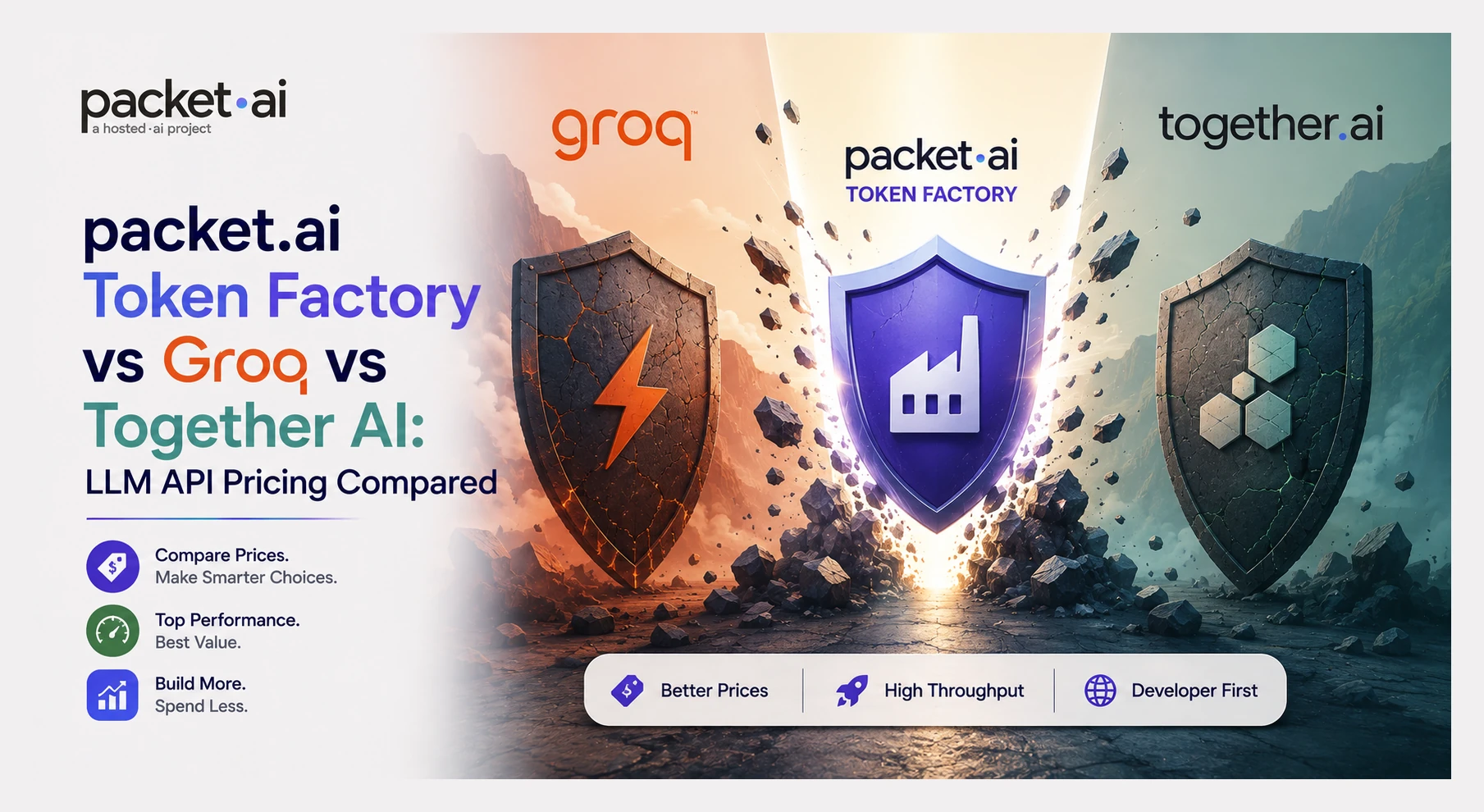
Groq is fastest. Together AI has the most models. packet.ai Token Factory has the lowest published rate for Llama 3.3 70B at $0.30/M. Here is how the three stack up across every scenario that matters.
packet.ai Team
August 25, 2026
packet.ai Token Factory serves Llama 3.3 70B at $0.30/M input and output - the lowest published rate for that model in August 2026. Groq serves the same model at $0.59/$0.79/M at 280-394 tokens per second. Together AI serves it at $0.88/$0.88/M with a 200+ model catalog behind it. The right choice depends on whether you optimise for cost, speed, or breadth - and the answer flips depending on whether you use batch processing.
Key takeaways
packet.ai Token Factory is cheapest on Llama 3.3 70B at $0.30/M flat - below Groq ($0.59/$0.79) and Together AI ($0.88/$0.88). On Llama 3.1 8B, packet.ai at $0.06/M also undercuts both Groq ($0.05/$0.08) on output and Together AI ($0.18/$0.18) across the board.
Groq wins on speed: 280-394 tokens per second on Llama 3.3 70B. Standard GPU hosts run 50-100 TPS. For latency-sensitive applications, Groq's LPU hardware has no managed API equivalent.
Together AI wins on model breadth: 200+ models including image, video, audio, and fine-tuning. Groq has 15 models. packet.ai Token Factory has Llama, DeepSeek, Qwen, Kimi K3, expanding monthly.
Groq and Together AI both offer 50% batch discounts for async workloads. Groq's batch rate on Llama 3.3 70B drops to ~$0.30/$0.40/M - within range of packet.ai's standard rate at $0.30/M flat.
Together AI charges $0.09/GB egress. Groq and packet.ai Token Factory charge zero egress. At production scale with high output volume, that fee adds a compounding line item.
Groq has a free tier (no credit card, 30 RPM). Together AI gives $5 signup credits. packet.ai Token Factory is pay-as-you-go with no free tier currently.
This is a direct llm api pricing comparison across three providers that share significant model overlap. All three serve Llama 3.3 70B and Llama 3.1 8B. All three have OpenAI-compatible APIs. All three target developers running open-weight inference without self-hosting. The differences are in per-token rates, throughput, model catalog depth, and what the total bill looks like at different volume tiers.
Pricing Compared: packet.ai vs Groq vs Together AI
All rates verified August 2026 from provider sources. Groq rates from UsagePricing.com (August 15, 2026) and AI Pricing Guru (August 23, 2026). Together AI rates from AI Pricing Guru (August 2026) and together.ai/models. packet.ai Token Factory rates from packet.ai blog (August 2026).
Model
packet.ai Token Factory
Groq
Together AI
Cheapest
Llama 3.3 70B (in/out per 1M)
$0.30 / $0.30
$0.59 / $0.79
$0.88 / $0.88
packet.ai
Llama 3.1 8B (in/out per 1M)
$0.06 / $0.06
$0.05 / $0.08
$0.18 / $0.18
Groq (input) / packet.ai (output)
DeepSeek V4 Pro (in/out per 1M)
$0.87 / $1.74
Not available
$2.10 / $4.40
packet.ai
Qwen 3.5 (in/out per 1M)
$0.30 / $1.80
Not available
Varies by variant
packet.ai
Kimi K3 (in/out per 1M)
Available
$1.00 / $3.00
$1.20 / $4.50 (K2.6)
Verify at launch
Llama 3.1 405B (in/out per 1M)
Not available
Not available
$3.50 / $3.50
Together AI only
packet.ai Token Factory rates from packet.ai blog (August 2026). Groq rates verified August 15-23, 2026 from UsagePricing.com and AI Pricing Guru. Together AI rates from together.ai/models and AI Pricing Guru (August 2026). Kimi K2.6 used as Together AI proxy for K-series; K3 pricing at launch may differ.
With Batch Discounts: How the Winner Changes
Batch processing is the biggest lever in this llm api pricing comparison that most developers miss. Both Groq and Together AI offer 50% batch discounts for async workloads. Groq also stacks prompt caching (another 50% off) on top - bringing effective rates to roughly 25% of on-demand for workloads with repeated system prompts.
Scenario (Llama 3.3 70B)
packet.ai
Groq
Together AI
Standard on-demand (output per 1M)
$0.30
$0.79
$0.88
Batch API (50% off, output per 1M)
N/A
~$0.40
~$0.44
Batch + cache stacked (Groq only, output per 1M)
N/A
~$0.20
N/A
The practical read: for real-time inference, packet.ai Token Factory at $0.30/M output is the cheapest. For async batch workloads, Groq's stacked batch + cache discount at ~$0.20/M output undercuts everyone - including packet.ai's standard rate. Together AI's batch rate ($0.44/M) is competitive for teams already on the platform but does not win outright on price at any tier.
Total Cost at Scale: 10M, 100M, and 1B Tokens/Month
Per-token rates are only half the story. The other half is what the monthly bill actually looks like. These scenarios use Llama 3.3 70B output token pricing, 1:3 input-to-output ratio (typical for chat applications), standard on-demand rates.
10M output tokens/month
packet.ai: $3.00
Groq: $7.90
Together AI: $8.80
Small app, few hundred daily active users. Difference is negligible in absolute terms.
100M output tokens/month
packet.ai: $30
Groq: $79
Together AI: $88 + egress
Growing product. Gap becomes a real budget line. packet.ai saves $49-$58/month vs alternatives.
1B output tokens/month
packet.ai: $300
Groq batch+cache: ~$200
Together AI batch: ~$440 + egress
At this scale Groq batch+cache wins. packet.ai standard rate still beats Together AI batch.
The crossover point: at very high volume with async workloads where you can use Groq's batch + cache stack, Groq's effective rate (~$0.20/M output stacked) undercuts packet.ai's standard rate ($0.30/M). For real-time inference at any volume, packet.ai remains cheapest on Llama 3.3 70B throughout. Together AI's batch discount brings it to $0.44/M output - competitive but not cheapest at any tier.
Speed Comparison: Groq LPU vs Standard GPU Inference
Speed is where Groq has no equivalent. The LPU (Language Processing Unit) architecture pre-schedules every operation at compile time - no dynamic scheduling overhead. The practical result is 280-394 tokens per second on Llama 3.3 70B (Groq GroqCloud docs, August 2026), versus 50-100 TPS on equivalent GPU-based inference.
280-394
Groq TPS on Llama 3.3 70B
50-100
Typical GPU inference TPS
packet.ai Token Factory and Together AI both run on GPU infrastructure. Neither publishes TPS figures for their managed API tier. For applications where response latency directly affects user experience - streaming chatbots, real-time voice pipelines, interactive coding assistants - Groq's throughput advantage is meaningful and not replicable on managed GPU APIs at comparable price points. For batch processing, offline document pipelines, or RAG where latency is not on the critical path, the speed difference does not affect outcome and cost becomes the dominant variable.
Provider Profiles: When to Use Each
packet.ai
Token Factory
Cheapest on Llama 3.3 70B and DeepSeek V4 Pro at standard rates
packet.ai Token Factory at $0.30/M flat on Llama 3.3 70B is the lowest published on-demand rate for that model in August 2026. Runs on owned B200 infrastructure with 80-100% GPU utilisation - the structural reason rates sit below competitors. OpenAI-compatible endpoint, no cold starts, zero egress fees. Model catalog covers Llama, DeepSeek V4 Pro, Qwen 3.5, Kimi K3 - narrower than Together AI but covers the most commonly used open models. No batch API currently - the standard rate is the only tier. No free tier. Best for teams running Llama 3.3 70B or DeepSeek V4 Pro workloads that want the lowest on-demand rate without batch complexity.
Groq
LPU inference
Fastest inference, best batch+cache economics at scale
280-394 TPS on Llama 3.3 70B is the fastest managed inference API available in 2026. On-demand rates ($0.59/$0.79/M) sit between packet.ai and Together AI. The real groq api pricing advantage is the batch + cache stack: 50% batch + 50% cache = ~$0.20/M effective output rate on workloads with repeated system prompts - the lowest achievable rate on this list at high async volume. Free tier with no credit card. 15-model catalog (Llama, Qwen, GPT OSS, Kimi K2, Whisper). No fine-tuning, no dedicated endpoints, no image/video models. Best for latency-sensitive real-time applications and high-volume async workloads where the batch+cache stack applies.
Together AI
200+ models
Broadest catalog, fine-tuning, image and video generation
Together AI's together ai pricing is the highest on-demand rate of the three for Llama 3.3 70B ($0.88/$0.88/M) but the value is catalog breadth and platform depth that neither Groq nor packet.ai match. 200+ models covering LLM, image (FLUX.1, Stable Diffusion 3), video, speech-to-text, text-to-speech. LoRA fine-tuning on Llama, Mistral, and Qwen up to 405B. Dedicated GPU endpoints for guaranteed throughput. $5 signup credits. Egress at $0.09/GB is the main hidden cost. Batch API (50% off) competitive but not cheapest. Best for teams that need multimodal pipelines, fine-tuning, or 200+ model access alongside LLM inference.
Free Tiers and Trial Credits Compared
Provider
Free tier
Rate limits (free)
Credit card required
Verdict
Groq
Yes - ongoing
30 RPM, 6K TPM, 14.4K req/day
No
Best for prototyping and low-volume dev
Together AI
$5 signup credit
Until credits exhausted
No (until credits gone)
Good for first model evaluations
packet.ai Token Factory
No free tier
-
Yes
Pay-as-you-go from first token
For initial evaluation and prototyping, Groq's free tier with no credit card required is the lowest-friction starting point on this list. Together AI's $5 credit covers roughly 5-6 million tokens on Llama 3.1 8B - enough for meaningful product evaluation before committing. packet.ai Token Factory does not have a free tier; it is designed for teams that have moved past evaluation and are optimising production costs.
Which Provider for Which Workload
Choose packet.ai Token Factory
Running Llama 3.3 70B or DeepSeek V4 Pro - cheapest standard rates
Cost is the primary constraint on real-time inference
Want zero egress fees and no cold starts
OpenAI-compatible drop-in with no config changes
Choose Groq
Response latency is on the critical path - streaming chat, voice, real-time agents
High-volume async workloads where batch+cache stack applies
Want a free tier for prototyping with no credit card
Groq API pricing with batch+cache beats everyone at 1B+ tokens/month async
Choose Together AI
Need 200+ model catalog including image/video/audio generation
Running fine-tuning on 70B+ models without self-hosting
Async batch workloads at scale where the 50% discount matters
Want dedicated GPU endpoints with managed serving layer
Use multiple providers
Route latency-sensitive requests to Groq, batch jobs to packet.ai
Use Groq free tier for dev/staging, packet.ai for production
Together AI for fine-tuned models + packet.ai or Groq for standard inference
All three are OpenAI-compatible - switching base URL is the only code change
Frequently asked questions
For Llama 3.3 70B on-demand, yes. packet.ai Token Factory at $0.30/M input and output is below Groq's $0.59/$0.79 per 1M. For high-volume async workloads where Groq's batch API (50% off) and prompt caching (another 50% off) can be stacked, Groq's effective rate drops to ~$0.20/M output - cheaper than packet.ai's standard $0.30/M. packet.ai has no batch API currently. For real-time inference, packet.ai is cheaper. For high-volume batch+cache workloads, Groq wins. See full model and rate details on the Token Factory page.
Groq charges $0.59 per million input tokens and $0.79 per million output tokens for Llama 3.3 70B Versatile as of August 2026, verified from GroqCloud developer docs. The batch API cuts both rates by 50% ($0.30/$0.40/M). Prompt caching applies another 50% discount on cached prefixes. Stacked batch + cache brings the effective rate to roughly $0.20/M output for workloads with repeated system prompts. All rates are pay-as-you-go with no subscription fee on the Developer tier.
Together AI is the most expensive of the three on Llama 3.3 70B at $0.88/$0.88 per 1M tokens on-demand. Its batch API brings that to ~$0.44/M output - cheaper than Groq's standard rate but above Groq's batch rate and above packet.ai's standard rate. The value proposition is catalog breadth (200+ models), fine-tuning, and image/video generation - capabilities neither Groq nor packet.ai match. Together AI also charges $0.09/GB egress, which both Groq and packet.ai waive.
Yes. Groq's free tier requires no credit card and provides access to all supported models including Llama 3.3 70B. Rate limits on the free tier: 30 requests per minute, 6,000 tokens per minute, and 14,400 requests per day per organisation. The free tier is suitable for prototyping and low-volume personal projects. For production inference, the Developer tier is pay-as-you-go with no monthly subscription fee - you pay only for tokens used.
Yes. All three providers use the OpenAI chat completions format. Switching between them is a base URL and API key change in most setups - one or two lines of code. The model name parameter changes (e.g. 'llama-3.3-70b' vs 'meta-llama/Llama-3.3-70B-Instruct-Turbo') but the request and response structure is identical. This makes it practical to test across providers and route between them based on load, cost, or latency requirements.
Groq runs on LPU hardware with 280-394 tokens per second on Llama 3.3 70B, versus 50-100 TPS on equivalent GPU-based inference. Together AI and packet.ai Token Factory both run on GPU infrastructure and neither publishes TPS figures for their managed API tier. At sub-100ms TTFT and 250+ TPS, Groq is 3-8x faster than standard GPU inference. For latency-sensitive applications - streaming chat, real-time voice, interactive coding - that gap matters. For batch processing and offline workloads, throughput speed does not affect outcome and cost becomes the only differentiator.
Last reviewed: August 25, 2026. packet.ai Token Factory rates from packet.ai blog (August 2026). Groq rates from GroqCloud developer docs, verified via UsagePricing.com (August 15, 2026) and AI Pricing Guru (August 23, 2026). Together AI rates from together.ai/models and AI Pricing Guru (August 2026). Together AI egress fee from markaicode.com pricing analysis (June 2026). Groq free tier limits from Groq rate-limit documentation and Omid Saffari (August 2026). Pricing changes frequently - verify on provider pages before committing. For the full multi-provider token cost comparison, see cheapest LLM API providers in 2026. For Together AI alternatives beyond Groq and packet.ai, see the Together AI alternatives guide. For the self-host break-even calculation, see the LLM inference cost breakdown. To use packet.ai Token Factory directly, see Token Factory.