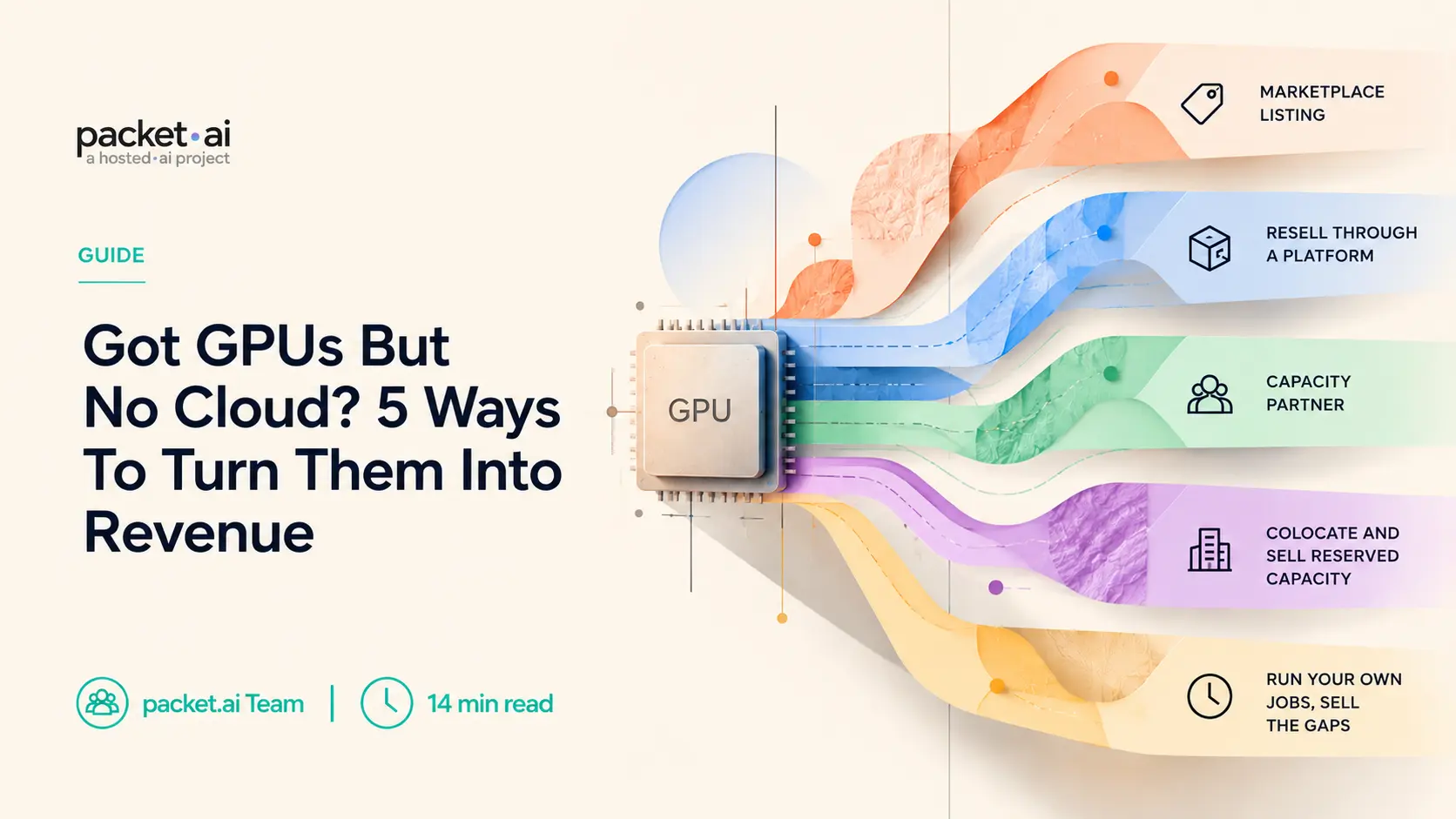
Own GPUs. No cloud. No customers. You still have five options, and each trades effort for control. Here is what each takes and which one fits your fleet.
Own GPUs, no cloud, no customers. You still have five ways to sell GPU compute. They range from listing a single machine on a marketplace to colocating racks and selling reserved capacity, and they differ far more in effort, control and risk than in headline price. This guide explains what each route takes, where it tends to break, and which one fits which fleet size, so you can monetize idle GPUs without defaulting to the first platform you find. It contains no earnings figures on purpose: what a GPU earns depends on utilization, your power cost and each platform's terms, and any single number would mislead.
Key takeaways
A marketplace is the lowest-friction way to sell gpu power online: you install the platform's software, set a price, and renters find you. On Vast.ai you open a separate host account (host and renter accounts cannot be combined), accept the hosting agreement and install the client.
The verification checklist is concrete. Each machine needs NVIDIA GPUs of one identical model, at least two physical CPU cores per GPU, system RAM of at least 95% of total GPU VRAM (an 8-GPU machine with 96 GB cards needs roughly 730 GB), a public IPv4 address, and 500 Mbps upload and download. Machines behind CGNAT or a shared ISP address cannot be used. Verification itself is automated, and Vast.ai's documentation says meeting the minimums does not guarantee it: a machine also needs a reliability score above 90%, which the docs say a stable new machine typically reaches within a few days.
On money, Vast.ai's hosting page says the rate you set is the rate you receive, with no fee or commission deducted from host earnings, and that Vast sets its own price to renters. Other platforms describe their models differently, and third-party summaries do not always match a platform's own wording, so treat any take-home percentage you read in a blog as a prompt to check the host agreement. The rental contract also matters: the host must deliver the advertised hardware until each rental's end date. For the renter's side of this model, including why host reliability shapes what the marketplace rewards, see the packet.ai Vast.ai alternatives guide.
Here you stay in front of the customer and a software vendor handles the plumbing: provisioning, multi-tenant scheduling, a branded portal and metering. White-label platforms in this category include hosted.ai (the company behind packet.ai), Rafay and Qubrid. Vendors describe fast launches. hosted.ai says a white-label GPU cloud typically takes two to four weeks from platform deployment to first paying customer, and Rafay says its platform takes operators from raw GPUs to billable services in roughly six to eight weeks. Both are vendor claims, not independent measurements, and neither includes the time it takes to find customers.
The trade is control for responsibility. You set prices and own the customer relationship, which also means you own sales, support, billing disputes and compliance questions. Selling GPU processing power this way is closer to starting a small cloud business than to listing hardware. hosted.ai also describes a wholesale capacity network that operators can use to source or sell capacity, which can ease the customer-finding problem but adds another party to the arrangement.
Capacity-partner programs trade control for demand: the network brings the customers, and you meet its standards. Curated programs set a high bar. RunPod's documentation says its Secure Cloud runs in T3/T4 data centers operated by vetted partners, with partner certifications such as SOC 2, ISO 27001 and PCI DSS.
Vast.ai's datacenter status asks for at least five GPU servers in a professionally managed facility, a registered business, owner identity verification and a signed datacenter hosting agreement. Its application page describes security certifications such as ISO 27001 or SOC 2 as encouraged but not strictly required, although an older documentation page lists ISO 27001 as required, so confirm the current wording when you apply.
Token-based networks work differently. On io.net, suppliers run the IO Worker software, stake IO tokens per device and earn rewards. io.net's documentation describes supplier compensation in IO. Under the earlier emission-based model, third-party analysis describes supplier income as heavily dependent on the IO token price, and CoinDesk Research describes a June 2026 change, the Incentive Dynamic Engine, that ties emissions to network earnings and aims to pay suppliers a stable dollar target, which is meant to reduce that exposure. Confirm the current terms directly before you model anything.
packet.ai runs a provider program of its own. The provider page describes listing spare capacity or launching your own neocloud, with scheduling, billing and support handled on the platform side, and requirements and terms are set by packet.ai and can change, so check that page for the current picture.
This route suits owners with enough hardware to sign term contracts. The first constraint is the building, not the GPUs. Standard colocation typically supports 5 to 15 kW per rack, while GPU racks can run from tens of kilowatts into the 100+ kW range, and GPU colocation is usually priced per kilowatt because power is the dominant cost, according to one colocation operator's 2026 guide. An 8-GPU H100 server alone draws on the order of 8 to 10 kW, so a facility has to be built for it before capacity can be sold on a reserved basis.
The second constraint is financing and delivery risk. When you sell reserved capacity you commit to deliver for the contract term. A filing dated October 5, 2026 illustrates how different this is from selling space and power: Duos Technologies said it sold its GPU-as-a-service entity to Axe Compute, removing about $98.1 million of prospective equipment financing, to become a pure-play colocation operator. Owning and financing GPUs to rent them out is a distinct business from hosting someone else's.
If you already train models or render on your own hardware, selling planned idle windows can look like free money. It works only if the platform gives you a supported way to schedule your own work. Vast.ai's verification documentation expects dedicated machines: personal workloads such as mining, gaming, running your own jobs or using the machine as a desktop will automatically fail verification, and hosts are told to run any jobs of their own only through the platform's Jobs tab or create-job command. Its rental contract adds that the hardware cannot be used for any other purpose during a rental and that the advertised service must run until each rental ends, so a rental that overlaps your own job would put you at odds with the contract, not just create a scheduling problem.
The practical version is to list on a schedule you can honor: expose machines only for windows when you know your own work will not need them, and take them offline before your jobs start. Platforms differ on whether they support availability windows or interruptible tiers, so confirm that before you build a plan around it.
Skills and risk appetite narrow it further. If you want to avoid direct customer acquisition, options 1 and 3 keep customer-finding with the platform. If you are comfortable running customers and support, option 2 gives you control. If you can carry financing and term commitments, option 4 is the only one that looks like infrastructure investing. If you already have workloads, option 5 works as an add-on to any of the others, not a standalone plan.
packet.ai's provider program is closest to option 3, and its application page also covers launching a white-label GPU cloud powered by hosted.ai, which is closer to option 2. This is packet.ai's own blog, so weigh it accordingly: compare the program against the questions above, and read the provider page for current requirements before you apply. For a walkthrough specific to packet.ai, see the guide to monetizing idle GPUs as a provider, and for the broader three-model comparison, see how to rent out your GPU in 2026.
Apply to list capacity when you have decided which route fits.
Retrieved October 6, 2026. Platform terms change often; verify against the linked pages before you commit hardware.
Last reviewed: October 6, 2026. Platform requirements, fees and token terms change frequently, and vendor launch-time figures are vendor claims. This post contains no earnings figures and no guarantee of income. For packet.ai's current provider requirements and terms, see the provider page.
Same models. Same API. Fraction of the cost. Start free — no credit card required.
Start Building →