Your GPUs are either making money or burning CAPEX. In 2026, with AI demand outpacing supply, idle compute is the most expensive choice a data center owner can make.
GPU providers on packet.ai earn an average of $2.84/GPU/hr across all SKUs - paid bi-weekly, with no sales team, no invoicing, and no customer support overhead on their end.
Key takeaways
GPU compute is the most constrained resource in the AI industry right now. Hyperscalers committed $600-630 billion to AI infrastructure in 2026 alone, and on-demand capacity across major neocloud platforms is effectively sold out. H100 contract rental rates climbed from roughly $1.70/hr in late 2025 to $2.35/hr by March 2026, according to RunPod's GPU supply analysis. Demand is not waiting for supply to catch up.
The paradox: data centers average 12-18% GPU utilization. Most of the idle capacity worldwide sits powered on, cooling systems running, electricity meter ticking. It generates zero revenue. If you operate NVIDIA hardware and it is not fully committed, you are paying to run a data center for an empty building.
This guide covers exactly how providers can turn that idle capacity into recurring income through the packet.ai provider marketplace: what hardware qualifies, what the economics look like, how the technical integration works, and what to expect from the first payout onward.
The GPU shortage in 2026 is structurally different from the 2021 gaming-era crunch. That one resolved when crypto demand cooled and supply caught up. This one will not resolve the same way. AI compute demand is growing exponentially while fab capacity is constrained by HBM supply chains, advanced packaging limits, and power infrastructure buildout that lags behind demand by years, not quarters.
Three numbers illustrate the gap. NVIDIA's data center revenue topped $62 billion in a single quarter. Hyperscalers have committed $600-630 billion to AI infrastructure in 2026 alone, according to LongYield's compute backlog analysis. And yet, analysts project AI datacenters will require tens of gigawatts of power capacity before the decade ends, while current infrastructure buildout lags well behind that target, per Clarifai's GPU shortage report.
Note
GPU lead times from major distributors reached up to 12 months in mid-2026, with analysts warning supply will remain tight through at least late 2026. If your hardware is idle, there is verified demand waiting for it right now.
For GPU hardware owners, this supply-demand gap translates directly into favorable economics. Qualified providers listing on packet.ai reach thousands of AI developers running production inference, fine-tuning, and batch workloads. No ads, no cold email, no sales cycle.
Not all GPU marketplaces treat providers the same way. The model packet.ai uses is meaningfully different from an open listing platform on five dimensions that directly affect how much you earn, how much effort it takes, and what kind of customers end up on your hardware.
packet.ai's stricter qualification bar - datacenter-grade hardware only, KYC-verified customers, 24/7 support handled entirely by the platform - means less operational overhead for you and higher-quality demand on your hardware. The tradeoff is that home-lab or lightly-hosted setups do not qualify.
packet.ai accepts datacenter-grade NVIDIA GPUs that can meet the uptime, networking, and cooling requirements for production AI workloads. Consumer-grade hardware and home-lab setups are not accepted. The rate band a GPU earns correlates directly with its tier.
Beyond the GPU itself, hosts must meet four infrastructure requirements: 1 Gbps or faster stable network connectivity, enterprise-grade datacenter hosting (not home lab), reliable power with N+1 redundancy where possible, and 99%+ uptime capability. The onboarding review checks all four before approving capacity.
Detailed rate cards for each SKU and region are shared during onboarding. As a general rule, providers earn the majority of the customer-billed $/hr after platform fees. The platform handles billing, collections, currency conversion, and customer support.
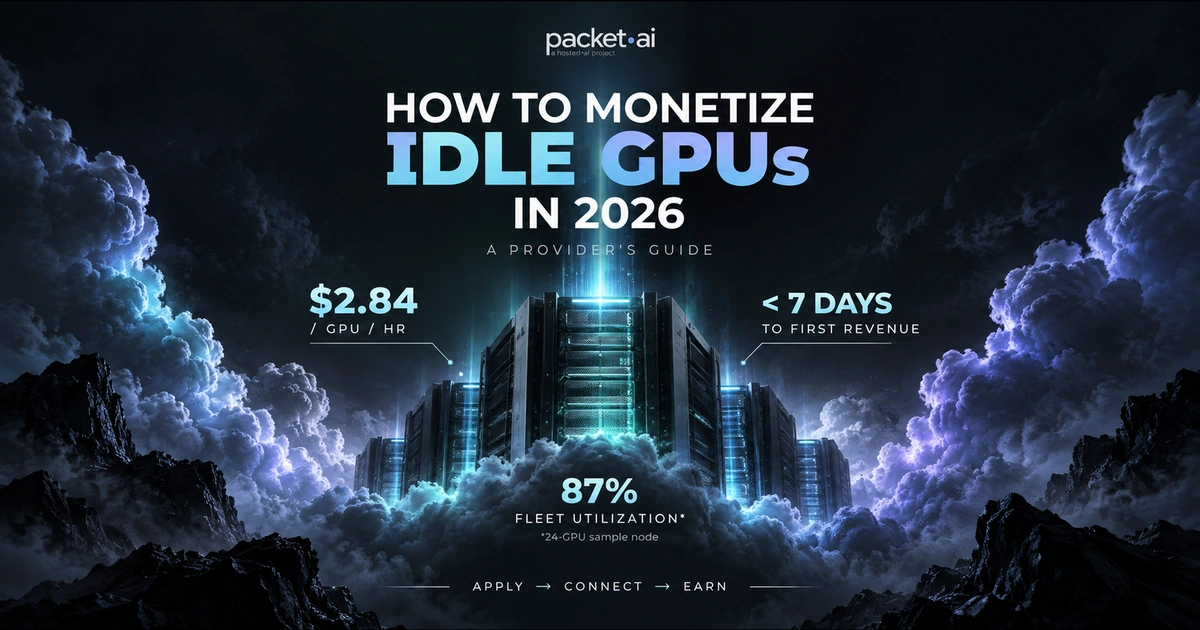
Getting from idle hardware to marketplace revenue typically takes under seven days. The process is designed to be low-friction for data center operators who want to add a revenue stream without standing up an entire cloud operations team.
Apply
Submit infrastructure details via the provider application. The review covers GPU model and BIOS revision, network quality (latency, jitter, peering), power redundancy, and hosting environment. Applications are reviewed within two business days.
Connect
Install the lightweight hosted.ai provisioning agent on your hosts. The agent handles VM lifecycle management over a minimal, audited API. It does not transmit customer workload data back to packet.ai. Workloads run isolated on your hardware. You keep root, BMC, and physical access at all times.
Earn
Your GPUs go live on the marketplace. Track occupancy, $/hr, and earnings in real time through the provider dashboard. The first payout lands on the next bi-weekly cycle after your capacity goes live.
Providers on the packet.ai network have averaged 87% fleet utilization and $12,450/month in revenue across a 24-GPU sample node. These figures come from live marketplace data shown on the for-providers page.
The core value of listing on a managed marketplace versus running your own cloud is that the platform absorbs every function that is expensive to build and maintain. For most data center operators, the alternative is months of engineering work and a dedicated ops team before the first dollar arrives.
Customer Acquisition
Thousands of AI developers and enterprises already on the marketplace. No ads, no outbound sales, no brand awareness required on your end.
Billing and Payouts
packet.ai handles billing, invoicing, payment collection, and currency conversion. Payouts arrive bi-weekly via ACH or SWIFT with a per-node CSV breakdown.
24/7 Support
The packet.ai support team handles all tier-1 and tier-2 customer issues. Providers are escalated only for hardware-level incidents such as a node down or fan failure.
Customer Vetting
All customers are KYC-verified businesses running production AI workloads. AUP enforcement keeps out crypto miners, abuse traffic, and low-quality demand.
VM Provisioning
The hosted.ai provisioning agent manages VM lifecycle automatically. You focus on keeping the hardware healthy. The platform handles the rest of the orchestration stack.
Real-time Dashboard
GPU-by-GPU utilization, $/hr, occupancy state, and earnings. CSV export for accounting. API access available for custom monitoring integrations.
packet.ai providers earn the majority of customer-billed $/hr after platform fees. The platform fee covers all of that in exchange for a share of revenue. If you run GPU workloads yourself and want to understand how containers interact with your hardware before listing, the Docker GPU workloads guide covers the NVIDIA Container Toolkit setup that most provider hosts configure before going live. To see the GPU SKUs your capacity would feed, browse available clusters on packet.ai.
One of the practical concerns any data center operator has before listing capacity on a third-party marketplace is lock-in. What happens if you need those GPUs back? What if your own demand picks up?
packet.ai operates on month-to-month terms with no financial penalty for withdrawing capacity. If your hardware is currently occupied by a customer workload, a 14-day notice period lets the platform migrate that workload smoothly. After the 14 days, the GPUs are yours again. There are no minimum commitments, no contracts requiring legal teams to unwind, and no penalty clauses.
Note
Providers also keep full root access, BMC access, and physical control of the hardware at all times. The hosted.ai provisioning agent does not grant packet.ai any administrative access to your systems beyond the VM lifecycle API.
This matters for operators who run mixed workloads - proprietary research clusters that go idle between training runs, for example, or colocation tenants whose leases allow subletting capacity. The flexibility to ramp in and out without penalty makes marketplace listing viable as a secondary revenue stream, not just a primary business model.
packet.ai sees active customer demand across three primary regions: United States (East, Central, and West), EU (Frankfurt, Amsterdam, Dublin, and Paris), and UK (London). Asia-Pacific and Latin America providers are onboarded selectively based on customer demand and latency profile.
Providers in active-demand regions see faster time-to-occupancy after going live on the marketplace. For US East and EU Frankfurt specifically, customer demand frequently outpaces available supply - which is why packet.ai is actively expanding the provider network. You can see the current active cluster inventory on the clusters page.
The onboarding review is a qualification check, not a competitive selection process. If your hardware and infrastructure meet the bar, you get in. The bar is straightforward, but a few things distinguish applications that move quickly from those that stall.
Network quality. AI workloads, especially multi-node training and distributed inference, are sensitive to network latency and jitter. Providers with clean peering, low latency to major exchange points, and 1 Gbps or better uplinks pass the network check quickly. Providers running over residential or poorly-peered connectivity do not qualify.
Power and cooling documentation. N+1 power redundancy is not a hard requirement but is noted favorably. BIOS configurations that support stable sustained load (no thermal throttling under 100% GPU utilization) matter more. Applications that include hosting environment photos, power specs, or colocation contracts tend to move faster through review.
Uptime track record. The marketplace SLA is 99% uptime from providers. Applicants who can demonstrate historical uptime data from existing workloads or monitoring systems are given priority during verification.
Note
Home-lab setups, consumer-grade power, and shared residential internet connections do not meet the hosting requirements. The qualification is for datacenter-grade environments only - colocation facilities, owned datacenters, or comparable enterprise hosting.
Applications are reviewed within two business days. The fastest path is a complete submission with infrastructure documentation, GPU model details, and a valid on-call contact for hardware-level escalations. Start your application on packet.ai.
Last reviewed: October 1, 2026. Ready to list your capacity? Apply to become a packet.ai provider and start earning from hardware that would otherwise sit idle.
Same models. Same API. Fraction of the cost. Start free — no credit card required.
Start Building →