
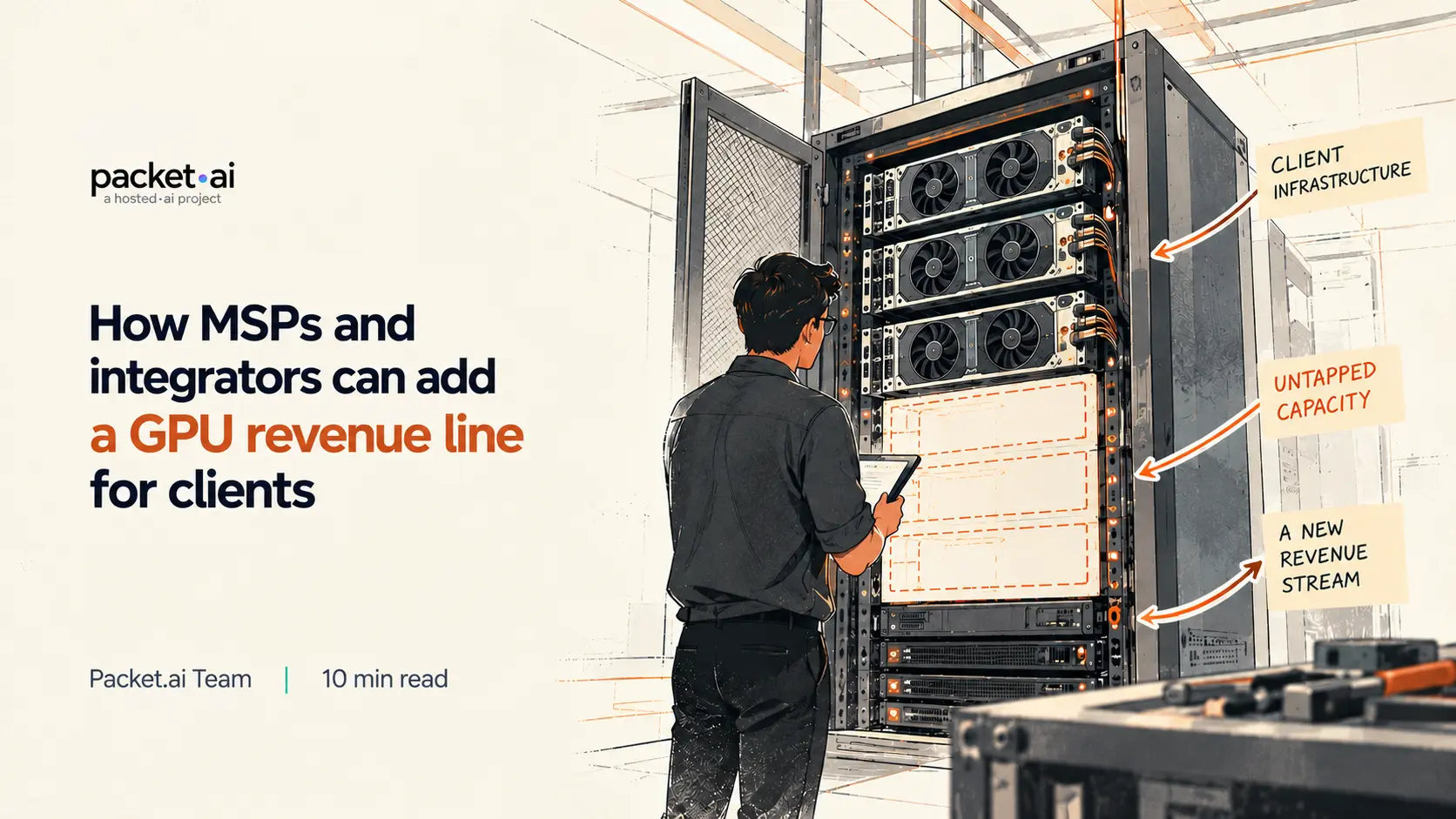
Every GPU you install could keep earning after the project ends. How MSPs and integrators can compare referral, resale, white-label and managed models for on-prem AI clients.
Every GPU you install could keep earning after the project ends. Clients who buy hardware for on prem ai, private ai or an on prem llm that stays inside their own walls tend to ask the MSPs and integrators who install a local ai server or a rack of GPU servers the same question a few months later: can it earn when we are not using it? This guide compares the models an MSP or integrator can use to build a GPU revenue line around those installs, using public partner programs from other companies as worked examples and a checklist you can use with any platform. One disclosure: packet.ai and its parent hosted.ai sell a marketplace and a white-label platform, so we have an interest in this topic. This guide does not set out any packet.ai partner terms; to discuss partnering, use the link at the end.
Key takeaways
A client running on prem ai on a gpu server or an ai gpu server, as part of its private ai infrastructure or wider enterprise ai infrastructure, usually sizes it for the busiest week they can imagine. The ai server cost is then largely fixed: the purchase price, depreciation, power and support run whether the GPUs are busy or not, as set out in what an idle GPU costs. Published cluster studies show how far real utilization sits from the ideal. Microsoft's Philly analysis (USENIX ATC 2019) found about 52% hardware utilization on GPUs in use, and Alibaba's production study (USENIX NSDI 2022) reported that 74% of GPUs on one class of machines were allocated while average utilization was 18%. A single client fleet is not a cloud cluster, and the two figures measure different things: hardware activity in the Philly study, and allocation versus use in Alibaba's. They show the general pattern, that allocated, busy and billable hours are three different numbers, which is the subject of GPU utilization explained.
That gap is the opening for an MSP or integrator. The client has paid for capacity that sits idle at night, on weekends and between projects, and the partner who installed it is the natural person to ask what to do about it. The answer is not always "rent it out," and in our view, for many on-prem AI deployments where data must stay on site, it should not be. Whether it fits depends on who owns the hardware, the client's permission, whether the infrastructure is suitable, software licensing and real demand, and the client's own utilization and billing records settle that, not a study. Where it fits, there are four distinct ways to build msp gpu revenue around it.
Channel programs sort partners by two questions: who owns the end customer, and who bills them. Referral partners introduce a prospect and earn a fee, while the vendor owns the customer and bills them. Resellers own the customer and the billing and earn the margin. MSPs run technology for a client month to month and earn recurring service revenue, and an ai managed service provider, or ai msp, is that type applied to AI infrastructure. Integrators design and implement multi-vendor solutions, so a system integrator gpu partner often sits in several vendors' programs at once. Applied to GPUs, that gives four models.
The table is our synthesis of how channel programs are generally structured, not a description of any one program.
Real programs show each pattern. E2E Networks' partner page describes two models. In bill-to-customer, partners refer leads, E2E handles onboarding, billing and support, and the partner earns commissions without managing the customer relationship; in bill-to-partner, the partner handles onboarding, billing and support itself. Together they span the referral and reseller ends of a cloud reseller program. AceCloud's partner program is the next step up: tiered partner levels, a dedicated account manager, price books and proposal kits, and 90 days of deal registration protection. Qubrid sits at the white label cloud end: its program lets neoclouds, MSPs, OEMs and resellers integrate their own GPU servers into a rebranded Qubrid platform, and Dihuni, a GPU server and IT solutions provider, launched Dihuni GPU Cloud on it. Financing partners add the fourth model, which earns from the hardware sale and not from running a service: Five West Financial, for instance, says it pays resellers 100% of the invoice when a deal funds and offers AI server resellers tiers with monthly application-volume thresholds of about $100,000 for co-branded and $500,000 for private label. Any referral fee or financing margin depends on the program.
If you are already an nvidia reseller or part of the NVIDIA Partner Network, none of these replaces that relationship. They add a revenue line on hardware you have already sold. The packet.ai guide to the five ways to turn idle GPUs into revenue compares the routes from the owner's side, and why neoclouds are adding a second demand channel covers why operators now run more than one channel.
Our view
Pick the model by two questions, not by the highest margin: who do you want to own the customer, and what delivery risk can you carry. Referral is the right start for most MSPs, because it adds a revenue line without adding an operations burden. Resale and white-label earn more per client but make you the cloud provider, with the sales, support, billing disputes and compliance that come with it.
Most of the programs above assume the partner or platform owns the hardware. When the GPUs belong to a client, five things change.
Who is the operator. Marketplaces and supplier programs generally onboard whoever operates the hardware, and many have their own rules. Vast.ai's verification, for example, fails machines that run personal workloads, and RunPod's Secure Cloud draws on vetted data center partners. Decide up front whether the client or you will be the named operator. The hosting environment. Many programs expect a real data center or comparable facility, with redundant power, cooling and fast networking, which a client's office comms room may not meet. Licensing. The clause titled "No Datacenter Deployment" in NVIDIA's GeForce driver license says the software is not licensed for datacenter deployment, with an exception for blockchain processing. It covers the GeForce driver software, and NVIDIA has not defined "datacenter," telling one outlet there are many types. Other NVIDIA products ship under different software terms, so confirm the terms for the exact cards and drivers before listing anything. Security and isolation. Renting capacity means running other people's workloads on the client's hardware, so keep it separate from the client's own AI workloads and data. Contract, warranty and liability. The client needs to agree in writing to who handles incidents, who carries insurance and who reports the income, and should check whether the hardware warranty and vendor support cover multi-tenant, around-the-clock use.
Whatever the model, a partner program has to answer how a deal is claimed and how the partner gets paid. The standard mechanism is deal registration: the partner tells the vendor it is pursuing a specific opportunity, the vendor approves it after a conflict check, and the partner gets a protection window during which other partners and the vendor's own sales team do not compete for the account. Guides put typical windows anywhere from 30 to 180 days, and AceCloud states 90. A registration usually carries the partner's resolved terms, whether a referral fee, a reseller margin or a revenue split, including the rate, any caps, the payment trigger and a clawback window. None of these terms is universal: each is set in the program agreement, so treat them as items to verify.
Payment mechanics vary more than programs admit. E2E's page says commissions are paid quarterly on invoices, that margins depend on the partnership model and plan level, and that agreements typically run three years, but it publishes no numbers, and AceCloud pays "as per schedule" after you register and close a deal. Microsoft's Cloud Solution Provider program shows how a mature program tiers it: an indirect reseller owns the customer relationship but works through a distributor that handles billing and support, and moving to direct billing requires a track record and revenue thresholds. Smaller GPU programs rarely publish this level of detail, which is why the questions matter more than the brochure.
Our view
Write the answers down, and ask for the support split and the exit terms in writing, because they decide who pays for a bad quarter. A program that publishes what it does and does not do is easier to trust: Spheron's supplier page, for example, says it does not own GPUs and sets out its role on pricing, contracts and branding. The same transparency should apply to any partner terms you sign.
Partner programs usually split work along a familiar line. The partner handles the client conversation and first-line support, the platform handles provisioning, billing and deeper technical issues, and marketing is either co-branded or white-labeled. Published examples show what programs offer: AceCloud lists a partner portal, standardized price books and proposal kits, a partner badge and a dedicated partner account manager. Whether a platform offers any of this is a question for the platform. The point for an MSP is to put the split in the agreement, including response times and who speaks to the client during an incident.
This is a structure, not a pitch, and it works for private ai clients who are open to the idea. Adapt the wording to your own voice.
Start small. Pick one on prem ai client with a GPU fleet that has idle hours, and measure allocated, busy and billable hours for a month, using the framework in GPU utilization explained. Decide which of the four models fits that client and your own capacity to deliver. Work through the ten questions with one or two platforms, ask for the answers in writing, and run a pilot on part of the fleet, keeping the client's own workloads protected. The GPU provider glossary defines terms such as multi-tenant, bare metal, SLA and take rate.
Our view
The strongest version of this revenue line is the one the client would choose even if you earned nothing from it. Lead with what the client gets, which is a smaller idle bill and a clear view of utilization, and treat your fee as the fair price for the work.
If you are an MSP, integrator or OEM reseller and want to talk through partnering, talk to the team about partnering. If you or a client operate the hardware yourselves, the supplier page and application page describe listing capacity or launching a white-label cloud.
Retrieved October 27, 2026. Program details come from each company's own page at the time of retrieval and can change. Third-party guides are noted as such.
Last reviewed: October 27, 2026. This is general information, not legal, tax or financial advice, and it contains no commission rates, no earnings figures and no guarantee of income. Program details are from public pages and can change. packet.ai has no relationship with the other companies named. For packet.ai's supplier information, see the supplier page.
Same models. Same API. Fraction of the cost. Start free — no credit card required.
Start building →