Kimi K3 hit #1 on the open-source leaderboard July 2026. Here is what it actually costs to run it, the fastest way to call the API, and how solo devs can access it without a cluster.
Kimi K3 is the world's first open-weight model in the 3-trillion-parameter class. The Kimi K3 API is live today at api.moonshot.ai/v1, OpenAI-compatible. packet.ai Token Factory is bringing it at 50% below Together AI list price.
Key takeaways
Moonshot AI released Kimi K3 on July 16, 2026, and its open weights landed on July 27. The model scored 57.1 on the Artificial Analysis Intelligence Index, third strongest model family overall behind GPT-5.6 Sol and Claude Fable 5, and hit first place on WebDev Arena at 1,678 Elo. It is the first open model to top that leaderboard.
Why does this matter for builders right now? K3's architecture was designed to be cheap to serve, not just to score well on benchmarks. Its KDA attention mechanism and MXFP4 quantization let providers run it at higher GPU utilisation than prior open models of comparable quality. That is what makes 50%-below-market token pricing structurally possible on packet.ai's overcommit infrastructure.
This guide covers the API quickstart, the cost math for every audience from solo developers to enterprise teams, architecture details, and how to self-host on packet.ai B200 hardware. For the broader token cost landscape across all frontier models, see the packet.ai AI token cost comparison.
The Kimi K3 API is an OpenAI-compatible inference endpoint from Moonshot AI serving the world's largest open-weight language model: 2.8 trillion parameters, 1-million-token context, native vision input, and always-on reasoning. Model ID is kimi-k3, base URL is https://api.moonshot.ai/v1. Any code that already calls the OpenAI SDK works with a two-line change.
Three practical reasons to try it over GPT-4o or Claude Sonnet: the weights are open so you can self-host for data residency; the 1M context window handles entire codebases or large document sets in a single pass; and at $1.50/$7.50 per million tokens via packet.ai Token Factory, it competes directly with frontier closed models on price while staying fully deployable on your own infrastructure.
Install the SDK
pip install openaiGet an API key from platform.kimi.ai or join the Token Factory waitlist for 50%-below-market rates
Call the API
from openai import OpenAI

client = OpenAI(
    api_key="your-api-key",
    base_url="https://api.moonshot.ai/v1",  # or Token Factory URL
)

response = client.chat.completions.create(
    model="kimi-k3",
    messages=[
        {"role": "system", "content": "You are a senior software engineer."},
        {"role": "user", "content": "Review this function and suggest improvements."},
    ],
    max_tokens=4096,
    # reasoning_effort="low"  # set for latency-sensitive workloads
)

print(response.choices[0].message.content)
K3 has reasoning always enabled and returns a reasoning_content field alongside the final answer. For latency-sensitive workloads, set reasoning_effort: "low" to cut output token burn. At $15.00 per million output tokens on Moonshot direct (or $7.50 via Token Factory), long reasoning chains add up quickly. Check your actual output token counts in the first week before locking in budgets.
LangChain, LlamaIndex, DSPy, and the Vercel AI SDK all work without any code changes beyond base_url and api_key.
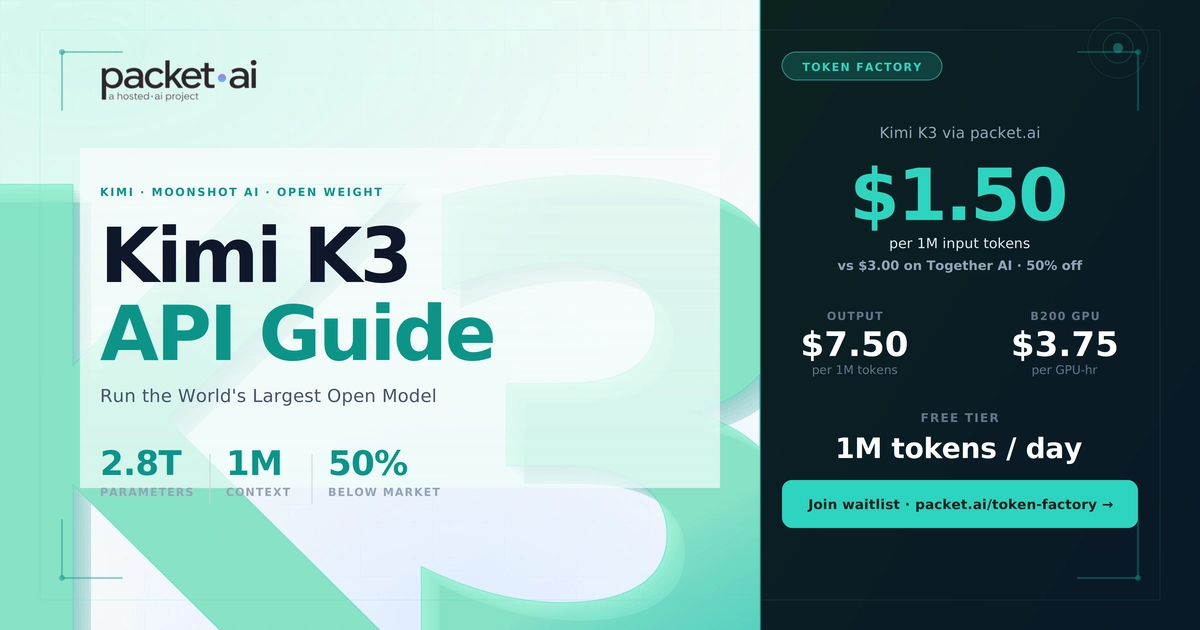
On Moonshot direct, Kimi K3 costs $3.00 per million input tokens and $15.00 per million output tokens. packet.ai Token Factory will serve it at $1.50/$7.50 per million tokens, 50% below Together AI's published list price, on owned B200 infrastructure running at 80-100% GPU utilisation via the haishare overcommit scheduler.
Token Factory pricing from internal packet.ai rate card. Market rates from Together AI list price, retrieved 12 August 2026.
Prompt caching is where the cost story gets interesting for agents and RAG pipelines. OpenRouter reports a 92% cache-hit rate on K3 traffic. At that rate, the weighted average input cost drops from $3.00 to roughly $0.52 per million tokens on Moonshot direct, because system prompts and document context get cached after the first request.
Most guides for Kimi K3 assume you are running a team with an AWS budget. This one is for solo builders, indie hackers, and freelancers who need frontier-quality AI without paying enterprise prices.
packet.ai Token Factory was built for exactly this. It runs on owned B200 infrastructure with an overcommit scheduler that achieves 80-100% GPU utilisation, versus the 20-40% typical at most shared cloud providers. That cost difference is structural, not a promotional discount. Token Factory currently serves Llama 3.3 70B, DeepSeek V4 Pro, and Qwen3.5, with Kimi K3 as the Phase 1 flagship addition.
For solo devs who want GPU access for lighter open models while evaluating K3, packet.ai has the cheapest entry points of any neocloud. The RTX 6000 Pro Dynamic at $0.66/hr runs Llama 3.3 70B at Q4 on a single card. The RTX 4090 Dedicated at $0.39/hr is the cheapest 24 GB option available anywhere. RunPod charges $0.69/hr for the same card. See what the RTX 6000 Pro actually runs for throughput numbers across 8 concurrent models.
Token Factory currently has Llama 3.3 70B at $0.30/$0.30 per million tokens, which lets solo developers prove out product economics before upgrading to Kimi K3's frontier quality. The crossover where self-hosting beats the Token Factory API is roughly 12 million output tokens per month, as the LLM inference cost breakdown shows in detail.
Kimi K3 is not the right call for every workload. Here is the honest comparison, with Token Factory pricing where available.
Token Factory pricing from internal packet.ai rate card. All models available now except Kimi K3 (Phase 1 launch). Market rates from Together AI list price, retrieved 12 August 2026.
If your workload needs frontier reasoning, 1M context, or native vision, K3 is worth the premium. At $1.50/$7.50 on Token Factory it is the most affordable way to access it. If cost is the primary constraint, start with Llama 3.3 70B on Token Factory at $0.30/$0.30 and upgrade once your token economics are proven.
Two architecture decisions in Kimi K3 have direct dollar consequences for anyone running inference at scale: Kimi Delta Attention and MXFP4 quantization.
Kimi Delta Attention (KDA) replaces standard quadratic attention in 3 of every 4 transformer layers with a delta-rule linear recurrence. In a standard transformer, the KV cache grows with every token. At 1M tokens, that cache alone can exceed the model weights in size. KDA keeps a fixed-size state instead, cutting KV cache memory at 1M context by up to 75% and increasing decoding throughput up to 6x versus a standard architecture at the same context length. One global MLA attention layer runs every 4 layers to preserve long-range retrieval accuracy.
MXFP4 quantization-aware training means the released weights ship already in 4-bit format at 1.56 TB, compared to roughly 5.6 TB in BF16. MXFP4 is native on NVIDIA Blackwell (B200, B300), the same hardware packet.ai runs. On older Hopper cards (H100, H200), MXFP4 falls back to slower paths. This is why K3 is effectively a Blackwell-first model in practice.
Hardware note
K3's 1.56 TB MXFP4 weight file requires a distributed cluster. A single 8xH100 node provides 640 GB, less than half the model footprint. The minimum production setup is 8xB200 (1,536 GB HBM3e). For the full hardware sizing breakdown, see the Kimi K3 GPU and VRAM requirements guide.
The MoE sparsity adds to this: K3 activates 16 of 896 experts per token, a 1.8% activation ratio. Each token touches roughly 104B parameters out of 2.8T. That low per-token compute cost is what lets packet.ai's overcommit scheduler run multiple inference workloads on the same cluster at 80-100% utilisation, versus the 20-40% typical at spot-instance providers.
Self-hosting makes financial sense when monthly token volume crosses roughly 10 million output tokens, when data residency rules require on-premises inference, or when you need deterministic latency. Below that threshold, Token Factory will cost less once you factor in GPU time, engineering, and ops.
* Cluster rate from $2.80-$3.20/GPU-hr on 12-month terms per packet.ai pricing FAQ. All prices verified August 2026 from packet.ai/pricing and packet.ai/gpu/b200. Compare vs RunPod B200 at $5.89/hr and Vast.ai at $4.34/hr.
packet.ai B200 Dynamic at $3.75/hr is 36% below RunPod ($5.89/hr) and 14% below Vast.ai ($4.34/hr) for the same Blackwell silicon. See packet.ai vs RunPod for the full comparison.
The vLLM serve command for an 8xB200 node, validated by the vLLM team on the July 27 weight release:
vllm serve moonshotai/Kimi-K3 \
  --tensor-parallel-size 8 \
  --max-model-len 131072 \
  --quantization mxfp4 \
  --trust-remote-code \
  --gpu-memory-utilization 0.92 \
  --port 8000
Start at --max-model-len 131072 (128K) and scale up once throughput is validated. For deeper hardware sizing math, see the Kimi K3 VRAM requirements guide.
Most production LLM workloads never exceed 32K tokens per request. K3's 1M window is worth paying for in a narrower set of situations where context length is the real bottleneck, not model quality.
Full-repo coding agents
Load an entire codebase into context. K3 ranked #1 on WebDev Arena and scores best on FrontierSWE among open models. Compatible with LangChain, LlamaIndex, and the Vercel AI SDK.
Long-document analysis
Legal discovery, financial filings, clinical notes. 1M tokens covers roughly 750,000 words in a single pass, the equivalent of a full contract archive without chunking.
RAG with large corpora
Skip chunking entirely for datasets under 1M tokens. Embed the full corpus in context. K3's KDA architecture keeps KV cache memory manageable even at that scale.
Multimodal side projects
K3 has native vision via MoonViT-V2. Screenshot-to-code, UI iteration from images, CAD feedback, all in a single API call. Scored 0.889 on OCRBench at max reasoning effort.
packet.ai Token Factory is an OpenAI-compatible inference API, currently live with Llama 3.3 70B, DeepSeek V4 Pro, and Qwen3.5, running on owned B200 hardware with an overcommit scheduling stack. The cost advantage is structural. Competitors running shared GPU infrastructure at 20-40% utilisation cannot match prices built on 80-100% utilisation without rebuilding their scheduling stack from scratch.
Kimi K3 is the flagship Phase 1 addition to Token Factory, priced at $1.50/$7.50 per million input/output tokens, 50% below Together AI's $3.00/$15.00 list price. The free tier gives developers 1 million tokens per day to test on their actual workload before committing to any paid plan. Join the Token Factory waitlist to lock in launch pricing.
Two lines to switch from OpenAI or Moonshot direct
Set base_url to the Token Factory endpoint and update your api_key. Everything else, tool calls, streaming, structured outputs, the model ID, stays identical. No rewrite. No migration risk.
Teams already running GPU workloads on packet.ai use a single account for both GPU-hour credits and Token Factory tokens. There is no separate billing setup or contract. For dedicated multi-node Kimi K3 inference with data residency requirements, browse packet.ai cluster options.
Last reviewed: August 18, 2026. GPU pricing verified from packet.ai/pricing and packet.ai/gpu/b200. Token Factory pricing from internal packet.ai rate card. Moonshot API pricing from platform.kimi.ai official docs. Browse cluster options for dedicated Kimi K3 inference.
Same models. Same API. Fraction of the cost. Start free — no credit card required.
Start Building →