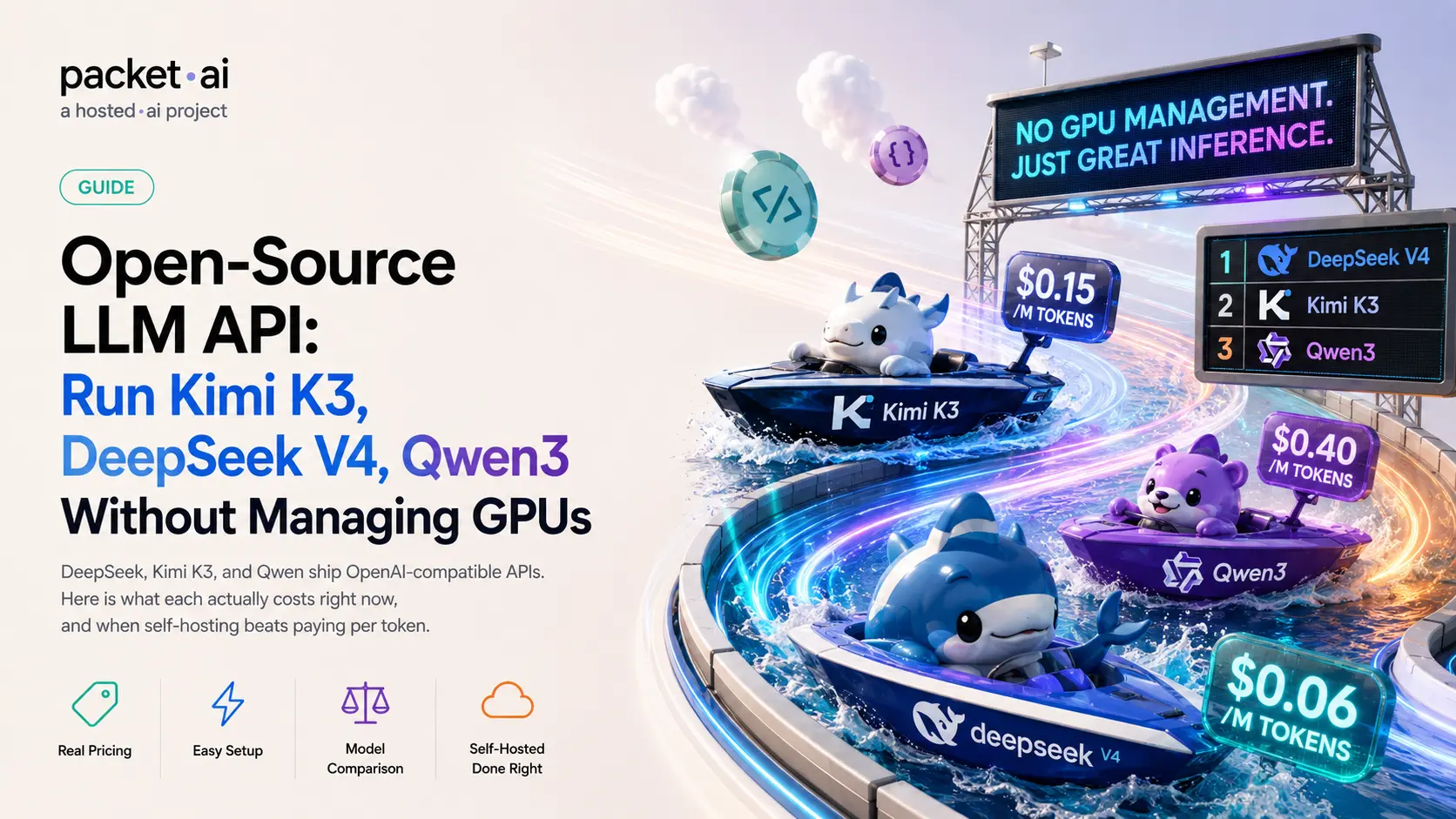
DeepSeek, Kimi K3, and Qwen all ship OpenAI-compatible APIs. Here is what each actually costs right now, and when self-hosting beats paying per token.
You don't need a GPU cluster to run DeepSeek, Kimi K3, or Qwen. Each ships an official, OpenAI-compatible open source LLM API: point your existing SDK at a different base URL, and you're calling a frontier open-weight model without provisioning a single GPU. None of these are a free ai api in the strictest sense, but between free trial credits and genuinely low per-token rates, the practical cost of testing all three is close to nothing. This guide covers what each one actually costs today, how they compare, and when self-hosting instead makes more sense.
Key takeaways
"Open source" here means open-weight: the model parameters are downloadable and self-hostable, distinct from the API access this post is actually about. This post covers calling these models through their official hosted APIs, the fastest way to use them without touching a GPU. For the self-hosting side of each model specifically, see the packet.ai DeepSeek V4 GPU requirements guide, Kimi K3 GPU requirements guide, and Qwen VRAM requirements guide. And if the whole idea of inference (running a trained model to get a response) versus training is new, the packet.ai What Is LLM Inference guide covers the fundamentals this post builds on.
An open-source LLM API, as the phrase gets used in practice, is a hosted endpoint that runs an open-weight model on the provider's own infrastructure and charges per token, the same commercial arrangement as OpenAI or Anthropic's APIs, but for a model whose weights you could also download and run yourself. Worth being precise about the three terms doing work in that sentence, since they're often used interchangeably and shouldn't be: "open-weight" describes the model (downloadable parameters, not necessarily a permissive license), "open-source" implies a genuinely open license (which, as the Kimi K3 section below shows, isn't always true even for a model with public weights), and "OpenAI-compatible" describes the API's interface, nothing about licensing at all. The "open" part describes the model, loosely; the API itself is a completely ordinary paid service sitting on top of it.
This distinction matters because it's easy to assume "open source" implies free, and the APIs themselves are not free in the way downloading the weights is. What you're actually paying for is the GPU infrastructure, uptime, and scaling that running these models at production quality requires, the exact same cost structure any inference provider faces. Getting started is the same everywhere: sign up, generate an llm api key, and point your existing OpenAI SDK at the provider's base URL. The advantage over a closed-model API isn't that it's free; it's that you have the option to self-host later without switching model families, and pricing tends to be dramatically lower since these providers compete aggressively against each other and against the incentive for anyone to just self-host instead.
DeepSeek's API is the cheapest serious option covered here, and it's the one people search for most by a wide margin. The current models are deepseek-v4-flash and deepseek-v4-pro; the older deepseek-chat and deepseek-reasoner names are legacy aliases. DeepSeek changed its pricing structure on August 16, 2026, moving to peak/off-peak billing; the rates below reflect that update, not the flat rate that was in effect before it.
Off-peak rates, per million tokens, effective as of DeepSeek's August 16, 2026 pricing update. Peak-hour rates (01:00-04:00 and 06:00-10:00 UTC) run roughly double.
Prompt caching is automatic and disk-based; no configuration needed. A system prompt or repeated document context that's already been seen gets billed at the cache-hit rate instead of cache-miss, a roughly 97% discount on that portion of the input. New accounts get a 5-million-token free grant, no credit card required, valid for 30 days, effectively a deepseek api free tier for evaluating the model before committing budget. Among open llm options, this is one of the more generous trial allowances available today.
from openai import OpenAI

client = OpenAI(
    api_key="your-deepseek-key",
    base_url="https://api.deepseek.com/v1",
)

response = client.chat.completions.create(
    model="deepseek-v4-flash",
    messages=[{"role": "user", "content": "Explain the deploy step by step."}],
)The Kimi API, run by Moonshot AI, costs more than DeepSeek but leads on long-context and agentic coding benchmarks. Kimi K3, its 2.8-trillion-parameter flagship, is the model most worth using specifically for its 1M-token context and native tool-use strength. Every moonshot api call goes through the same OpenAI-compatible endpoint regardless of which Kimi model you target.
Per million tokens, api.moonshot.ai official rates. Cached input is billed separately at a substantial discount.
client = OpenAI(
    api_key="your-moonshot-key",
    base_url="https://api.moonshot.ai/v1",
)

response = client.chat.completions.create(
    model="kimi-k3",
    messages=[{"role": "user", "content": "Review this pull request."}],
)
⚡ The Kimi K3 license, precisely
K3 ships under its own license, not a standard MIT or Apache 2.0 term (that "Modified MIT" label applies to Moonshot's smaller K2.6/K2.7 models, not K3). For internal use, most commercial products, and calling the hosted API, there's no special obligation. The one real gate: if you run K3 as a "Model as a Service" business, reselling inference to third parties, and your combined revenue with affiliates exceeds $20M over any 12 months, you need a separate agreement with Moonshot before continuing commercially. A display requirement kicks in separately above 100M monthly users or $20M in monthly revenue. Worth noting: Alibaba has signaled a similar revenue-share structure for its next flagship Qwen model, so this kind of threshold may become more common across open-weight releases, not just Moonshot's.
Alibaba's Qwen family spans a genuinely wide price range, from a nearly-free high-volume tier to a flagship competitive with DeepSeek's Pro tier.
Per million tokens, Alibaba Cloud Model Studio, International mode.
client = OpenAI(
    api_key="your-alibaba-key",
    base_url="https://dashscope-intl.aliyuncs.com/compatible-mode/v1",
)

response = client.chat.completions.create(
    model="qwen3.5-flash",
    messages=[{"role": "user", "content": "Summarize this document."}],
)All three speak the OpenAI API, so testing more than one against your actual workload before committing is genuinely low-cost: the same code, three base URLs, a real comparison on your own prompts rather than someone else's benchmark.
DeepSeek, Kimi, and Qwen aren't the only open-weight families with a hosted API. Meta's Llama API and the Mistral API both follow the same OpenAI-compatible pattern, and the Huggingface Inference API is worth knowing about specifically because it hosts a huge range of open-weight models, not just one vendor's family, behind a single interface. None of these currently undercut DeepSeek on raw price for a comparably capable model, which is why this guide leads with the three above, but they're worth checking if a specific model in one of those families fits your use case better.
If you're pricing out a workload seriously, treat this as an llm api pricing comparison exercise, not a single-provider decision: run the same prompts against two or three candidates before committing budget to one.
The API route wins on simplicity for as long as your volume stays modest: no GPU provisioning, no serving infrastructure, billed per token with no fixed cost. That advantage shrinks as volume grows, since per-token pricing doesn't get cheaper with scale the way owned or rented GPU capacity does.
The practical crossover, based on typical reserved-GPU-capacity economics, lands around 2 to 5 million tokens a day, assuming reasonable GPU utilization once self-hosted. Below that, the API is almost always the better call; the engineering time alone to stand up and maintain self-hosted serving costs more than the token savings. Above it, particularly for a workload with predictable, sustained volume, self-hosting starts to win on pure cost, and it also removes any dependence on a specific provider's uptime or pricing changes, like the DeepSeek pricing update that took effect mid-August.
For the actual GPU sizing math on each model, the dedicated DeepSeek, Kimi K3, and Qwen guides cover exactly what hardware each one needs.
Between calling a model's own API directly and self-hosting from scratch, packet.ai's Token Factory is building a managed, OpenAI-compatible inference API for open-weight models: per-token billing with input and output metered separately, no minimums, and scale-to-zero so idle traffic costs nothing. Launch pricing starts at $0.06 per million tokens.
Token Factory is currently in private preview. Join the waitlist for early access and launch-pricing credits once it opens.
Last reviewed: August 19, 2026. DeepSeek pricing reflects the August 16, 2026 rate update. For self-hosting each model instead, see the DeepSeek, Kimi K3, and Qwen GPU requirements guides.
Same models. Same API. Fraction of the cost. Start free — no credit card required.
Start Building →