🚀 B200 starting at $3.75/hr. The best price you'll find. DC in US West → (Access it from button on top after login).

Get Your B200 →
Start Building
Infrastructure

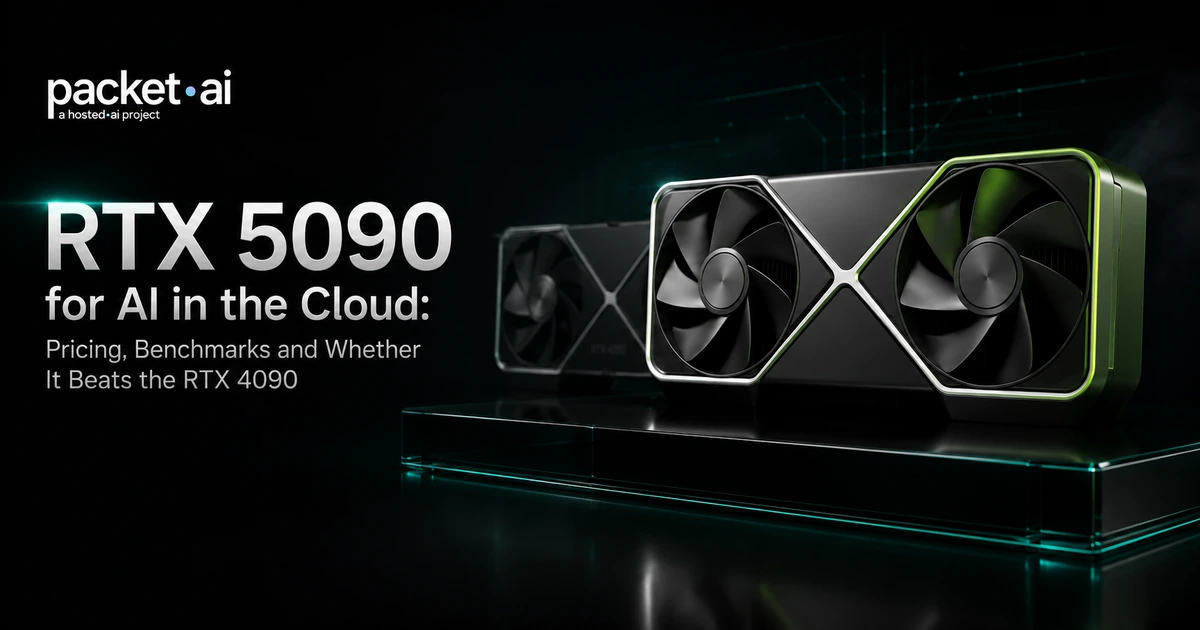
RTX 5090 for AI in the Cloud: Pricing, Benchmarks vs RTX 4090

32 GB GDDR7 at 1,792 GB/s, Blackwell architecture, from $0.29/hr. The RTX 5090 nearly doubles 30B inference throughput over the RTX 4090 and costs less per million tokens doing it.

Author photo
packet.ai Team
July 23, 2026

The RTX 5090 rents for a market median of $0.56/hr in 2026, 17% above the RTX 4090, with 32 GB GDDR7 and 1,792 GB/s bandwidth that delivers roughly 2x the vLLM throughput on 30B models at a lower cost per million tokens than the older card.

Key takeaways

  • RTX 5090 has 32 GB GDDR7 at 1,792 GB/s bandwidth, a 78% increase over the RTX 4090's 1,008 GB/s, which directly translates to faster token generation on memory-bandwidth-bound LLM inference.
  • Market cloud pricing spans $0.29/hr (Theta EdgeCloud, spot) to $0.99/hr (RunPod), with a verified median of $0.56/hr across 12 providers as of July 2026. packet.ai RTX 5090 launches at $0.59/hr dedicated.
  • On Qwen3-Coder 30B with vLLM, a single RTX 5090 delivers 4,570 tok/s versus 2,259 tok/s on a single RTX 4090, roughly 2x throughput at a lower cost per million tokens ($0.040 vs $0.048).
  • The extra 8 GB of VRAM unlocks FP16 inference on 20B-34B models that the RTX 4090's 24 GB cannot comfortably serve; 70B at Q4_K_M still requires ~40 GB and won't fit on a single RTX 5090.
  • No ECC memory, no NVLink: the same production caveats that apply to the RTX 4090 apply here. The RTX 5090 is a development and inference card, not a data-center replacement.
  • Critical driver note: the RTX 5090 requires NVIDIA driver 575.57.08 or newer for full Blackwell inference performance. Older drivers reduce throughput to RTX 4090 levels.

The RTX 5090 is the first consumer GPU built on NVIDIA's Blackwell architecture, launched January 2025. For teams already running workloads on the RTX 4090, the question is specific: does the 17% hourly premium translate into real workload gains, and for which jobs? This guide covers the exact numbers: specs, cloud pricing across 12 providers, head-to-head throughput benchmarks against the RTX 4090, model fit at 32 GB, and the precise cases where you should skip the RTX 5090 and go straight to an L40S 48 GB or H100 SXM.

If you are still sizing GPUs against model VRAM requirements before committing to a card, the packet.ai VRAM requirements guide maps every major model to a minimum GPU and hourly price.

RTX 5090 Specs for AI: Blackwell Architecture, 32 GB GDDR7, and the 78% Bandwidth Jump

The RTX 5090 uses the GB202 die on TSMC's 4NP process. The architectural change that matters most for AI inference is the memory subsystem: 32 GB GDDR7 on a 512-bit bus running at 1,792 GB/s. LLM token generation is almost entirely memory-bandwidth-bound in the decode phase, so a 78% bandwidth increase over the RTX 4090 directly raises tokens-per-second, not just in benchmarks but in every production request.

32 GB

GDDR7 VRAM

1,792

GB/s bandwidth

3,352

AI TOPS (FP4)

104.8

TFLOPS FP32

575W

TDP

21,760

CUDA cores

Why Does the RTX 5090 Matter More for Inference Than Training?

The 5th-generation Tensor Cores in Blackwell add native FP4 support, which is new to consumer GPUs. At FP4 sparse, the RTX 5090 reaches 3,352 AI TOPS. In practice, FP4 quantization in vLLM is still maturing in 2026, but the hardware path is there. More immediately useful: the bandwidth jump (1,792 vs 1,008 GB/s) means the RTX 5090 sustains higher batch sizes within the same latency budget, increasing effective requests-per-second on production endpoints.

What has not changed from the RTX 4090: no NVLink, no ECC memory, PCIe interconnect only. The RTX 5090 is still a consumer GPU running on PCIe at 64 GB/s between cards, versus 900 GB/s NVLink on H100 SXM. Multi-GPU RTX 5090 inference via tensor parallelism scales poorly; replica parallelism (multiple single-GPU vLLM instances behind a load balancer) is the correct pattern for scaling this card.

Does the RTX 5090 Need a Specific NVIDIA Driver for Full AI Performance?

Yes, and this is not a footnote. CloudRift benchmarks documented that with NVIDIA driver 570.86.15, the RTX 5090 performed at RTX 4090 levels in vLLM. Upgrading to driver 575.57.08 unlocked full Blackwell throughput, with significant gains across all inference benchmarks. Before renting an RTX 5090 cloud instance, verify the host is running driver 575.57.08 or newer. Any provider running older drivers is effectively charging 5090 prices for 4090 performance.

RTX 5090 Cloud Pricing in 2026: What Providers Actually Charge

RTX 5090 cloud GPU rental pricing spans $0.29/hr to $0.99/hr across 12 providers as of July 2026, with a market median of $0.56/hr. Compared to the RTX 4090 median of $0.48/hr, that is a $0.08/hr premium for 78% more memory bandwidth and 8 GB more VRAM. Availability is the bigger constraint: the RTX 4090 is listed across 14 providers; the RTX 5090 across 12, with lower stock depth per provider.

RTX 5090 vs adjacent GPUs, on-demand market median, July 2026

RTX 4090
$0.48/hr
RTX 5090
$0.56/hr median
L40S 48GB
from $0.92/hr
A100 80GB
from $1.43/hr
H100 SXM
from $2.50/hr
ProviderRTX 5090 price/hrTypeUptime SLA
packet.ai (coming soon, dedicated)from $0.59/hrDedicatedHigh
Theta EdgeCloudfrom $0.29/hrMarketplaceVariable
Vast.aifrom $0.40/hrMarketplaceVariable
RunPodfrom $0.99/hrCommunity / SecureModerate
CloudRift$0.65/hrManagedHigh
packet.ai L40S 48GB (ECC, step up for 70B)from $0.92/hrManagedHigh
GPU.ai / managed tierup to $0.99/hrManagedHigh

Pricing data sourced from the AI Multiple GPU Price Index and getdeploying.com, updated July 2026. The RTX 5090 median of $0.56/hr sits $0.36/hr below the packet.ai L40S at $0.92/hr. For workloads that need 48 GB of VRAM, ECC memory, or guaranteed uptime, the L40S is the correct step at that gap.

Is the RTX 5090 Reliably Available on Cloud Providers in 2026?

Availability is the RTX 5090's real constraint in 2026. GPU Finder's 30-day uptime tracking shows Vast.ai at 100% coverage but only 66% uptime reliability on RunPod community nodes, and under 50% on several smaller marketplaces. For a continuous batch inference job or a fine-tuning run longer than 4 hours, the RTX 5090's inventory depth is thin enough that interruption risk is real. The RTX 4090, by contrast, has 14 providers and materially deeper stock at each. For uninterrupted workloads, the RTX 5090 is still a development and experimentation card on the cloud, not a production inference GPU in the same league as managed L40S or H100 inventory.

RTX 5090 vs RTX 4090 for LLM Inference: Throughput, Cost Per Token, and the 32 GB Advantage

The headline benchmark from CloudRift's production vLLM tests on Qwen3-Coder 30B (AWQ, 8K context, FP8 KV-cache): a single RTX 5090 delivers 4,570 tokens/s versus 2,259 tokens/s on a single RTX 4090, roughly 2x throughput. At those rates and on-demand prices, the RTX 5090 costs $0.040 per million tokens versus $0.048 per million tokens on the RTX 4090: the more expensive card is actually cheaper per token on 30B-class models.

MetricRTX 4090RTX 5090Delta
VRAM24 GB GDDR6X32 GB GDDR7+8 GB
Memory bandwidth1,008 GB/s1,792 GB/s+78%
8B inference, batch 1 (tok/s)~130~213+64%
30B inference, vLLM (tok/s)2,2594,570+102%
Cost per 1M tokens (8B)$0.058$0.0684090 cheaper
Cost per 1M tokens (30B)$0.048$0.0405090 cheaper
Largest model at FP16~12B~16B+4B
70B at Q4_K_M (~40 GB)NoNoL40S or A100
Market price/hr$0.48/hr$0.56/hr+$0.08/hr

Throughput data from CloudRift production benchmarks (Qwen3-Coder 30B AWQ, vLLM, FP8 KV-cache) and community benchmarks (8B Q4_K_M). Cost-per-token calculated at July 2026 on-demand median rates. Results vary with context length, quantization, and concurrent request load.

When Does the RTX 5090 Beat the RTX 4090 on Cost Per Token?

The crossover is at model size. For 8B models, the RTX 4090 at $0.058/M tokens is about 15% cheaper per token than the RTX 5090 at $0.068/M: the bandwidth advantage does not overcome the hourly premium at small batch sizes where both cards sit underutilised. For 30B models where the RTX 4090's 24 GB becomes the constraint (forcing shorter contexts or quantization trade-offs), the 5090 wins on both throughput and cost per token. The practical rule: if your model fits comfortably in 24 GB and concurrency is low, keep the RTX 4090. If your model is 20B-34B, or if KV-cache pressure at production context lengths is causing quality trade-offs, the RTX 5090 pays for itself.

The RTX 5090 on packet.ai's Token Factory delivers managed LLM inference from $0.66/hr equivalent, removing driver management, uptime risk, and GPU capacity planning entirely.

RTX 5090 for Stable Diffusion, Flux, and ComfyUI: Does the Upgrade Pay Off?

Image generation is where the RTX 5090 delivers the most straightforward gains over the RTX 4090. Puget Systems' Procyon AI XL (FP16) benchmark shows the RTX 5090 running 40% faster than the RTX 4090. For diffusion pipelines, the extra 8 GB of VRAM is equally valuable: Flux.1-dev at FP16 sits comfortably at ~20 GB on the 4090 (tight), while the 5090's 32 GB gives substantial headroom for multi-controlnet stacks, large VAE, and video diffusion sequences. See the best GPU for ComfyUI guide for a full pipeline breakdown including scheduler and sampler benchmarks.

Which Image Generation Models Benefit Most from the RTX 5090?

PipelineRTX 4090RTX 5090Upgrade verdict
SDXL 1.0 (xFormers, 1024px)~4.5 img/s~6.3 img/s+40% speed
Flux.1-dev (FP16, 1024px)~8 sec/img (tight)~5.5 sec/imgFaster + headroom
ComfyUI + 2x ControlNet + LoRA~3 img/s (tight)~4.2 img/sStrong upgrade
AnimateDiff (16 frames, 512px)~25 sec~17 sec+32% faster
SDXL standard (7 GB VRAM used)~4.5 img/s~6.0 img/sModest gain

Image generation figures are community benchmarks scaled from Puget Systems' FP16 AI XL test and ComfyUI community results. The RTX 5090 earns its premium most clearly on VRAM-pressured pipelines: stacked controlnets, large VAE, and Flux.1-dev at full precision where the 4090 is running at 22+ GB.

RTX 5090 for Fine-Tuning: QLoRA Up to 34B and the ECC Caveat

The extra 8 GB of VRAM is the main fine-tuning story. QLoRA on a 34B model at 4-bit requires roughly 36-38 GB, which sits just outside the RTX 4090's 24 GB but is reachable on an RTX 5090 at 32 GB with batch size 1 and gradient checkpointing. For 7B and 13B QLoRA runs, both cards handle the workload comfortably, and the RTX 4090's lower hourly rate makes it the better choice for small-model fine-tuning.

Fine-tuning taskVRAM neededRTX 4090 (24 GB)RTX 5090 (32 GB)
QLoRA 7B (4-bit, batch 8)~6 GBYesYes
QLoRA 13B (4-bit, batch 4)~14 GBYesYes
QLoRA 20B (4-bit, batch 2)~22 GBYes (tight)Yes (comfortable)
QLoRA 34B (4-bit, batch 1)~30 GBNo (OOM)Yes (tight)
QLoRA 70B (4-bit)~40 GBNo (OOM)No (OOM)
Full FP16 fine-tune 7B~60 GBNo (OOM)No (OOM)

The same ECC caveat from the RTX 4090 applies: multi-hour fine-tuning runs on non-ECC consumer memory carry silent bit-error risk. For experimental 34B QLoRA runs under 2 hours, the RTX 5090 is a reasonable choice. For production fine-tuning checkpoints at any model size, the A100 80GB from $1.43/hr provides ECC memory and 80 GB of HBM2e with no VRAM ceiling below 70B.

RTX 5090 vs L40S vs H100: Which GPU to Rent in 2026?

The RTX 5090 sits between the RTX 4090 and the L40S. At $0.56/hr median, it runs $0.36/hr below the packet.ai L40S from $0.92/hr. That gap buys ECC memory, 48 GB of VRAM, and managed cloud uptime. The decision matrix below maps every use case.

Choose RTX 5090 when

  • Model is 16B-34B and does not fit in RTX 4090's 24 GB
  • Cost-per-token on 20B-34B models is the primary metric
  • Short inference or image generation runs (under 2 hours)
  • Flux.1-dev or SDXL with heavy controlnet stacking
  • QLoRA experiments on 34B models before committing to larger GPU
  • Budget is under $0.90/hr and 32 GB is sufficient

Skip RTX 5090 and choose L40S or H100 when

  • Model requires 48+ GB (70B at Q4_K_M, 34B at FP16)
  • Fine-tuning run exceeds 2 hours (ECC matters)
  • Production inference API with guaranteed uptime SLA
  • Multi-GPU tensor parallelism is required (use H100 SXM)
  • Availability interruptions cannot be tolerated
  • The $0.36/hr gap to L40S is acceptable for your workload

Which GPU Should You Rent for Each AI Workload in 2026?

Use caseBest GPUReasonPrice
7B-13B inference, low concurrencyRTX 4090Cheaper per token at small models$0.48/hr
20B-34B inference or tight 24 GB contextRTX 509032 GB + 2x throughput at lower $/M tok$0.56/hr
Flux.1-dev, heavy ComfyUI stacksRTX 509040% faster + VRAM headroom$0.56/hr
70B inference at Q4_K_ML40S 48GBOnly 48GB+ fits Q4 70B (~40 GB)from $0.92/hr
Production fine-tune (ECC, 2h+)A100 80GBECC + 80 GB for long checkpoint runsfrom $1.43/hr
Batch inference, 20+ concurrent usersH100 SXM3,350 GB/s HBM3 + NVLink at scalefrom $2.50/hr
70B FP16 single-cardH200 141GBOnly single-card path for full 70B FP16from $2.49/hr

Frequently asked questions

It depends on model size. For 7B-13B inference where both cards fit the model, the RTX 4090 is cheaper per token. For 20B-34B models, the RTX 5090 wins on both throughput and cost per million tokens, delivering roughly 2x the vLLM throughput at $0.040/M tokens versus $0.048/M on the RTX 4090. If your model fits in 24 GB, keep the 4090.
RTX 5090 cloud pricing ranges from $0.29/hr (Theta EdgeCloud) to $0.99/hr (RunPod), with a market median of $0.56/hr across 12 providers as of July 2026. packet.ai launches RTX 5090 dedicated at $0.59/hr. Marketplace providers like Vast.ai start around $0.40/hr on-demand; spot community pricing can reach $0.06/hr.
No. Llama 3 70B at Q4_K_M requires approximately 40 GB, which exceeds the RTX 5090's 32 GB. At Q2_K, the model fits but quality degrades significantly. For 70B inference at Q4_K_M, the minimum GPU is the L40S 48GB at $0.92/hr on packet.ai. For 70B at full FP16, the H200 SXM 141GB from $2.49/hr is the only single-card option.
NVIDIA driver 575.57.08 or newer is required for full Blackwell inference performance. Benchmarks documented that running the RTX 5090 on the older 570.86.15 driver produced throughput equivalent to the RTX 4090. Always verify the driver version before starting a job on any RTX 5090 cloud instance.
Availability is limited compared to the RTX 4090. The 5090 is tracked across 12 providers as of July 2026, with only Vast.ai showing 100% availability over a 30-day window and RunPod at 66%. Inventory depth is thin. For workloads requiring continuous uptime, the RTX 4090 has materially deeper stock, or step up to a managed L40S on packet.ai from $0.92/hr.
The RTX 5090 ($0.56/hr median) and L40S 48GB (from $0.92/hr on packet.ai) sit $0.36/hr apart. The L40S wins on VRAM (48 GB vs 32 GB, covering 70B at Q4_K_M), ECC memory for safe long training runs, and managed cloud uptime with SLA guarantees. The RTX 5090 wins on cost for 20B-34B inference and image generation throughput. If you are near the 32 GB ceiling, the L40S is the correct step.
Yes. The RTX 5090 supports CUDA compute capability 9.0, covering PyTorch 2.x, TensorFlow 2.x, JAX, vLLM, Hugging Face Transformers, and the NVIDIA Container Toolkit for Docker and Kubernetes. Flash Attention 2 runs natively on Blackwell. The one requirement: NVIDIA driver 575.57.08 or newer for full inference throughput on Blackwell architecture.

Last reviewed: 22 July 2026. When 32 GB is not enough, rent an L40S 48GB from $0.92/hr on packet.ai, or browse all GPU clusters for H100, H200, and B200 options.

Waste less compute.

Same models. Same API. Fraction of the cost. Start free — no credit card required.

Start Building →

More from the blog