RTX Pro 6000 renters are paying up to 3.6x more than they need to. Here is the real price-per-GPU math, plus what 96GB actually unlocks for LLM inference.
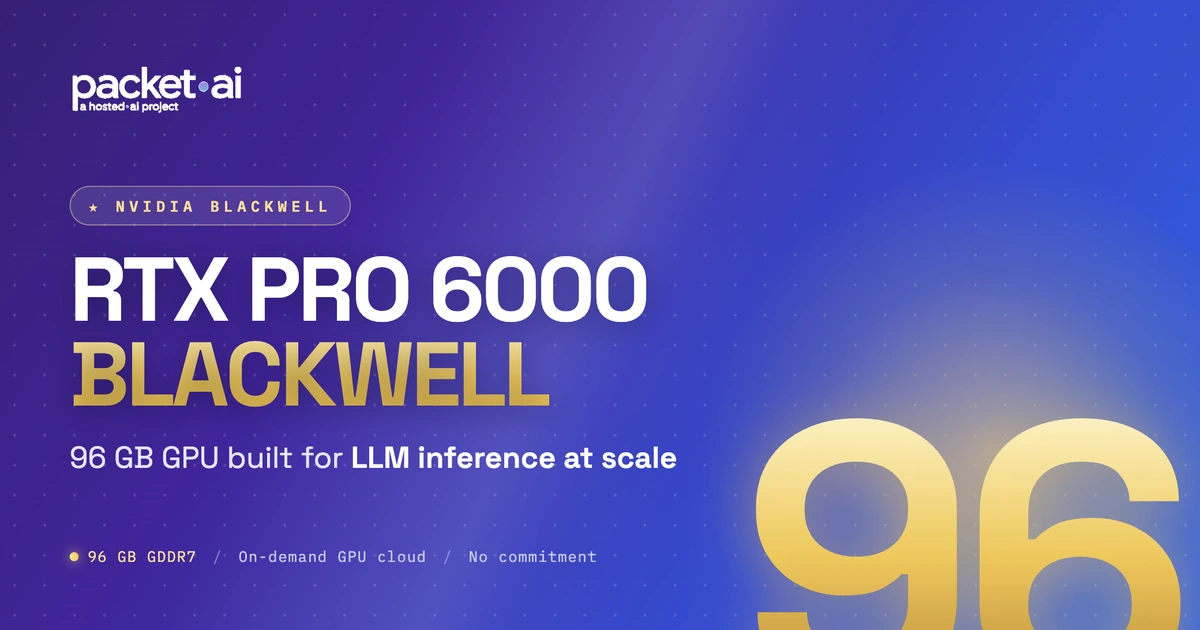
RTX Pro 6000 Blackwell rental on packet.ai starts at $0.66/hr for 96GB of GDDR7 memory, the lowest verified on-demand rate available as of July 2026.
Key takeaways
Prices for the RTX Pro 6000 Blackwell, sometimes listed as the RTX 6000 Pro, have moved in two directions at once. NVIDIA's own hardware price climbed 55% in a year, driven by a GDDR7 memory shortage. Cloud rental rates for the same card have stayed comparatively flat. That gap is why renting has become the default choice for teams that want 96GB of VRAM without a five-figure hardware purchase.
This guide covers current RTX Pro 6000 price data on packet.ai, what the 96GB of memory buys you for LLM inference, and how the card compares to the H100. It sits alongside the B200 GPU cloud pricing guide in packet.ai's GPU pricing series, which covers the rest of the current Blackwell and Hopper lineup.
packet.ai runs the RTX Pro 6000 Blackwell on three plans. Dynamic on-demand starts at $0.66/hr with no minimum commitment, spins up in under 5 minutes, and is the tier confirmed live across packet.ai's own product page, pricing page, and Dynamic GPU page. A monthly plan is also available at a flat $299, with a 99.9% uptime SLA, full root SSH access, and a pre-installed CUDA 12.8 and vLLM stack. A Dedicated (single-tenant) tier is not yet live; packet.ai currently lists it as launching soon, so on-demand and monthly are the two options to deploy today.
Note
Availability by tier changes quickly on any GPU cloud. Confirm the current Dedicated tier status on the RTX Pro 6000 product page before deploying a production workload.
Six other cloud providers list the RTX Pro 6000 at prices ranging from $0.99/hr to $2.41/hr as of July 2026. The table below lines them up against packet.ai's on-demand rate.
At $0.66/hr, packet.ai's on-demand rate runs 33% below Vast.ai's $0.99/hr and 73% below Sesterce's $2.41/hr for the same GPU.
For the full breakdown of GPU rental rates across all models on packet.ai, see the packet.ai GPU pricing page.
Running one RTX Pro 6000 continuously for a 720-hour month costs $299 on packet.ai's flat monthly plan, versus roughly $713 for the same 720 hours at Vast.ai's $0.99/hr on-demand rate. Teams running the card for more than a few hours a day typically come out ahead on the monthly plan rather than on-demand.
NVIDIA's datasheet for the RTX Pro 6000 Blackwell lists 96GB of GDDR7 ECC memory on a 512-bit bus, delivering 1.8 TB/s of bandwidth, alongside 24,064 CUDA cores and 752 5th-generation Tensor Cores with FP4 support. That is nearly double the 48GB the previous-generation RTX 6000 Ada offered, and it changes what fits on one card rather than being simply a bigger number.
Llama 3.3 70B at FP8 precision needs roughly 70GB, which fits on the RTX Pro 6000 with headroom left over for KV cache. The same 70B class of model in 4-bit quantization runs comfortably under 40GB. Qwen 2.5 32B at full FP16 needs about 64GB, also well within budget. Only full FP16 70B models, which need close to 140GB, exceed the card's capacity and require an H200 or B200 instead.
The trade-off is bandwidth and interconnect. The RTX Pro 6000 has no NVLink, so it communicates with other GPUs in the same server over PCIe Gen 5 only. That is enough for running separate inference jobs on each card, but not for the tensor-parallel training that NVLink-equipped GPUs support across multiple GPUs at once.
The RTX Pro 6000 and the H100 SXM solve different problems. The RTX Pro 6000 trades bandwidth and NVLink for more memory at a lower price. The H100 trades memory capacity for bandwidth and multi-GPU scaling.
H100 SXM is not yet live on packet.ai. It is listed at a reference price of $2.50/hr and is currently open for waitlist signup, with dedicated bare-metal H100 nodes available today through wholesale cluster deployments. The RTX Pro 6000 is deployable immediately at $0.66/hr, which makes it the practical starting point for teams that want to begin serving 70B-class models today rather than wait for H100 on-demand access.
For workloads that fit in 96GB and run on a single GPU, the RTX Pro 6000's larger memory pool and lower price make it the better fit. For multi-node distributed training that needs NVLink and higher bandwidth, the H100 remains the correct tool once it is available on-demand.
NVIDIA sells the RTX Pro 6000 Blackwell in three variants that share the same 96GB GDDR7 memory and core counts but differ in cooling and form factor. The Workstation Edition uses active dual-flow-through cooling rated up to 600W, built for single-GPU desktop towers, and is the variant packet.ai runs. The Max-Q Workstation Edition caps power at 300W in a standard dual-slot width for denser workstation builds. The Server Edition uses passive cooling built for multi-GPU rack servers, and effectively replaces the L40S in NVIDIA's data center lineup.
Note
packet.ai deploys the Workstation Edition of the RTX Pro 6000, which matters for teams running software with edition-specific driver or certification requirements.
The distinction rarely changes what you can run. All three variants share the same 96GB of memory, the same CUDA core count, and the same Tensor Core generation. What changes is thermal design and whether the card fits a workstation tower or a multi-GPU server chassis.
A packet.ai RTX Pro 6000 instance ships with CUDA 12.8 and vLLM pre-installed, so serving a model is one command:
vllm serve meta-llama/Llama-3.1-70B-InstructThat single 70B model serves comfortably within the 96GB budget, with room left for batching and longer context windows.
On 30B-class models, a single RTX Pro 6000 delivers approximately 8,400 tokens/sec on Qwen3-Coder-30B AWQ at 400 concurrent requests using vLLM, nearly matching a four-card RTX 4090 setup at 8,900 tokens/sec, according to CloudRift's published LLM inference benchmark (October 2025).
On Llama 3.1 8B at sustained high concurrency, the RTX Pro 6000 reaches approximately 8,990 tokens/sec with vLLM, outperforming both the A100 80GB and H100 on smaller model tiers, according to Databasemart's vLLM benchmark report (January 2026).
For Qwen3-32B served at NVFP4 precision on vLLM, the RTX Pro 6000 delivers roughly 2x the throughput of BF16 with no measurable accuracy loss, cutting first-token latency from approximately 340ms to 150ms, according to Jarvislabs' NVFP4 benchmark (May 2026).
Teams that would rather not manage the inference stack themselves can route the same workload through packet.ai's Token Factory, a managed inference API that runs open models behind an OpenAI-compatible endpoint.
Beyond inference, the 96GB of memory supports LoRA and QLoRA fine-tuning on models up to 70B parameters without sharding across multiple GPUs, and Multi-Instance GPU (MIG) partitioning lets a single card serve several isolated workloads at once. For a deeper look at running multiple LLMs side by side on one Blackwell server, see packet.ai's benchmark post on serving 8 large language models on a single RTX Pro 6000 server.
✓ Right for
✗ Wrong for
Last reviewed: July 14, 2026. Ready to deploy? Rent an RTX Pro 6000 on packet.ai starting at $0.66/hr, or get a wholesale quote for multi-GPU deployments.
Same models. Same API. Fraction of the cost. Start free — no credit card required.
Start Building →