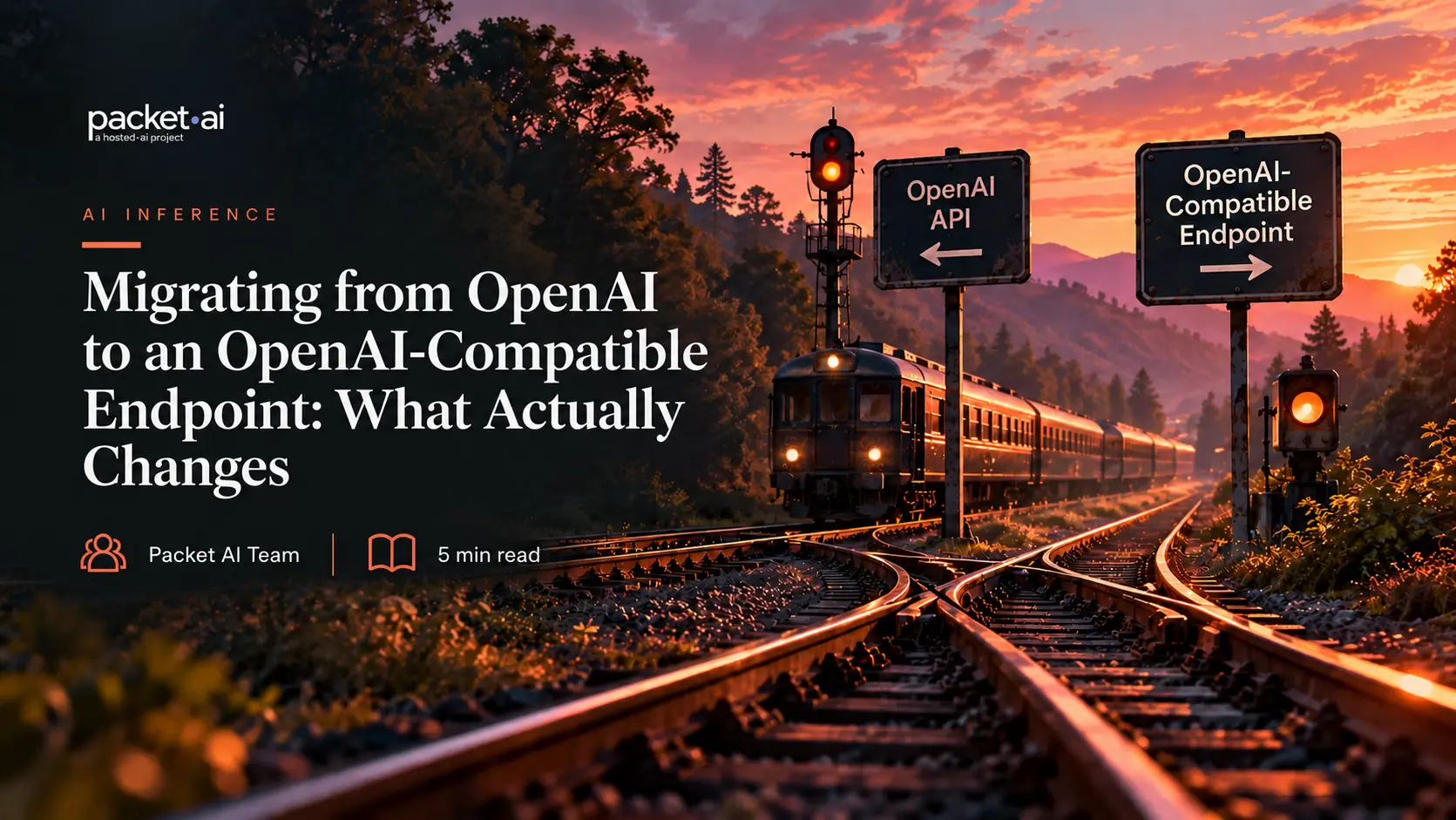

Token Factory is packet.ai's OpenAI-compatible inference API - swap the base URL, get open model inference without managing GPU infrastructure. Here's why we built it and when to use it instead of a raw GPU instance.
Token Factory is packet.ai's OpenAI-compatible inference API - serving Llama 3, DeepSeek, Qwen, and Mistral on the same GPU infrastructure behind packet.ai's compute cloud, billed per token instead of per hour.
Key takeaways
The standard path to open model inference in 2024 was: provision a GPU, SSH in, install vLLM, download the model, figure out the right quantisation for your VRAM budget, write a serving script, handle batching, manage restarts. For teams that just want to call an API and get tokens back, this is too much friction.
Token Factory removes the infrastructure layer entirely. You get an OpenAI-compatible endpoint, a list of supported models, and per-token pricing. The GPU provisioning, model loading, batching, and scaling happen on our end.
We built it on the same GPU infrastructure behind packet.ai's compute cloud because we already had the hardware utilisation problem solved. Dynamic placement means we can run shared inference efficiently - workloads scheduled across a well-utilised fleet, priced at wholesale rates, with per-token billing that does not charge you for idle time.
Token Factory implements the OpenAI Chat Completions and Embeddings API. To switch from OpenAI to Token Factory:
import openai

client = openai.OpenAI(
    api_key="your-packet-ai-api-key",
    base_url="https://api.packet.ai/v1"
)

response = client.chat.completions.create(
    model="llama-3.1-70b-instruct",
    messages=[{"role": "user", "content": "Hello"}]
)
No other code changes required. Streaming works. Function calling works on supported models. The response format is identical to the OpenAI API response format.
Token Factory currently supports:
Model additions are driven by usage patterns and requests. If you need a specific model not listed, email help@packet.ai.
Token Factory bills per token - input tokens and output tokens priced separately, consistent with OpenAI's pricing structure. No minimum spend, no monthly commitment, no idle cost between requests.
Per-token rates for Token Factory are set to be meaningfully below OpenAI's equivalent model pricing for comparable quality. The specific rates are on the packet.ai pricing page and are updated as model availability and infrastructure costs change.
For teams doing high-volume inference - millions of tokens per day - raw GPU instances with vLLM remain more cost-efficient than any API. Token Factory is optimised for teams that want per-token economics without managing the infrastructure to get there.
The two options are complementary, not competing:
Use Token Factory when:
Use raw GPU instances when:
Token Factory runs on vLLM behind the OpenAI-compatible API layer. Continuous batching handles request queuing. The API is stateless - each request is independent, no conversation history is stored server-side. Clients manage conversation state by passing the full message history in each request, consistent with the OpenAI Chat Completions format.
Context window limits match the deployed model's native context length. Output token limits are configurable via the max_tokens parameter. Rate limits are generous and designed for production use cases - contact support if you need higher limits for a specific workload.
Token Factory is in limited access during the current launch period. Sign up at packet.ai, and Token Factory API access is available through the dashboard once your account is approved. The same API key used for GPU instance provisioning works for Token Factory - no separate credentials.
Same models. Same API. Fraction of the cost. Start free — no credit card required.
Start Building →