packet.ai raised $19M to build the scheduling layer that treats GPU compute as a multi-dimensional resource, not a reserved card. Here's what the round is for, who led it, and what we're building.
packet.ai has raised $19M to build software-defined GPU infrastructure - a scheduling and orchestration layer that treats GPU compute as a multi-dimensional resource, not a single reserved card.
Key takeaways
GPU compute is expensive not because the hardware is expensive to run, but because the pricing models GPU clouds use assume static allocation. You rent a GPU, you pay for the whole card, whether your workload uses 40% of it or 100% of it.
This creates a structural problem: most AI workloads are not 100% GPU-bound for their entire duration. Training has data loading steps. Inference has idle time between requests. Fine-tuning has evaluation steps that use a fraction of VRAM. The standard GPU cloud model charges you for peak capacity across all of these phases.
The packet.ai scheduler treats GPU resources as four-dimensional - VRAM, memory bandwidth, SM utilisation, and PCIe throughput - and schedules workloads based on actual consumption across these dimensions. The result is higher fleet utilisation, which means lower per-hour cost, which means lower prices for developers without sacrificing margins.
We have been running this model in production on the hosted-ai infrastructure base since launch, and the data supports the thesis: Dynamic tier workloads run at within 2-5% of Dedicated performance for throughput-oriented tasks, at 30-40% lower price.
The $19M lets us scale the GPU fleet to meet demand and build the infrastructure products that the scheduler enables - Token Factory and Pixel Factory being the first two.
Balderton Capital led the seed. Balderton has backed infrastructure companies across the stack - storage, networking, databases - and understands the pattern of infrastructure commoditisation that GPU compute is following. The thesis is straightforward: the gap between wholesale GPU infrastructure cost and developer-facing GPU cloud pricing is large and will compress. packet.ai is building the layer that compresses it.
hosted-ai participated as a strategic investor. hosted-ai is the infrastructure backbone of packet.ai - the compute facilities, hardware operations, and provisioning agent that the packet.ai scheduler runs on. Having hosted-ai on the cap table aligns incentives on infrastructure expansion and capacity planning.
GPU fleet expansion
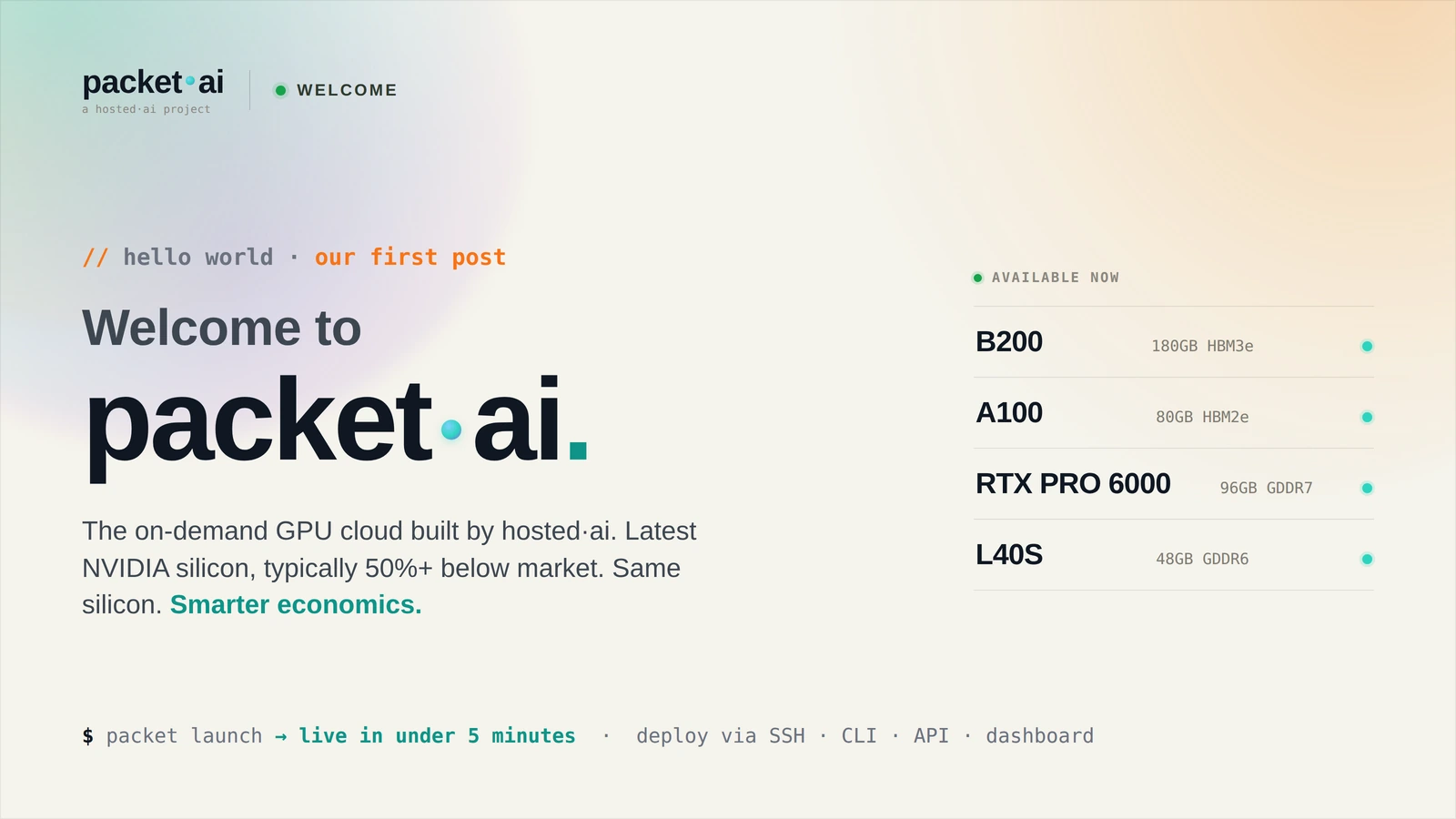
The primary use of capital is adding GPU capacity. The current fleet covers NVIDIA B200, A100, L40S, and RTX 6000 Pro across US East, US West, and EU (Frankfurt, Amsterdam) regions. The expansion plan adds H100 SXM and H200 capacity in US and EU, with additional regions in the pipeline. B200 cluster capacity for multi-node training is the highest-demand addition in the near-term backlog.
Inference API layer
Token Factory and Pixel Factory are the first two products that run on top of the packet.ai GPU layer without requiring developers to provision or manage GPU instances. Token Factory is an OpenAI-compatible inference API - change the base URL, get open model inference. Pixel Factory is an image and video generation API - per-image billing, no GPU management.
Both products are possible because the packet.ai scheduler can run shared workloads efficiently. The Dynamic tier that powers per-token and per-image pricing is the same infrastructure that makes developer-facing GPU rates lower than hyperscaler rates.
Scheduler improvements
The current scheduler handles four-dimensional resource profiling and complementary workload co-location. The next version adds predictive placement - using historical workload fingerprints to anticipate resource demand 30-60 seconds ahead, allowing pre-warming of capacity before it is needed. This reduces cold-start latency on Dynamic tier and improves batch throughput for training workloads with periodic high-VRAM demand spikes.
packet.ai is 14 people. The founding team came from hosted-ai, which means the infrastructure operations experience pre-dates packet.ai - the provisioning agent, operational runbooks, and hardware relationships were in place before we launched.
Engineering is split between the scheduler (3 people), the API layer (3 people), infrastructure tooling (2 people), and the developer-facing product - dashboard, CLI, documentation (3 people). Two people on operations. One on finance and legal.
No enterprise sales team. No SDRs. No outbound. Every tier of packet.ai is available self-serve. The team does not scale headcount by adding layers of account management - it scales by building product that does not require hand-holding to use.
GPU cloud is a competitive market. Being explicit about what packet.ai is not building is useful:
Not building proprietary silicon. NVIDIA is the GPU. packet.ai is the scheduling and orchestration layer on top of it. We are not competing with NVIDIA or building application-specific accelerators.
Not going upmarket to enterprise. The business model is self-serve, transparent pricing, no contracts. Enterprise-specific features (dedicated support SLAs, custom procurement, MSA negotiation) are not the roadmap. Teams that need those things have hyperscalers for a reason.
Not building a marketplace. packet.ai owns and operates its GPU capacity through hosted-ai. It is not an aggregator that rents capacity from third-party providers and marks it up. The supply chain is direct.
Not raising a Series A in 12 months. The $19M is sized to reach profitability on the current growth trajectory before needing additional capital. The plan is to not raise again unless the opportunity warrants a step-change in fleet expansion that outpaces organic revenue growth.
The GPU cloud market has a pricing model problem, not a supply problem. There is enough GPU capacity globally - TSMC is producing H100 and B200 dies at scale, and supply constraints are easing through 2025. The problem is that the dominant pricing model - static allocation at peak capacity - creates waste at the infrastructure level and high prices at the developer level.
The waste is structural: a fleet running at 60% average GPU utilisation through static allocation has 40% of its capacity generating revenue at any given moment. The remaining 40% is reserved but idle. Developers pay for the reserved capacity whether or not they use it.
The packet.ai scheduler addresses this by running the fleet at above 85% utilisation through dynamic placement. The efficiency gain flows through to pricing. The B200 at $3.75/GPU-hr on Dynamic tier is not a promotional rate that expires - it is what the hardware costs to run at 85%+ fleet utilisation, with a margin that sustains the business.
That is the problem we raised to solve at scale.
Same models. Same API. Fraction of the cost. Start free — no credit card required.
Start Building →