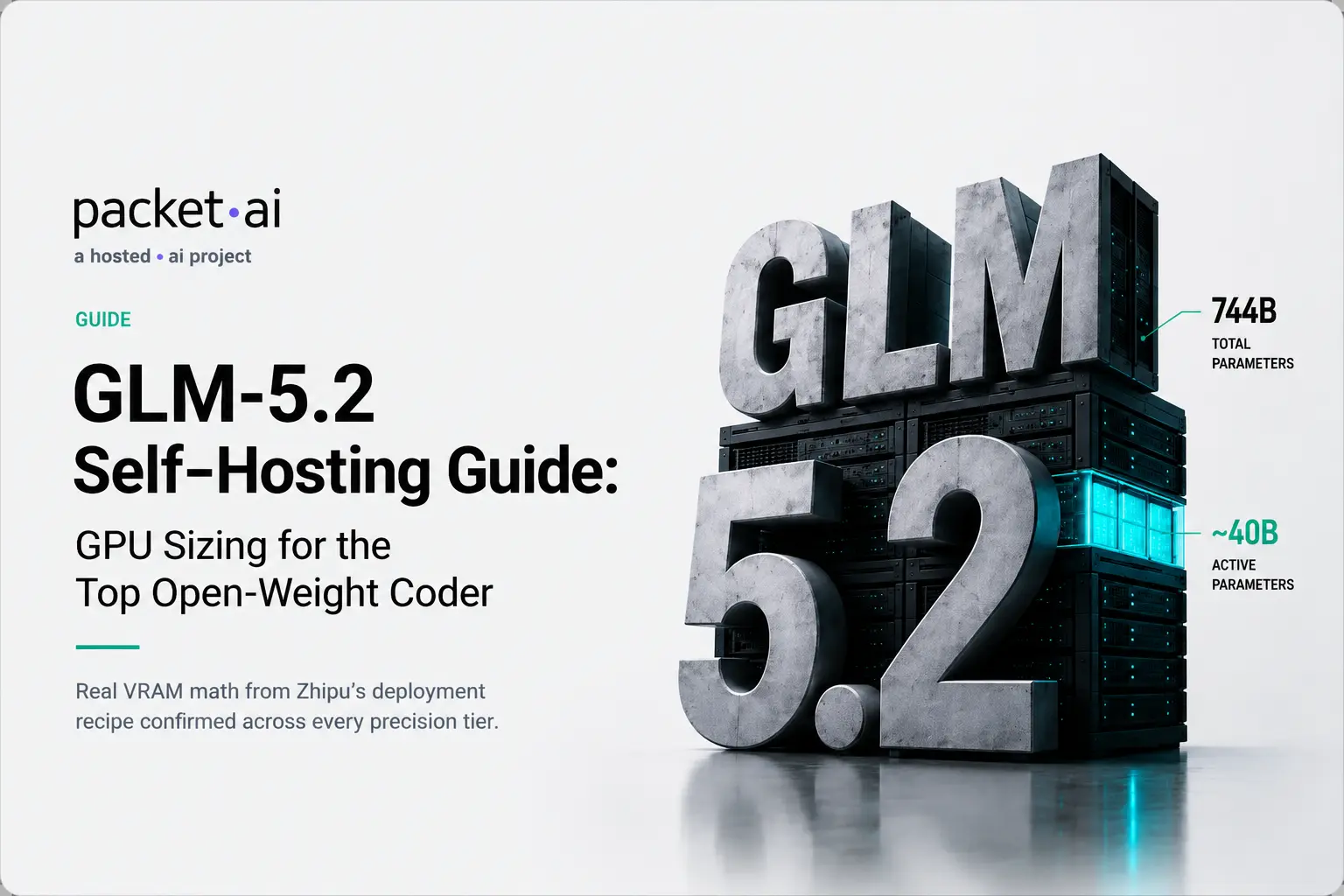
GLM-5.2's 40B active parameters describe speed, not memory. Here's the real VRAM math Zhipu's own deployment recipe confirms, across every precision tier.
GLM-5.2's 40B active parameters describe how fast it generates tokens, not how much VRAM it needs. At FP8, the model needs roughly 744GB, matching Zhipu's own deployment recipe of an 8-GPU node for production serving. The active-parameter count and the actual memory requirement are two very different numbers.
Key takeaways
GLM-5.2 has moved fast from release to genuine adoption: strong coding and agentic benchmark results, an MIT license with no legal review required, and day-one support across major serving frameworks. Sizing hardware for it correctly starts with separating two numbers that get conflated constantly: how many parameters activate per token, and how many parameters have to sit in memory the whole time.
GLM-5.2 is Zhipu AI's (Z.ai's) flagship open-weight model, released June 13, 2026, succeeding GLM-5.1. It's a sparse mixture-of-experts model tuned specifically for coding, multi-step reasoning, and tool-augmented agentic work rather than general chat, with a 1-million-token context window, selectable High and Max reasoning modes, and a full MIT license with no regional restrictions. Early third-party benchmarks have been genuinely competitive: one security research team found GLM-5.2 beating Claude Code on an IDOR vulnerability detection benchmark, and other evaluations have shown it closely tracking frontier closed models on long-horizon planning tasks.
The numbers here are unusually well-documented, since Zhipu publishes an official vLLM deployment recipe alongside the model itself.
Zhipu's own vLLM recipe recommends an 8-GPU node with 141GB+ per card (matching H200-class memory) for single-node FP8 serving, and specifically calls out a larger, higher-memory 8-GPU configuration to reach the full 1M-token context with FP8 KV cache. For a smaller footprint, INT4/AWQ quantization brings GLM-5.2 within reach of an 8x 80GB-class node, a real, meaningful drop in hardware requirements at the cost of some output quality worth testing against your specific use case first.
⚡ Note
vLLM prefers power-of-two tensor-parallel sizes (1, 2, 4, 8). If a sizing guide recommends more GPUs than your memory budget strictly needs, the extra cards are often a parallelism and throughput choice, not a hard VRAM requirement. Size for the memory budget first, then round up to the nearest power of two for clean sharding.
This is the single most common mistake in sizing hardware for GLM-5.2, and it isn't specific to this model, it shows up with every mixture-of-experts release. The ~40B active parameter figure describes how much compute happens per generated token. It says nothing about how much memory the model needs to be loaded at all.
GLM-5.2 routes each token through a subset of its experts, and that routing decision can select different experts on different tokens. All ~744B total parameters have to be addressable in memory regardless of how few activate on any given pass, since the router isn't fixed to the same experts every time. Sizing a deployment around the 40B active figure rather than the ~744B total figure will under-provision by more than an order of magnitude, exactly the failure mode that shows up when people confuse a compute metric for a memory metric.
GLM-5.2's context window is the headline feature, and IndexShare is the mechanism that makes it computationally practical rather than a spec nobody can actually use. IndexShare reuses the same sparse-attention indexer across every four attention layers, rather than computing a fresh index at every layer, cutting per-token FLOPs by 2.9x at a 1M-token context length compared to a naive implementation.
Zhipu also improved the model's multi-token prediction (MTP) layer for speculative decoding, increasing the acceptance length by up to 20%, a separate efficiency gain focused on generation speed rather than context handling. Together these changes are why GLM-5.2 can sustain long-horizon agentic work, the kind that keeps a large context window actively in use across many tool calls, without the compute cost scaling as badly as a standard attention mechanism would at the same context length.
⚠ Watch out
Zhipu's official recipe names H200-class cards (141GB each) as the reference configuration. On packet.ai specifically, H200 is currently listed as coming soon rather than on-demand. B200 (192GB) is the largest currently-bookable card and comfortably exceeds H200's per-card memory, making it a reasonable substitute for the same tensor-parallel configuration the official recipe describes.
Once you've settled on a precision tier, matching it to hardware follows directly from the figures above. INT4/AWQ's ~372GB footprint fits comfortably on 8x A100 80GB, a reasonable entry point if full FP8 precision isn't a requirement for your workload. FP8's ~744GB footprint and the full 1M-context configuration both point toward packet.ai's GPU Clusters, InfiniBand-connected multi-node fabric built for exactly this scale of deployment.
If you'd rather not manage self-hosted inference infrastructure at all, packet.ai's Token Factory, a managed, OpenAI-compatible inference API, is worth checking for current model availability before committing to a self-hosted deployment. Current rates for every GPU tier are on the pricing page.
For sizing other current models before deciding on infrastructure, packet.ai's general VRAM requirements guide covers the same kind of sizing math across the broader model landscape.
Last reviewed: July 30, 2026. VRAM figures cross-referenced across multiple independent sources and Zhipu's official vLLM deployment recipe. GPU availability confirmed against packet.ai's live product pages.
Same models. Same API. Fraction of the cost. Start free — no credit card required.
Start Building →