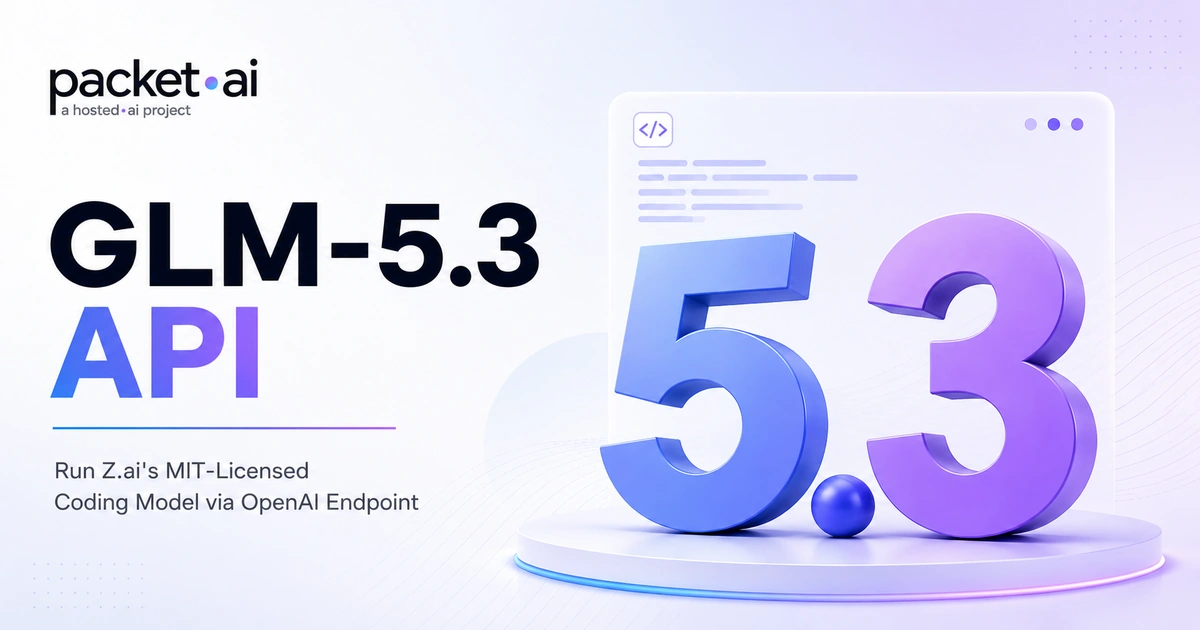
Z.ai shipped GLM-5.3 four days ago. It scores 66.9 on DeepSWE v1.1 and runs on an OpenAI-compatible endpoint you can point at with one line of code. Here is exactly how.
GLM-5.3 launched August 14, 2026 and immediately posted 66.9 on DeepSWE v1.1, the top open-weight coding benchmark score at time of writing. It runs on an OpenAI-compatible endpoint you can point at with two lines of Python.
Key takeaways
Z.ai ships a new GLM-5 roughly every two months. GLM-5.2 dropped June 13 with MIT-licensed weights, a 1M-token context window, and a top-of-open-source SWE-bench Pro score of 62.1. GLM-5.3 landed August 14: same 743B-parameter Mixture-of-Experts base, no new architecture, but a post-training regime that cost tens of thousands of long-horizon compute environments to build.
For solo developers and indie hackers, the pitch is simple: a frontier-class coding model, MIT license, OpenAI-compatible endpoint, and no per-seat subscription required to get started. The only question is where to run it cheaply. That is where packet.ai Token Factory comes in, an OpenAI-compatible inference API for open models launching with per-token pricing from $0.06/1M tokens.
GLM-5.3 is not a new model in the traditional sense. Z.ai kept the same 743B-parameter MoE architecture that shipped with GLM-5.2 (40B active parameters per forward pass, IndexShare routing). The gains come entirely from scaling post-training: more executable environments, longer task horizons, harder verification criteria, and more reinforcement-learning compute.
Terminal-Bench 3.0 is the clearest signal. It rose from 4.6% on GLM-5.2 to 28.3% on GLM-5.3, the largest single-metric jump in Z.ai's launch table. That benchmark specifically tests sustained, tool-using, terminal-native workflows rather than one-shot code generation. If your agent loop involves multi-step bash, file edits, and compiler feedback, this is the number that matters.
Z.ai also reports that average output fell from roughly 96,000 to 75,000 tokens per task at Max effort, a 22% efficiency gain on top of the quality improvement. More correct in fewer tokens means lower inference cost per task, not just per token.
Note on benchmarks
All launch-day figures above are from Z.ai-run evaluations, not independent third-party reproductions. Treat them as strong directional signals, not settled rankings. Independent harnesses typically arrive within two to four weeks of a major model release.
GLM-5.3 is available today through two routes: Z.ai's GLM Coding Plan (subscription-based, targeting agentic coding tools) and third-party inference providers. The general per-token API from Z.ai is not yet live. Pricing has not been published as of August 18, 2026.
Both the Z.ai Coding Plan endpoint and any vLLM self-hosted deployment expose the same /v1/chat/completions format as the OpenAI API. Change one string in your existing code:
For teams already using the OpenAI SDK, LangChain, LlamaIndex, or any other OpenAI-compatible toolchain, no further changes are needed. The model string and base URL are the only migration. Function calling, streaming, and structured output all work on the same interface.
When the general API goes live, the model ID will be glm-5.3. The same model string works on a self-hosted vLLM deployment once the weights ship around August 28.
The open-weight coding API market in August 2026 has three credible options at the frontier tier. Here is what the numbers actually say, with no vendor spin:
GLM-5.3 and Kimi K3 benchmarks from Z.ai and Moonshot AI launch materials respectively. GLM-5.3 per-token pricing not yet published by Z.ai. GLM-5.2 pricing from provider data (not confirmed for 5.3). DeepSWE v1.1 via Z.ai-run evaluation.
On raw coding benchmark numbers, GLM-5.3 and Kimi K3 are within one point on DeepSWE v1.1. The gap opens on Terminal-Bench 3.0, where GLM-5.3 (28.3%) nearly doubles Kimi K3 (17.4%), a meaningful difference for terminal-native agentic workflows. On cost, Kimi K3 at $15/1M output tokens is expensive for any high-volume solo-dev workload. GLM-5.3 pricing is not published yet, but GLM-5.2's precedent ($4.40/1M output) and the Token Factory launch pricing from $0.06/1M suggest the gap to Kimi K3 will be substantial.
For developers running the Kimi K3 API today and spending more than $50/month on output tokens, the math warrants a GLM-5.3 test once pricing lands. See the AI token cost guide on packet.ai for the workload math behind that threshold.
GLM-5.3 carries an MIT license. Z.ai has confirmed this, following the same pattern as GLM-5.2. The open weights are delayed roughly two weeks from the August 14 launch date, expected around August 28, because post-training produced emergent offensive cybersecurity capabilities Z.ai says it did not plan for.
Specifically: GLM-5.3 scored 84.5% on CyberGym and discovered 1,097 critical vulnerabilities across Linux, WebKit, and FreeBSD during evaluation. Z.ai runs a security hardening process before releasing the weights publicly under an MIT license (which permits commercial use, modification, and redistribution with no restrictions above attribution).
For solo developers, the MIT license matters on two levels. First: you can self-host once the weights land, on your own GPU, with no per-token billing and no rate limits. Second: you can fine-tune, quantize, and redistribute derivative works commercially. No gated access, no enterprise agreement required.
Note
Self-hosting GLM-5.3 requires significant hardware. At 743B parameters, a standard BF16 deployment needs roughly 8 H100s or equivalent. At INT4 quantization, you can get it down to 2 to 4 high-VRAM cards. Until weights ship and the community maps the minimum viable serving config, hosted inference via an API like Token Factory is the lowest-friction path for most solo developers.
packet.ai Token Factory is an OpenAI-compatible inference API for open models. You point your existing SDK at a new base URL, swap the API key, and the GPU infrastructure disappears into the background. No cold starts, no provisioning, scale-to-zero billing so idle traffic costs nothing.
Token Factory launch pricing starts at $0.06/1M tokens, verified on packet.ai/token-factory. That is more than 200x cheaper per token than Kimi K3's output rate, and roughly 70x below the reference GLM-5.2 output rate on third-party providers. The current model catalog includes Llama 3.3, Qwen 2.5, DeepSeek-V3, and Mistral. GLM-5.3 is not yet in the catalog. Join the waitlist and you will be notified when it is added.
$0.06
per 1M tokens. Token Factory launch pricing on packet.ai
vs $15.00/1M output on Kimi K3. Source: packet.ai/token-factory, verified August 2026.
Token Factory is in private preview. Join the waitlist and your API key arrives as access opens, with launch-pricing credits included. For context on how Token Factory fits the broader open-model inference cost picture, the Kimi K3 API guide covers the same OpenAI-compatible workflow for a comparable model.
Token Factory launch pricing from $0.06/1M tokens is the lowest published rate for open-model inference in this tier. Here is what a realistic solo-developer coding workflow costs at that rate compared to the alternatives:
Token Factory at $0.06/1M tokens (launch pricing, packet.ai/token-factory, August 2026). Kimi K3 at $15.00/1M output (Moonshot AI official). GLM-5.2 at $4.40/1M output (reference rate from third-party providers, not confirmed for GLM-5.3). Output token estimates assume typical agentic coding ratio of 80% output / 20% input.
At Token Factory launch pricing, a solo developer running a moderately active agentic coding workflow pays under $3/month. The same workload on Kimi K3 runs $600. For indie hackers and solo SaaS builders, that is not a rounding error.
For teams making infrastructure and hardware decisions, the spec sheet matters. GLM-5.3 inherits the GLM-5.2 architecture with no structural changes:
One spec worth flagging for cost-sensitive developers: thinking cannot be disabled on GLM-5.3. GLM-5.2 had a thinking-off mode that made short, high-volume tasks (classification, routing, extraction) much cheaper. On GLM-5.3, Low is the floor. If your workload involves many small calls, say a code-review bot that classifies 10,000 diffs per day, factor that into the total token budget before switching from 5.2.
Use GLM-5.3 now if...
Wait until August 28 if...
Last reviewed: August 19, 2026. GLM-5.3 is actively evolving. Pricing, weights availability, and third-party benchmark scores will change in the coming weeks. For open-model inference at the lowest per-token rates, join the Token Factory waitlist and we will notify you as new models are added to the catalog.
Same models. Same API. Fraction of the cost. Start free — no credit card required.
Start Building →