
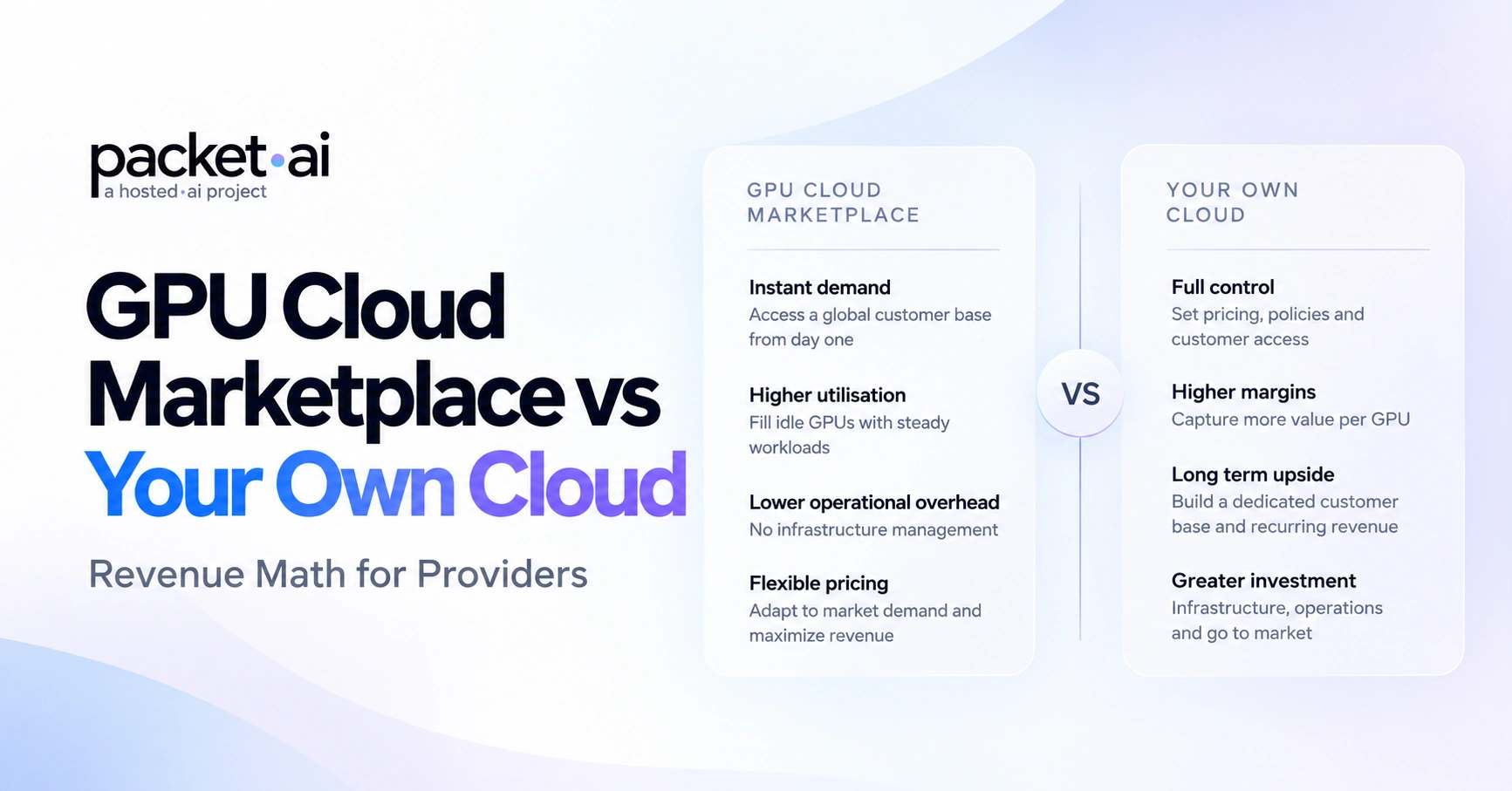
Build a GPU cloud or list on a marketplace? The answer depends on fleet size, overhead and who fills your idle hours. Here is the neutral revenue math.
Building a GPU cloud business or listing on a GPU cloud marketplace comes down to fleet size: in a neutral model at B200 pricing, an own cloud with $60,000 a month of overhead only out-earns a 20% marketplace fee above about 184 GPUs, and only if it keeps them as busy.
Key takeaways
Every neocloud operator, hosting company, and GPU owner with spare capacity reaches the same fork. You can build a GPU cloud under your own brand, or list the hardware on a GPU cloud marketplace and let it sell your capacity. Both paths monetize idle GPUs. Most comparisons stop at the marketplace fee. The fee is rarely the number that decides it.
The GPU cloud market is larger and more fragmented than the headline names suggest. ViaBandwidth's July 2026 State of GPU Cloud report indexes 588 GPU operators across 48 countries, of which 53 are GPU marketplaces and 375 run their own infrastructure. Both categories are growing, and they are not mutually exclusive.
Below, both paths go through one neutral cost and time model, with every assumption listed so you can swap in your own. For the full stack walkthrough, start with our guide on how to become a GPU cloud provider. This post is about which path pays.
An own cloud costs more before the first dollar and keeps more of each hour once the GPUs are busy. A marketplace costs a share of every hour but starts earning in days. Hardware capex is identical on both paths, because you buy the same GPUs either way.
An own GPU cloud, or GPU-as-a-Service (GPUaaS) business, is a software and services layer wrapped around hardware you already own. The GPUs are the easy part. What you add is everything a renter touches between signing up and paying the invoice. The goal is to sell GPU compute on your own SLA, your own rate card, and your own brand.
Model it this way
Treat the own-cloud path as a fixed monthly overhead that exists whether your GPUs are busy or idle. Most of it is people, not licenses.
A marketplace sells your capacity under its brand and keeps a share of each billed hour. In exchange it brings the renters, runs billing and collections, and handles first-line support.
On packet.ai, the GPU provider program covers customer acquisition, billing, 24/7 tier-1 and tier-2 support, and provisioning through a lightweight agent. You keep full root, BMC and physical access to your servers, and packet.ai escalates to you only for hardware incidents such as a failed node. Eligible GPUs run from RTX 4090 up to B200, including H100, H200 and A100 80GB, and must sit in a real datacenter with 1 Gbps+ networking and redundant power.
The cost is the spread between what renters pay and what you receive. Vast.ai says its live renter prices typically run about 25% above what hosts earn, so hosts keep roughly 80% of the renter price. packet.ai shares tier-based rate cards by GPU SKU during onboarding and states that providers earn the majority of customer-billed revenue after platform fees.
What you give up is the customer relationship, your name on the invoice, and some or all control over price. For many fleets that trade is fine. For a telco that already sells GPU compute to enterprise accounts, building under your own brand is usually the better business.
Marketplace fits if
Own cloud fits if
Utilization moves revenue more than fees do. On an own cloud, every unsold hour is your problem. On a GPU cloud marketplace, demand is pooled across many renters, but nobody guarantees it. ViaBandwidth's July 2026 State of GPU Cloud report finds only 157 of 588 indexed GPU operators are network-verified direct operators running their own metal on their own networks. The remaining 431, or 73%, sell compute that physically sits somewhere else. That 73% is the natural marketplace segment.
On a B200 billed at $3.75 per GPU-hour, each 10 points of utilization is worth about $274 per GPU per month.
A 20% marketplace fee costs the same as about 12 points of utilization: an own cloud running at 58% earns what a marketplace listing earns at 70%, before any own-cloud overhead.
Monthly net revenue per B200 before own-cloud fixed overhead
USD per GPU per month. Model inputs: $3.75/GPU-hr, 730 hours, 20% marketplace share, 3% card processing on own cloud.
Source: packet.ai neutral model, October 2026. Price from the packet.ai B200 Dynamic rate card.
Large own clouds manage this risk with contracts. CoreWeave's 2025 annual report (Form 10-K) says customers generally buy capacity on multi-year take-or-pay contracts, with a weighted-average duration of about five years as of December 31, 2025, and that it finances infrastructure with debt backed by those contracts. By June 2026, CoreWeave's revenue backlog had reached $104 billion, per its Q2 2026 earnings release. Smaller operators can copy the idea at a smaller scale. Certainty has a price, though: packet.ai's own GPU rate card gives monthly commits up to 20% off the hourly rate.
The first months are where own clouds lose the most. Utilization is zero on launch day and climbs only as fast as your team closes deals, while overhead starts on day one. If you want the per-SKU version of this math, see what an H100 or B200 can earn per month.
An own cloud out-earns a marketplace listing once the fleet is large enough to cover fixed overhead. In this model that point is about 184 GPUs at $60,000 a month of overhead, 92 GPUs at $30,000, and 368 GPUs at $120,000.
With $60,000 a month of fixed overhead, own-cloud revenue only overtakes a 20% marketplace share at about 184 GPUs, assuming both paths hold 70% utilization.
The tree below applies the model to two kinds of operator. If you already sell cloud or hosting, your billing, support and sales exist, so your extra overhead is lower and the break-even point drops. GPU owners with no cloud carry the full overhead.
Do you already sell cloud, hosting or telco services to paying customers?
|
+-- No (GPU owner or new neocloud)
|     +-- Under 128 GPUs ...... list on a GPU marketplace
|     +-- 128 to 512 GPUs ..... marketplace now, build a sales motion, re-run the model at 6 months
|     +-- Over 512 GPUs ....... buy a GPUaaS platform, sell contracts, send unsold hours to a marketplace
|
+-- Yes (telco, CSP or hosting company)
      +-- Under 64 GPUs ....... marketplace; overhead still outweighs the margin
      +-- 64 to 256 GPUs ...... own cloud on a bought GPUaaS platform, if billing and support already exist
+-- Over 256 GPUs ....... own cloud, with a marketplace as a second demand channelYou don't have to pick once. The hybrid route lists capacity on a GPU cloud marketplace while your own cloud is built, then moves GPUs to your own brand as your demand grows.
A 64-GPU B200 fleet that waits eight weeks for a platform build forgoes about $226,000 of gross revenue at $3.75 per GPU-hour and 70% utilization.
Even after a 20% marketplace share, listing during the build keeps about $181,000 of that. Two conditions make the hybrid route work. The marketplace must let you take capacity back: packet.ai has no minimums or long-term contracts and asks for 14 days of notice only when a node is occupied, with no financial penalty. Your own platform must also handle pooled supply; hosted.ai, for example, lets operators sell nodes through its GPU Mesh network while also selling direct.
Note
Check each marketplace's terms before you list the same nodes in two places at once. Withdrawal notice periods and exclusivity rules differ between platforms.
If you own GPUs but have no cloud today, our guide to renting out your GPU in 2026 covers the listing options. If you are already a provider wondering which idle hours to sell into a marketplace, see our GPU monetization guide for providers. To size your own fleet, run your numbers through the GPU cost calculator.
Last reviewed: October 14, 2026. Prices checked against the packet.ai rate card on the same date. Not sure which path fits your fleet? Get a recommendation from the packet.ai provider team.
Same models. Same API. Fraction of the cost. Start free — no credit card required.
Start Building →