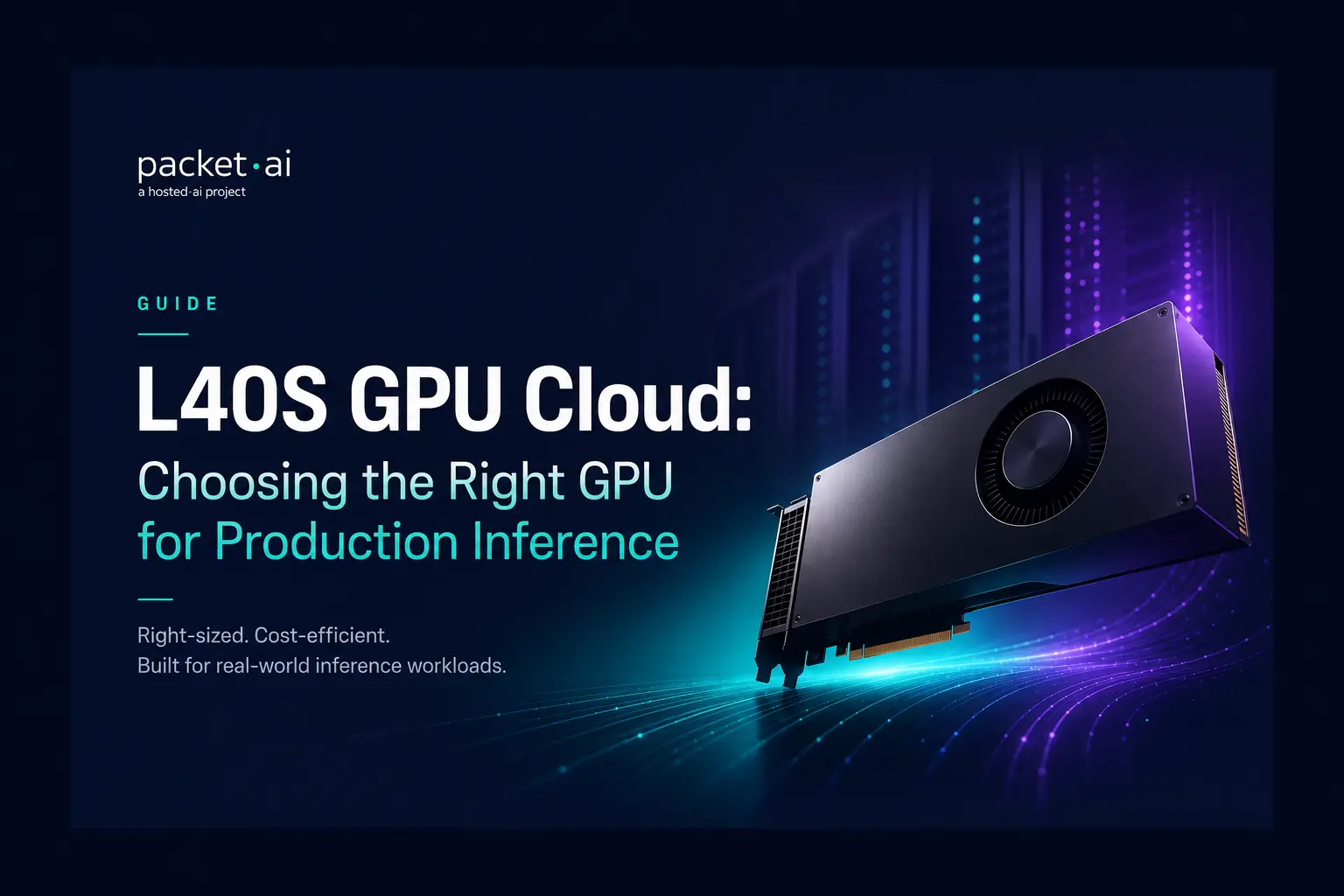
Most GPU comparisons start with the biggest card and work backward to justify it. L40S starts with what inference actually needs, and prices infrastructure accordingly.
L40S is priced at $0.92/GPU-hour on packet.ai because its specs match what most production inference actually needs: 48GB of VRAM and FP8 Tensor Cores tuned for token generation, without paying for multi-GPU interconnects or partitioning most single-model deployments never use.
Key takeaways
The usual way to shop for an inference GPU is to start with the biggest card and work backward to justify the cost. A more useful starting point is the workload itself: what precision you're serving at, how large the model is, and whether you need multi-GPU coordination at all. L40S is built around the answer most inference teams actually have to those questions.
L40S runs on the Ada Lovelace architecture, the same generation as the RTX 4090, but built as a data-center card: no GeForce driver license restriction, passive cooling for dense rack deployment, and ECC-backed GDDR6 rather than consumer memory.
On packet.ai, L40S runs $0.92/GPU-hour Dedicated or $604/month flat, provisioning in under 5 minutes with a 99.99% SLA. The price reflects a focused spec sheet: enough memory and inference-tuned compute for single-model serving, without the multi-GPU interconnect hardware that a training-oriented card carries.
The FP32 TFLOPS number on a spec sheet is usually the first thing people compare, and it's the wrong number for inference. L40S's 4th-generation Tensor Cores support FP8 with sparsity, which is the precision most production inference serving actually runs at, and it's where the card's real throughput advantage shows up.
For teams running vLLM, TensorRT-LLM, or Hugging Face TGI, this translates directly into token generation speed. L40S's 48GB comfortably serves 7B-13B models with room for reasonable batch sizes and KV cache, and stretches to 34B at 4-bit quantization with a tighter memory budget. NVIDIA's own Triton Inference Server also runs well on L40S, useful if you're standardizing serving infrastructure across model types rather than committing to a single framework.
⚡ Note
48GB comfortably covers the model sizes most inference deployments actually run. 70B+ models or full FP16 precision at scale genuinely need more memory, which is where a larger card earns its place, not as an upgrade path from L40S by default.
L40S and A100 solve different problems, and the price gap between them reflects real hardware differences rather than one card simply being a discount version of the other.
The 48GB vs 80GB gap matters less than it looks for pure inference, since L40S already covers 13B models at FP16 natively and 34B at 4-bit, the large majority of production deployments. Where A100 earns its premium is NVLink for multi-GPU training and MIG for splitting one card across multiple tenants or models, both genuinely valuable, just not for a single-model inference workload.
NVLink and MIG aren't free. They're part of why A100 costs more, and they only pay off if your workload actually uses them.
If your deployment doesn't need either, L40S delivers the same core inference capability at a lower price, not because it's missing something you wanted, but because it was designed without paying for capability the workload wouldn't use. If you're fine-tuning with multi-GPU gradient synchronization or serving multiple tenants off one card, A100's premium is the right tradeoff, and L40S would be the wrong choice regardless of price.
Once you've confirmed your model fits in 48GB and your workload doesn't need NVLink or MIG, deployment is straightforward. L40S provisions in under 5 minutes on the Dedicated tier, with a 99.99% SLA and single-tenant isolation, no scheduler contention from other workloads competing for the same card.
Both hourly and monthly billing are available. The hourly rate makes sense for testing or short-lived workloads; the monthly flat rate saves roughly 35% over hourly once you know you'll be running the card consistently, worth calculating before committing to either.
For teams running Hugging Face models specifically, the same one-click TGI app template covered in our Llama GPU sizing guide deploys cleanly on L40S for any model that fits the 48GB budget. If you're sizing a model outside that guide, packet.ai's general VRAM requirements guide maps most current models to the right card, L40S included. Current rates for L40S, A100, and every other GPU on packet.ai are on the pricing page.
If you're running ComfyUI or an LLM tool like oobabooga or Ollama rather than a dedicated inference server, L40S's 48GB applies the same way, since VRAM constraints don't change based on which tool loads the model.
Last reviewed: July 21, 2026. Pricing and availability confirmed directly against packet.ai's live GPU pages at time of writing. Rates and stock status change frequently.
Same models. Same API. Fraction of the cost. Start free — no credit card required.
Start Building →