
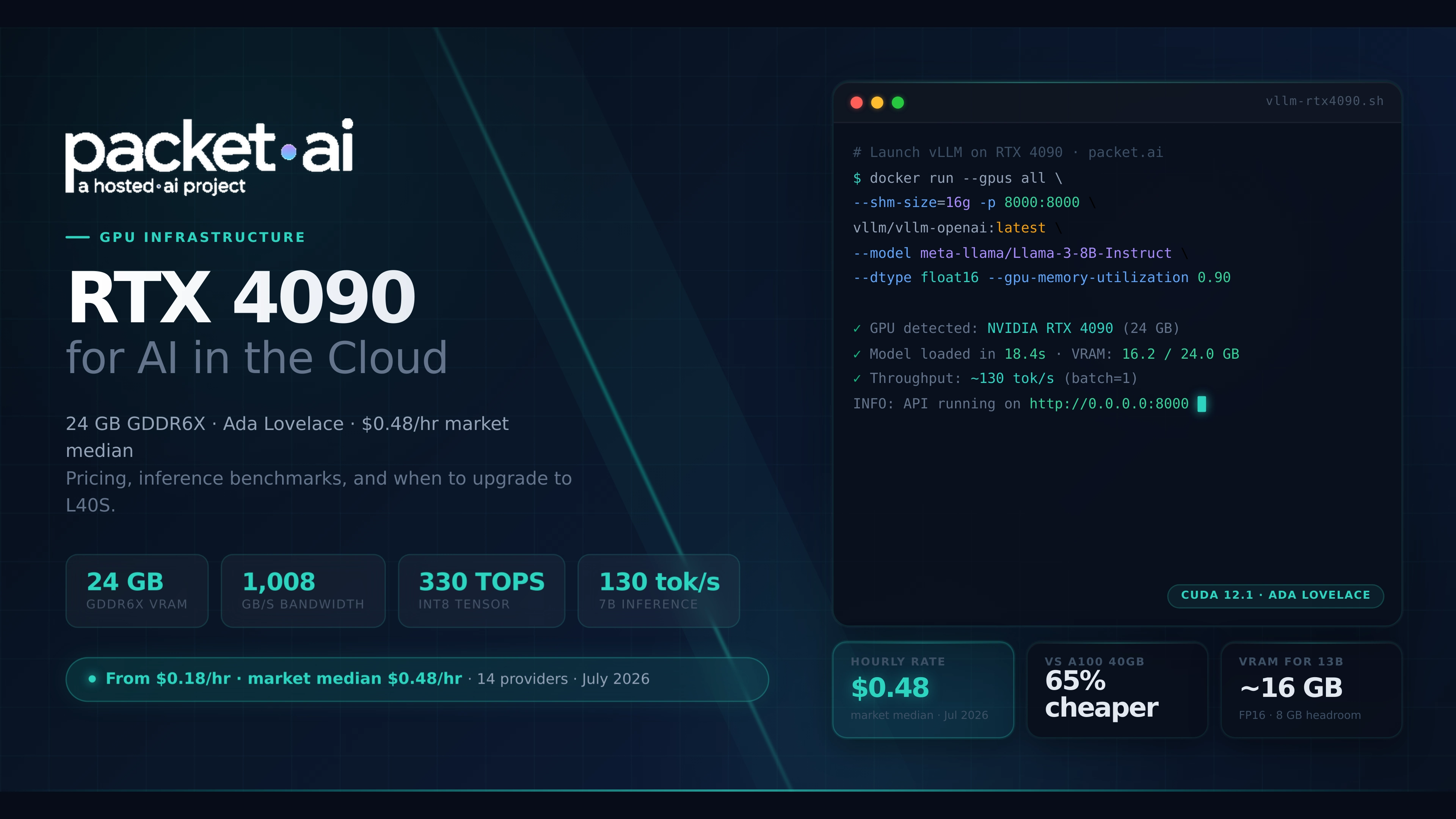
24 GB GDDR6X, Ada Lovelace, from $0.39/hr on packet.ai. The RTX 4090 is the cheapest capable GPU for AI. Here is exactly what it runs, what it cannot, and when to upgrade.
The RTX 4090 rents for a market median of $0.48/hr in 2026, making it the cheapest capable GPU for 7B-13B LLM inference, QLoRA fine-tuning up to 20B parameters, and Stable Diffusion image generation, as long as your workload stays inside 24 GB of VRAM and below roughly 8 concurrent requests.
Key takeaways
The RTX 4090 is the GPU engineers reach for when they want real AI workloads without data-center prices. 24 GB of GDDR6X, Ada Lovelace Tensor Cores, and a market rental price that undercuts an A100 80GB by 65-70%. What it trades away: ECC memory, NVLink interconnect, and the raw bandwidth ceiling that batch inference demands. This guide covers exact numbers on all of it: specs, cloud pricing, inference benchmarks, fine-tuning limits, framework compatibility, and the precise moment to upgrade.
If you are still sizing GPUs for model fit before committing, the packet.ai VRAM requirements guide maps every major model to a GPU and hourly price. For the inference server layer, the vLLM Docker deployment guide covers setup on any NVIDIA GPU including the RTX 4090.
The RTX 4090 is the fastest consumer GPU NVIDIA has built, launched October 2022 on a TSMC 4nm process with the Ada Lovelace architecture. For AI workloads in 2026, its 24 GB GDDR6X covers most 7B-13B inference use cases at FP16 without quantization, a threshold most competitors cannot match at this price point.
GDDR6X delivers 1,008 GB/s per the NVIDIA RTX 4090 specs page, about half the 2,000 GB/s on an A100 80GB with HBM2e. For single-sequence inference this gap is invisible. For batched inference with 8+ concurrent users, the bandwidth limit caps throughput before compute is ever saturated.
Two features absent from the RTX 4090 that matter in production: NVLink (so PCIe multi-GPU at 64 GB/s is the only option) and ECC memory (so silent bit errors are possible on long training runs). The Ada Lovelace architecture does support CUDA 8.9 and all fourth-generation Tensor Core operations, meaning it is fully compatible with PyTorch 2.x, TensorFlow 2.x, JAX, vLLM, and the Hugging Face Transformers library, just without the data-center reliability layer.
| Framework / Tool | RTX 4090 support | Min CUDA version | Notes |
|---|---|---|---|
| PyTorch 2.x | Full | CUDA 11.8+ | Compute cap 8.9 |
| TensorFlow 2.x | Full | CUDA 11.8+ | cuDNN 8.6+ required |
| JAX | Full | CUDA 12.1+ | XLA JIT compatible |
| vLLM | Full | CUDA 12.1+ | Compute cap 7.0+ required |
| Hugging Face Transformers | Full | CUDA 11.8+ | BitsAndBytes 4-bit supported |
| ComfyUI / AUTOMATIC1111 | Full | CUDA 11.7+ | xFormers attention supported |
| Flash Attention 2 | Full | CUDA 11.6+ | Ada Lovelace native support |
| FP8 inference | Partial | CUDA 12.0+ | Ada supports FP8 via Transformer Engine; full FP8 path needs H100+ |
| Docker + Kubernetes (NVIDIA Container Toolkit) | Full | CUDA 11.7+ | --gpus all flag; nvidia.com/gpu resource in pod specs |
RTX 4090 cloud GPU pricing ranges from $0.18/hr on decentralized consumer marketplaces to $1.61/hr on managed, SLA-backed instances, with a verified market median of $0.48/hr across 14 providers as of July 2026. packet.ai rents the RTX 4090 from $0.39/hr on dedicated, single-tenant instances. At 720 hours per month, continuous compute costs $130-$1,160 depending on provider type and availability tier.
RTX 4090 vs comparable cloud GPUs, on-demand per hour, July 2026
| Provider | RTX 4090 price/hr | Type | Uptime SLA |
|---|---|---|---|
| Salad | from $0.18/hr | Decentralized | Variable |
| Vast.ai | from $0.33/hr | Marketplace | Variable |
| RunPod | from $0.34/hr | Community / Secure | Moderate |
| packet.ai | from $0.39/hr | Dedicated | High |
| Beam.ai | from $1.61/hr | Managed | High |
The RTX 4090 is the cheapest training-class card on the GPU price index at a $0.48/hr market median, verified by the AI Multiple GPU Price Index, updated 16 July 2026. packet.ai's dedicated RTX 4090 instances at $0.39/hr sit below that median with single-tenant reliability. The key structural risk at the low end: decentralized marketplace hosts can go offline mid-job with no compensation. For fine-tuning runs over 2 hours or batch inference pipelines, the $0.18/hr entry price stops being cheap the moment a run gets interrupted and restarts from checkpoint.
The RTX 5090 launched in early 2025 with 32 GB GDDR7 and rents from Launching Soon on packet.ai. For LLM inference where both cards fit the model, the RTX 5090 offers roughly 30-40% higher throughput at similar batch sizes due to improved memory bandwidth (1,792 GB/s vs 1,008 GB/s). For image generation workloads, the gain is smaller at 10-20%. The RTX 4090 remains the value pick for teams already running 7B-13B inference at low concurrency: the RTX 5090 makes sense when 24 GB is tight and the extra 8 GB avoids quantization trade-offs.
At batch size 1, the RTX 4090 produces 120-140 tokens/second on a 7B model, matching or slightly exceeding the A100 40GB. The gap opens at batch size 8+ when HBM2e's 2,000 GB/s bandwidth lets the A100 sustain concurrency the GDDR6X-backed 4090 cannot. At batch 32, the A100 80GB delivers roughly 2.5 times more throughput on the same 7B model.
| Metric | RTX 4090 | A100 80GB | L40S 48GB |
|---|---|---|---|
| VRAM | 24 GB GDDR6X | 80 GB HBM2e | 48 GB GDDR6 |
| Memory bandwidth | 1,008 GB/s | 2,000 GB/s | 864 GB/s |
| 7B inference, batch 1 (tok/s) | ~130 | ~120 | ~110 |
| 7B inference, batch 32 (tok/s) | ~700 | ~1,800 | ~1,400 |
| Largest model (FP16) | ~12B | ~40B | ~24B |
| 70B at Q4_K_M | No (~40 GB) | Yes | Yes |
| ECC memory | No | Yes | Yes |
| NVLink | No | SXM only | No |
| packet.ai price | from $0.39/hr | from $1.43/hr | from $0.92/hr |
Throughput figures are community benchmarks from vLLM runs at batch=32. Individual results vary by quantization, context length, and concurrent request distribution. Run python -m vllm.entrypoints.benchmark_throughput against your specific model before capacity planning.
The A100 80GB delivers roughly 2.5 times more throughput than the RTX 4090 at batch 32 on 7B inference. For a production API serving 20 concurrent users, that means the A100 handles the load that would require three RTX 4090s, at a total cost that is lower.
At batch size 8: three RTX 4090s at $0.39/hr cost ~$1.17/hr and deliver ~2,100 tok/s. One A100 80GB costs $1.43/hr and delivers ~900 tok/s. Below batch 8, RTX 4090s win on throughput-per-dollar. Above batch 8, A100 wins by a widening margin as its bandwidth advantage compounds. The cross-over happens between batch 8 and batch 16, the exact point where most production chat APIs sit under moderate load.
For teams evaluating the managed inference path: the packet.ai Token Factory serves LLM inference at a flat rate, eliminating GPU management overhead entirely while staying below OpenAI's ~$15/M token rate.
Image generation is the RTX 4090's strongest use case relative to its rental price. Diffusion models are single-image memory-bound, not batch-throughput-bound, so the RTX 4090's high clock speed and 24 GB VRAM give it a practical advantage over the A100 on standard tasks. See the full GPU guide for ComfyUI for a full pipeline breakdown.
| Model / Pipeline | Resolution | RTX 4090 | A100 40GB | Fits 24 GB? |
|---|---|---|---|---|
| SDXL 1.0 (xFormers) | 1024x1024 | ~4.5 img/s | ~4.0 img/s | Yes (~7 GB) |
| SDXL 1.0 + HiRes Fix | 2048x2048 | ~0.5 img/s | ~0.5 img/s | Yes (tile VAE) |
| Flux.1-dev (FP16) | 1024x1024 | ~8 sec/img | ~10 sec/img | Yes (~20 GB) |
| Flux.1-schnell (FP16) | 1024x1024 | ~2 sec/img | ~2.5 sec/img | Yes (~16 GB) |
| AnimateDiff (16 frames) | 512x512 | ~25 sec | ~28 sec | Yes (~18 GB) |
| ComfyUI + ControlNet + LoRA stacked | 1024x1024 | ~3 img/s | ~3 img/s | Tight (~22 GB) |
Image generation speed figures are community benchmarks from ComfyUI and AUTOMATIC1111 forums as of Q2 2026. Results vary with scheduler, sampler steps, and VAE precision. For multi-controlnet stacks at 2K resolution or video diffusion with 32+ frames, the L40S 48 GB on packet.ai is the direct upgrade at $0.92/hr.
The RTX 4090 handles QLoRA fine-tuning up to 20B parameters within its 24 GB budget. A 13B model fine-tune with QLoRA (4-bit quantization + LoRA adapters) uses roughly 14-16 GB of VRAM at batch size 4, leaving 8-10 GB of headroom. At $0.39/hr on packet.ai, a 10-hour fine-tuning run on a 13B model costs $3.90.
| Fine-tuning task | VRAM needed | RTX 4090 (24 GB) | A100 80GB |
|---|---|---|---|
| QLoRA 7B (4-bit, batch 8) | ~6 GB | Yes | Yes |
| QLoRA 13B (4-bit, batch 4) | ~14 GB | Yes | Yes |
| QLoRA 20B (4-bit, batch 2) | ~22 GB | Yes (tight) | Yes |
| QLoRA 34B (4-bit) | ~38 GB | No (OOM) | Yes |
| Full FP16 fine-tune 7B | ~60 GB | No (OOM) | Yes |
| QLoRA 70B (4-bit) | ~40 GB | No (OOM) | Yes |
The practical ceiling is QLoRA up to 20B at batch size 2-4. Above 20B, the 24 GB budget runs out. The transition to an A100 80GB or L40S 48 GB is also the point where ECC memory becomes important: a 48-hour fine-tuning run on a consumer GPU without ECC risks silent weight corruption. That is acceptable for experimentation, not for production checkpoints. For a comparison of A100 and H100 performance on fine-tuning at scale, see the packet.ai A100 vs H100 benchmark guide.
The decision breaks cleanly on VRAM, concurrency, and production requirements. No GPU is universally best: the right choice is the one that fits your model and concurrency target without over-provisioning.
✓ Choose RTX 4090 when
✗ Choose A100, L40S, or H100 when
| Use case | Best GPU | Why | packet.ai price |
|---|---|---|---|
| 7B-13B inference, low concurrency | RTX 4090 | Fastest at batch 1, cheapest | from $0.39/hr |
| Stable Diffusion, Flux, ComfyUI | RTX 4090 | Clock-speed advantage on single images | from $0.39/hr |
| QLoRA fine-tune up to 20B | RTX 4090 | 24 GB enough, cheapest per hour | from $0.39/hr |
| 70B inference at Q4_K_M | L40S 48GB | Only 48GB+ fits Q4 70B (~40 GB) | from $0.92/hr |
| QLoRA 34B+ or production fine-tune | A100 80GB | 80 GB + ECC for long runs | from $1.43/hr |
| Batch inference 20+ concurrent | H100 SXM | 3,350 GB/s HBM3 + NVLink | from Launching Soon |
| 70B FP16 on one card | H200 SXM 141GB | Only single-card option at full FP16 | from Launching Soon |
| 405B or Llama 4 Maverick | B200 192GB | 192 GB single card, no tensor parallelism needed | from $3.75/hr |
The L40S 48 GB on packet.ai starts at $0.92/hr: that is $0.53/hr above the RTX 4090's $0.39/hr, with twice the VRAM, ECC memory, and a managed uptime guarantee. For teams that have hit the 24 GB wall, that is the right step. For teams running 70B+ models at FP16, the H200 SXM 141 GB from Launching Soon is the only single-card path. For multi-node 405B inference or the largest Llama 4 variants, the B200 192GB from $3.75/hr handles the full weight without tensor parallelism overhead. All of these run as dedicated GPU instances on packet.ai — single-tenant, no noisy neighbours, predictable GPU access time.
--gpus all flag and the nvidia.com/gpu resource limit in pod specs. Standard AI containers from Hugging Face, vLLM, and ComfyUI all run without modification. The only constraint is the 24 GB VRAM budget: model size limits apply identically inside and outside containers.Last reviewed: 21 July 2026. When your workload outgrows 24 GB, rent an L40S 48GB from $0.92/hr or browse all GPU options on packet.ai.
Same models. Same API. Fraction of the cost. Start free — no credit card required.
Start Building →
.webp)