GPU supply outlook, 2027 edition: Rubin is live, capacity is the constraint, and a $1.3B lease backstop shows one way big deals get financed. What should smaller suppliers do?
The GPU supply outlook for 2027 rests on three constraints, which are hardware and manufacturing capacity, power, and who can finance long contracts. Small and mid suppliers do best when they plan for all three instead of betting on one.
Key takeaways
GPU supply forecasts are easy to publish and hard to defend. This GPU supply outlook takes a narrower route. Each forecast below is attributed to its source, and each opinion is labelled as ours. We make no price predictions, because none of us can source one honestly.
Three things changed. Vera Rubin moved from production ramp to a first live cloud customer, NVIDIA itself said manufacturing capacity is the constraint, and enterprise buyers were told to scrutinise neocloud networking and liability terms. Supply is now shaped by components, power and contract terms as much as by chip launches.
NVIDIA announced on May 31, 2026 that Vera Rubin is ramping into full production, with production shipments set to begin this fall. On October 21 it said that Google Cloud's Vera Rubin A5X instances have a first customer, with general availability coming next month. Its January launch materials named AWS, Google Cloud, Microsoft and OCI, plus CoreWeave, Lambda, Nebius and Nscale, among the first to deploy Rubin-based instances in 2026.
NVIDIA expects its total semiconductor testing capacity to double from calendar 2026 to 2027, according to its October 21, 2026 supply chain announcement.
In that release, CEO Jensen Huang said that capacity is the constraint. Omdia's April 2026 audit of 50 neoclouds adds a second pressure point: 43% are hiring network engineers and security specialists to close skills gaps.
The same audit found that over a third of neoclouds minimise contractual liability, and it advised enterprise buyers to scrutinise certifications and service commitments. The Omdia findings, as reported by Light Reading, are a useful preview of the questions your next customer may ask.
Public sources support three trends: hardware generations that overlap while component capacity catches up, power as the gating input, and long-term capacity financed against contracts and credit support. Each carries an opinion from us, labelled as such.
NVIDIA describes its release rhythm as an annual cadence of new platform generations, and Rubin is the next step after Blackwell.
Opinion: a supplier in 2027 will probably run two or three generations at once. The useful question is not which generation is best, it is which workloads and contract lengths each one suits. Matching the fleet to buyer needs is a better plan than guessing at resale values.
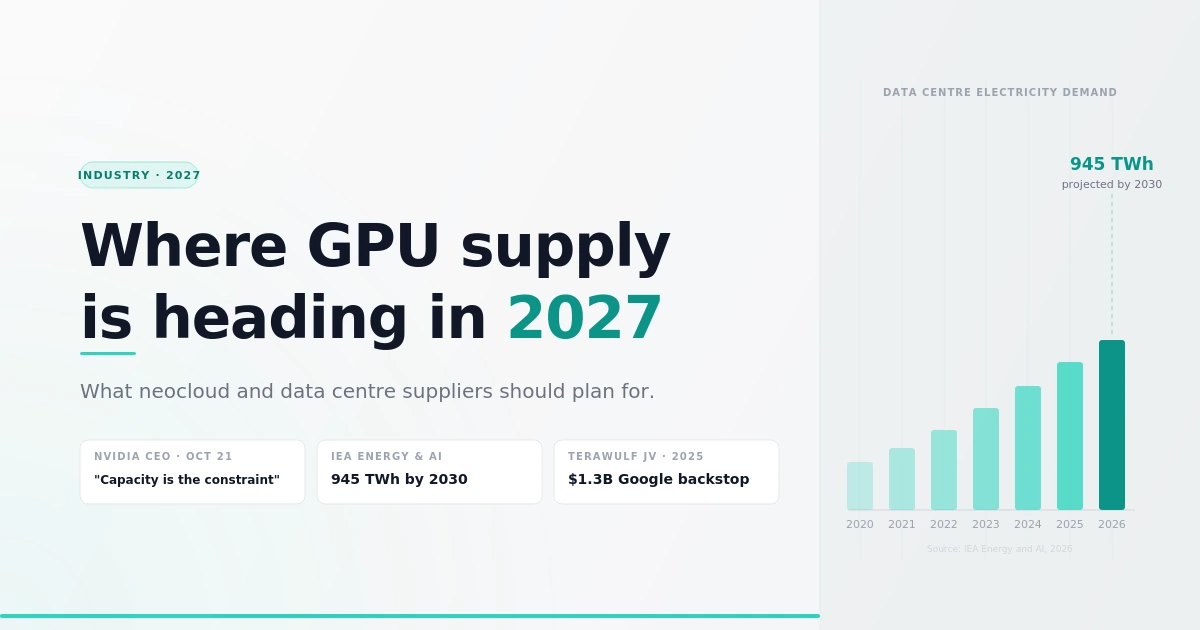
The IEA projects global data centre electricity demand to more than double to around 945 TWh by 2030, slightly more than Japan's entire consumption today.
The same IEA Energy and AI report projects demand from AI-optimised data centres to more than quadruple over that period. NVIDIA's own GTC Berlin coverage calls power the biggest bottleneck in infrastructure, citing more than $300 billion of backlogged equipment and over 200 gigawatts of projects waiting in US interconnection queues. TeraWulf cites a total project cost of $8 to $10 million per MW of critical IT load for its Abernathy project.
On the manufacturing side, NVIDIA plans to raise substrate capacity 2.5x over three years. Unimicron's expansion is expected to start adding capacity in the second quarter of 2027 and reach full capacity by mid-2028, and Amkor targets more than 300% more interposer wafer capacity by the end of 2028.
Opinion: most of the announced manufacturing capacity arrives across 2027 and 2028, so we would not plan around supply loosening in 2027. That is a planning stance, not a forecast. For colo and data centre owners, the scarce asset is energised, cooled capacity with a delivery date in writing. A rack without power is a liability.
In TeraWulf's October 2025 joint venture, Google backs about $1.3 billion of Fluidstack's long-term lease obligations to support project debt, against roughly $9.5 billion of contracted revenue.
That is a 25-year lease, which TeraWulf says may shorten to 20 or 15 years under certain options. CoreWeave's 2025 Form 10-K describes the same logic at a larger scale: customers generally buy capacity through multi-year take-or-pay contracts, and CoreWeave finances infrastructure with asset-level debt supported by those contracts. Separately, ClusterMAX 2.0 reported in November 2025 that Shadeform listed GPUs from 23 providers, the most its reviewers had seen on a marketplace, and had moved into brokering wholesale bare-metal deals in Taiwan, Japan and India. That review is about 11 months old, so read it as a snapshot.
Opinion: two public examples point the same way, with big multi-year capacity financed against contracts and credit support. If that pattern spreads, the biggest deals will favour counterparties that bring it, and smaller suppliers will compete on flexibility and reliability. More channels also means more places to be listed, and more places to be compared.
Small and mid suppliers rarely win on scale. They win on flexibility, on location, and on being easy to buy from. That is our opinion. Most deals above are far larger than a typical supplier's fleet, so their relevance is indirect: they set the terms buyers compare you against. The table pairs each point with the sourced signal behind it.
Opinion: networking deserves its own line. If buyers are being told to check network design, uptime commitments and liability terms, a supplier who can answer all three in one document removes a reason to say no.
packet.ai does not own hardware. It connects buyers to suppliers, handles billing and first-line support, and earns from the spread. That makes it directly relevant to the three trends above.
On generation overlap: packet.ai already lists B200 (Dynamic at $3.75/hr and Dedicated at $6.99/hr), A100 (Dedicated at $1.43/hr) and RTX 6000 Pro (Dynamic at $0.66/hr). Suppliers on the network run mixed fleets today. A supplier adding Rubin-class hardware when it becomes available can list it without migrating the rest of the fleet.
On channels: the same capacity can sell five ways through packet.ai: as inference tokens, hourly, monthly, on a reserved basis, or as offtake. That is the multi-channel approach Trend 3 points to. The supplier sets nothing. packet.ai brings verified business customers, handles KYC, collects payment and pays suppliers every 14 days in US dollars.
On flexibility: there are no minimums, no long-term commitments from the supplier side, and withdrawing occupied capacity needs 14 days of notice. For a colo operator carrying anchor tenants, that structure lets you send idle hours to a marketplace without a long-term lock-in.
None of that is a guarantee of occupancy. The For Suppliers page states the 2.5x average revenue multiple as an average over six months, not a floor. Run your own numbers using the supplier calculator, and read the rate card at onboarding before you model anything.
For suppliers
packet.ai takes applications from GPU suppliers now. Application to first revenue typically takes under seven days. No minimums, no long-term supplier contracts, 14 days withdrawal notice if a node is occupied.
Answer these six questions in writing before the year ends. The ones you cannot answer are where your 2027 risk sits.
Keep part of your capacity on short, exit-friendly terms and sell the rest through more than one route. That is opinion, not a forecast, and it follows from the three trends above.
One way to spread the risk is to keep your anchor tenants and sell the gaps between them through a marketplace. Our own comparison of the two routes is in GPU cloud marketplace vs your own cloud: revenue math for providers, and five ways to turn spare GPUs into revenue covers colocation and reserved capacity as well.
On the supplier side, packet.ai takes applications from GPU suppliers on that model. Suppliers keep root and physical access to their hardware, terms are plain-language and month-to-month and agreed before technical access, and payouts arrive every 14 days. The programme onboards hardware operators rather than resellers or brokers. Operators who would rather run their own cloud can look at the white-label platform.
Buyers will ask about readiness, so write your own checklist first. As listed on the supplier page today, the baseline looks like this:
Requirements can change, so read the supplier requirements before you apply.
Planning 2027 capacity and want a second opinion? Talk to partnerships.
Last reviewed: October 22, 2026. See the packet.ai supplier page for current supplier terms.
Same models. Same API. Fraction of the cost. Start free — no credit card required.
Start building →