Solo builders shouldn't pay AWS prices to fine-tune a 7B model. Here is what GPU cloud actually costs, which GPU you need, and how to go from signup to SSH-ready in under 5 minutes on packet.ai.
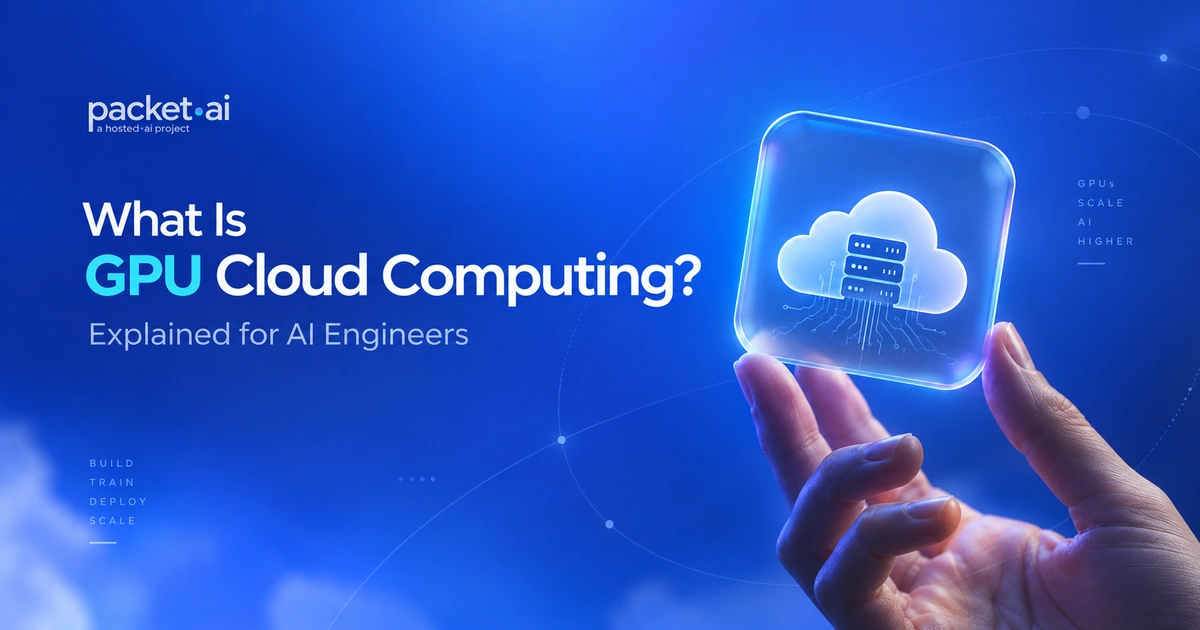
GPU cloud computing means renting NVIDIA silicon by the hour, so you run real AI workloads without buying a single server. On packet.ai, that starts at $0.39/GPU-hr with no egress fees, no platform fee, and no credit card to start.
Key takeaways
The GPU bill kills side projects. You spin up something to fine-tune a small model, leave it running slightly longer than planned, and the AWS invoice arrives looking like a typo. That is not a you problem. That is a pricing model problem.
GPU cloud fixes that, but only if you know what you are renting, what it actually costs, and which providers will not surprise you at checkout. This post covers all three, with verified pricing and real workload math for solo builders. If you already know which GPU you need and just want the VRAM numbers, jump to the VRAM requirements guide for every major model.
You rent NVIDIA GPU capacity over the internet, billed by the hour. The provider owns the hardware, the datacenter, the power contracts, and the cooling. You pay only for the GPU time your workload consumes, and billing stops the moment you terminate the pod.
The hardware is identical to what you would buy outright. The NVIDIA A100 80GB you rent on packet.ai for $1.43/hr is the same chip sold at $10,000 to $15,000 on the open market. At $1.43/hr running continuously, that works out to about $1,030 a month. But most workloads do not run continuously. A solo builder running a fine-tuning job for six hours pays $8.58 total, not $1,030. That arithmetic is the whole point.
packet.ai B200 Dynamic pricing starts at $3.75/GPU-hr. That is the lowest publicly listed rate for NVIDIA B200 access across the major neocloud providers, verified against the packet.ai rate card.
CPU cloud (AWS EC2, Google Cloud VMs, Azure VMs) is built for serial workloads. A CPU core executes one thread at a time, fast, with large caches designed for branching logic and unpredictable memory patterns. That architecture is exactly wrong for matrix multiplication.
Neural network training is, at its core, billions of small multiply-add operations running in parallel across a matrix. A modern NVIDIA B200 has 10,752 CUDA cores and 3.35 TB/s of HBM3e memory bandwidth. A high-end CPU server has maybe 192 CPU cores and 400 GB/s of DDR5 bandwidth. That gap is not incremental. It determines whether your training job takes 20 minutes or two days.
The practical rule: anything that runs PyTorch, JAX, or CUDA needs a GPU. Everything else (data pipelines, web servers, API orchestration, pre/post-processing) runs fine on CPU cloud. For a deeper look at where the boundary sits, the inference vs training breakdown is useful context.
Most GPU cloud content targets enterprise ML teams with six-figure compute budgets. These numbers are for everyone else: the indie developer building a product, the freelancer fine-tuning models for clients, the one-person startup that needs GPU access before the seed round closes.
A fine-tuning run on an RTX 4090 at $0.39/hr costs less than $1.60 for four hours. That is less than a coffee. The job runs, you pull the weights, you terminate the pod. No minimum. No egress charge on packet.ai, which matters because a 13B model checkpoint at FP16 is roughly 26GB. At AWS rates that download costs $2.34 per pull, every pull. Run ten experiments a month and you spent $23 extra doing nothing except moving your own files.
The egress math nobody talks about
10 fine-tuning runs per month on packet.ai: ~$27.60 compute (30 hrs x $0.92/hr on L40S), $0 egress. Same workflow on a GPU-comparable cloud instance with standard egress: the compute costs more, plus $2.34 per checkpoint pull. packet.ai egress is always $0/GB.
Faster than you expect, and less setup than AWS.
Pick a GPU and tier
RTX 4090 for budget work. RTX 6000 Pro for mid-range. A100 80GB for serious training. B200 for frontier inference. Choose Dynamic (shared, cheaper) or Dedicated (whole card, SLA). Set the region. That is the whole config.
Provision via API, CLI, or dashboard
packet.ai allocates the node, attaches up to 2TB NVMe, and boots your container image. CUDA drivers, PyTorch, JAX, and TensorFlow come preinstalled on standard images. No driver hunting. No CUDA version conflicts.
SSH in and run your code
Credentials arrive within minutes. The GPU works like any remote Linux machine. Run your training script, launch vLLM, start Ollama, open Jupyter, boot ComfyUI. No special SDK required.
Stop when done, pay for what you used
Terminate the pod. Billing stops immediately. Per-second metering under the hood, billed hourly. Pull your outputs first or save to a persistent volume. No minimums. No platform fee.
Dynamic-tier GPUs go from request to SSH-ready in under 5 minutes. Dedicated single-GPU nodes provision in 5-10 minutes. The comparison here is any hyperscaler, where a GPU quota request can sit for days and AMI setup adds another 30 minutes before you write a single line of training code.
Wrong GPU choice is the most common budget mistake. Too small and the model does not load. Too large and you are paying for VRAM you will never use.
Pricing verified against packet.ai/pricing, September 2026. H100 SXM and H200 are launching soon. Monthly commits on any live tier save up to 20%.
VRAM determines whether your model loads at all. Get it wrong and you hit an OOM error before the first forward pass. The rough rule: N billion parameters at FP16 needs roughly 2N gigabytes just for weights. A 7B model needs ~14GB before you account for KV cache or activations, so the practical minimum is the next tier up.
QLoRA is the solo builder's best friend for fine-tuning. It uses 4-bit quantization to cut VRAM requirements by 4-8x versus full fine-tuning. A 70B model that needs 140GB at FP16 full fine-tune runs on a single A100 80GB with QLoRA. Quality loss is minimal for most downstream tasks. The best GPU for fine-tuning LLMs post has the full benchmark breakdown. For model-specific sizing, the Llama GPU sizing guide (8B to 405B) and the Mixtral GPU requirements post cover MoE models specifically.
Every GPU cloud provider makes a choice about how to sell their hardware. That choice hits your performance and bill more than any spec on the page.
NVIDIA MIG partitions a card into fixed hardware slices. Isolated, but rigid. Slice size is locked before the job starts. Change it and you reboot. Built for internal teams, not commercial clouds where workload sizes vary constantly.
NVIDIA MPS runs multiple tenants on the same card with no real memory isolation. Fine for one team running their own batch jobs. Not appropriate for selling compute to strangers. The full breakdown of all three modes is in the GPU passthrough vs vGPU vs MIG post.
packet.ai Dynamic uses hosted.ai's scheduler, which proxies every GPU call and enforces VRAM limits in software across a pool of GPUs rather than a single card. It co-locates workloads that stress different GPU dimensions, so a memory-heavy job and a compute-heavy job share a card without contending for the same resource. p99 latency stays within 2-5% of a Dedicated card. More on how this works on the packet.ai technology page and in the Dynamic GPU placement deep dive.
For most solo builders, Dynamic is the right call. You are not running an SLA for customers. You are running experiments. The 2-5% latency variance is invisible in practice. Switch to Dedicated when you have paying users depending on your inference API and need that 99% uptime guarantee in writing.
On-demand hourly is the right starting point for anyone still learning their compute patterns. You pay per hour active, no commitment. Stop billing by terminating the pod. The GPU pricing models comparison post has the full breakdown. The self-hosting vs API break-even post is also useful if you are deciding between running your own inference server versus calling an API. Short version: on-demand wins when you run fewer than ~570 hours per month on any given GPU.
Monthly commits lock in a GPU for 30 days at up to 20% off. The breakeven is roughly 18-19 days of continuous usage per month. If your inference server runs 24/7 because customers are depending on it, monthly billing saves money. If it runs 6 hours per day, on-demand wins by a lot.
Cluster contracts are multi-node InfiniBand setups for distributed training at 64 to 1,024+ GPUs. Pricing runs roughly 30% below retail on custom terms. A 64-node B200 cluster lands at around $2.80-3.20/GPU-hr on a 12-month term. See GPU clusters explained and multi-node GPU cluster training for the full architecture picture. This is not the right tier unless you are pre-training or running frontier-scale jobs.
AWS has P4d and P5 GPU families. Google Cloud has A2 and A3. Azure has NC A100 v4 and NDm series. Specialized GPU cloud providers like packet.ai exist because the hyperscaler model is not built around GPU density. It is built around general enterprise infrastructure with GPU bolted on.
Price. An NVIDIA A100 80GB starts at $1.43/hr Dedicated on packet.ai. Hyperscaler equivalent rates are higher, and they add egress charges and EBS storage fees on top. packet.ai charges $0/GB for egress. AWS charges $0.09/GB.
Availability. Hyperscalers regularly show zero capacity for high-demand GPU SKUs. During peak demand, P4d quota requests take days. GPU-native providers build around keeping inventory stocked because availability is the product.
Friction. AWS requires IAM setup, VPC configuration, security groups, and AMI selection before you touch a GPU. packet.ai takes you from account signup to SSH-ready in under 5 minutes, CUDA preinstalled, no credit card required.
The full AWS vs packet.ai pricing breakdown has the numbers side by side, including how packet.ai B200 pricing compares across the market.
Ollama is the fastest path from zero to a working local LLM. Install, pull a model, get an OpenAI-compatible API endpoint. Works on any packet.ai GPU from the RTX 4090 upward. The Ollama cloud vs local post covers when it makes sense to pay for cloud instead of running locally.
vLLM is the production inference engine for anyone serving LLMs at scale. It handles continuous batching, PagedAttention for KV cache, and OpenAI-compatible endpoints. On a Dedicated A100 80GB at $1.43/hr, vLLM serving a 70B model at 8-bit handles serious concurrent load. Full setup in the vLLM deployment guide. If you are evaluating alternatives, the SGLang vs vLLM vs TensorRT-LLM comparison is the fastest way to decide.
ComfyUI runs well on an RTX 4090 (24GB) for Flux Dev and SDXL. A solo builder generating client assets or running an image-generation side project gets real throughput at $0.39/hr. Spin up, generate the batch, terminate. Total cost for a 2-hour session: $0.78.
Jupyter Notebooks work over SSH tunneling on any packet.ai pod. No additional setup. For a faster path, one-click GPU environments get you into VS Code or Jupyter without any terminal setup at all.
What is the isolation model? Whole card, MIG slice, MPS, or scheduler-enforced? This is the single most important question for performance predictability.
Are there egress fees? Invisible until the bill arrives. packet.ai charges $0/GB. Some providers do not advertise this clearly.
How fast does provisioning work? A provider that consistently provisions in under 5 minutes matters more to iterative development than any spec comparison.
Is there a minimum spend or mandatory credit card? For solo builders this creates cash flow friction before you have proven the idea. packet.ai requires no credit card and has no platform fee.
Is local NVMe included? Checkpoint files and dataset caches need fast local storage. packet.ai includes up to 2TB per node at no extra charge. And if you care about how memory bandwidth differences between GPU generations affect throughput, the HBM3e vs HBM2e post has the numbers.
Not sure what your workload will cost?
Run the numbers before committing to anything. The packet.ai GPU cost calculator estimates monthly spend across GPU types and billing tiers in about 30 seconds.
No credit card. No quota request. No IAM policy to configure.
Create an account at dash.packet.ai. Browse the rate card. For most solo builders, start with RTX 4090 Dedicated at $0.39/hr for small models and notebooks, or RTX 6000 Pro Dynamic at $0.66/hr for mid-range inference and image generation. Pick a prebuilt image with CUDA and PyTorch. Click deploy. SSH in within minutes.
Run your job. Terminate when done. Billing stops.
Dynamic PODs carry the GPUs live for shared tier. Dedicated PODs cover single-tenant options with the 99% uptime SLA. For multi-node training, the clusters team handles custom quotes. Monthly commits on any tier save up to 20%.
Last reviewed: September 15, 2026. Pricing verified against packet.ai/pricing. Estimate your workload cost with the GPU cost calculator.
Same models. Same API. Fraction of the cost. Start free — no credit card required.
Start Building →